 Slashdot Mirror
Hubble's Exoplanet Pics Outshined by Keck's
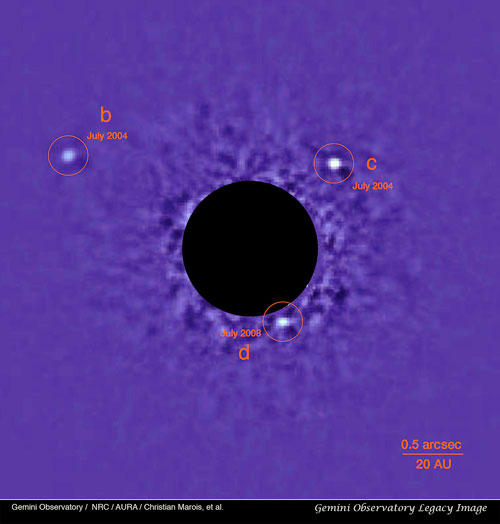
dtolman writes "Scientists at the Keck and Gemini telescopes stole the thunder of Hubble scientists announcing the first picture of an extrasolar world orbiting a star. Hubble scientists announced today that they were able to discover an extrasolar world for the first time by taking an actual image of the newly discovered exoplanet orbiting Fomalhaut — previous discoveries have always been made by detecting changes in the parent star's movement, or by watching the planet momentarily eclipse the star — not by detecting them in images. Hubble's time to shine was overshadowed though by the Keck and Gemini observatories announcing that they had taken pictures of not just one planet, but an entire alien solar system. The images show multiple planets orbiting the star HR 8799 — 3 have been imaged so far."
We already knew there were planets orbiting other stars.
If the "noise" obeys Kepler's laws, it's probably an image of something real.
Taking pictures of them *is* news. In fact, that's the point of these releases. These are the first direct images ever released. Before this, all evidence was indirect (oscillating plots of star brightness as the planet periodically eclipsed the host star, for instance).
planets != habitable != life != intelligent life
Hell there is no reason to assume that intelligence is even the natural outcome of evolution, it didn't work during the era of the dinosaurs. When you take into account so many unknown factors, the existence of planets that we already knew would exist hardly makes it likely that we are not alone in the AU (we are ofcourse not alone in the universe, but what does it matter if we can never make contact with them). How many species are there in the AU well Drake came up with an equation for this i believe the answer was something like 31 +/- 3,000,000.
IranAir Flight 655 never forget!
Not entirely sure why the summary touches on one being overshadowed by the other.
On the contrary, the two works are complimentary, and it is thus no coincidence that they have been released at the same time. Hubble shows an old cold planet on the edge of a solar system, while Keck shows some very young hot infra-red emitting planets close to their star. The two discoveries help elucidate the workings of other solar systems - and each is just as valuable as the other.
Why on earth (or whatever planet you live on) would this be good for creationists? It's good science, and indicates significant progress in astronomy. Of course, they don't count any data as against them but I can't imagine how that would help them.
The more people I meet, the better I like my dog.
What they have right now can give a pretty accurate idea of the atmosphere on that planet. Pass the light from that dot through a diffraction grating and the spectrum will tell you which gases are present in what proportion in the atmosphere, and what is their temperature.
Funny thing is, it grabs *my* imagination! To see something, we have been doing this since eyes evolved on animals. But to perform careful calculations and realize that the results imply the existence of a planet, well, that's what I call awesome.
Good as in "there you go, you ignorant idiot" :)
Web2.0: I love when people Flickr my cuil and digg my boingboing until my google is reddit and I start to yahoo
Intelligence isn't a binary, yes-or-no trait. Dinosaurs were intelligent, just like lizards and birds and cats. They weren't very intelligent compared to us, but compared to an amoeba they certainly were. While you're sitting there thinking that you're so intelligent, there's probably some super-advanced alien race observing us, the way we observe mice or ants, and laughing at us for thinking we're intelligent.
Because of our limited technology for detecting exoplanets, the only ones discovered so far are gas giants, mostly larger even than our own solar system's gas giants (which are already gigantic compared to Earth). There's no telling how many earth-sized rocky planets (or moons) exist, even around the stars we've already found gas giants around. ETs may even exist on some of these, but short of detecting radio transmissions from them, there's no way to tell.
Go ahead and write a proposal for telescope time on Keck II for an Apollo landing site observation run. You'd better have some funding from the moon conspiracy theorists in hand to pay for that expensive time, since it's not likely to lead to a paper in the ApJ.
The determined Real Programmer can write Fortran programs in any language.
Maybe not. It might be easier to name them in the order of discovery. If nothing else, that eliminates any possible confusion down the road.
Good, inexpensive web hosting