Slashdot Mirror


Hubble's Exoplanet Pics Outshined by Keck's

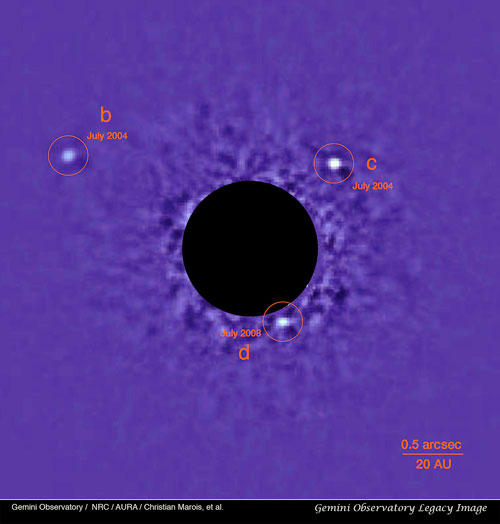
dtolman writes "Scientists at the Keck and Gemini telescopes stole the thunder of Hubble scientists announcing the first picture of an extrasolar world orbiting a star. Hubble scientists announced today that they were able to discover an extrasolar world for the first time by taking an actual image of the newly discovered exoplanet orbiting Fomalhaut — previous discoveries have always been made by detecting changes in the parent star's movement, or by watching the planet momentarily eclipse the star — not by detecting them in images. Hubble's time to shine was overshadowed though by the Keck and Gemini observatories announcing that they had taken pictures of not just one planet, but an entire alien solar system. The images show multiple planets orbiting the star HR 8799 — 3 have been imaged so far."
45 of 140 comments (clear)

  1. Gene Wolfe fans rejoice by CRCulver · · Score: 3, Interesting

    A planet orbiting Fomalhaut? Well, it seems Gene Wolfe was prescient in his work The Book of the New Sun when one of his characters contacts a wise civilization there on, as Wolfe uses the Arabic name, "the Fishes' Mouth".

    1. Re:Gene Wolfe fans rejoice by FiloEleven · · Score: 2, Interesting

      I did'nt catch that reference while reading New Sun - good eye. I was thinking of mentioning Fomalhaut system's role in the Hyperion Cantos by Dan Simmons, even though it's just a minor setting IIRC. Then I was going to tell people to check out the series because it's a fine one, but since you've mentioned The Book Of The New Sun, I'm just going to shut up and hope that more folks put it at the top of their reading lists, and then insert it again halfway down to catch what they missed before.

    2. Re:Gene Wolfe fans rejoice by Grishnakh · · Score: 5, Informative

      It's unlikely there's any civilizations on ANY exoplanets we've discovered, since they're all gas giants. Civilizations like ours are only likely on small, rocky, warm planets, which are currently undetectable to us as they're too small, and too close to their stars.

      Of course, Fomalhault "b" is only a temporary designation; if smaller planets are detected closer to the star, then one of those would become "b" I imagine. But even so, it still isn't likely there'd be a civilization on one of those, since this star is so young, and so would any planets orbiting it. If the age of this star is correct, it didn't even exist when our world had dinosaurs on it, which wasn't really that long ago considering the age of our planet.

      As for moons, however, I wouldn't be surprised to find that Fomalhault's gas giant planets had some moons. Our own gas giants have tons of moons, many of them just tiny asteroids really. Surely at least a few stray asteroids have been captured by these gas giants over the past 60 million years.

    3. Re:Gene Wolfe fans rejoice by techno-vampire · · Score: 2, Insightful
      Of course, Fomalhault "b" is only a temporary designation; if smaller planets are detected closer to the star, then one of those would become "b" I imagine.

      Maybe not. It might be easier to name them in the order of discovery. If nothing else, that eliminates any possible confusion down the road.

      --
      Good, inexpensive web hosting
  2. The Author by cuby · · Score: 5, Informative

    Hello,
    I think the discovery was made by the team led by Paul Kalas:
    http://astro.berkeley.edu/~kalas/index.html

    --
    Math is beautiful... e^(pi*i)+1=0
  3. obligatory... by advocate_one · · Score: 3, Funny

    that's not a planet...

    --
    Donald 'Duck' Dunn: We had a band powerful enough to turn goat piss into gasoline.
    1. Re:obligatory... by truthsearch · · Score: 4, Funny

      It would be "That's no planet..."

      I wish I could mod myself (-1: Pedantic)

    2. Re:obligatory... by metamatic · · Score: 2, Informative

      On the contrary, if it's in Kecks, it might be Uranus.

      --
      GCHQ Quantum Insert installed. If only our tongues were made of glass, how much more careful we would be when we speak
    3. Re:obligatory... by RiotingPacifist · · Score: 4, Funny

      That's no mod choice!

      --
      IranAir Flight 655 never forget!
  4. Direct link to Hubble Press Release and pix by dtolman · · Score: 5, Informative

    This came out after I posted the article... Hubble presents - Fomalhaut B! This graphic is particularly nice!

  5. Colonization by Scutter · · Score: 4, Funny

    I wanna live on the left dot.

    --

    "Tell me doctor, with all of your defenses, are there any provisions for an attack by killer bees?"
    1. Re:Colonization by dkleinsc · · Score: 5, Funny

      If you can get there, it's yours.

      --
      I am officially gone from /. Long live http://www.soylentnews.com/
  6. Re:Amazing by EraserMouseMan · · Score: 2, Insightful

    We already knew there were planets orbiting other stars.

  7. Alien vs Predator by avandesande · · Score: 2

    Alien vs Predator made even more sense than the comparison in the headline...

    --
    love is just extroverted narcissism
  8. The similarities are stunning! by need4mospd · · Score: 5, Funny

    they are massive, young, hot planets that are probably mostly gaseous and completely inhospitable. They'd get along great with my ex!

  9. In the hubble picture by SnarfQuest · · Score: 4, Informative

    In the hubble picture, does anyone else see the shadow of the Enterprise?

    --
    Who would win this election: Andrew Weiner vs Andrew Weiner's weiner.
  10. Re:Planets look like... by msbmsb · · Score: 5, Informative

    You have to see the orbital progression to get over the thought that it's just another speck of light noise. Here is a larger image showing the position of the planet from 2004 and 2006. Also, here is the url for the release showing the image of HR 8799 with its 3 planets.

  11. Re:Planets look like... by Stephen+Ma · · Score: 4, Insightful
    So planets look a lot like noise.

    If the "noise" obeys Kepler's laws, it's probably an image of something real.

  12. Re:Amazing by Anonymous Coward · · Score: 5, Insightful

    Taking pictures of them *is* news. In fact, that's the point of these releases. These are the first direct images ever released. Before this, all evidence was indirect (oscillating plots of star brightness as the planet periodically eclipsed the host star, for instance).

  13. Mote in God's Eye by MikeMo · · Score: 4, Funny

    no, not Sauron. That is clearly the Mote in God's Eye.

  14. Sorry by istartedi · · Score: 4, Funny

    As deed holder via the International Star Registry, that includes a deed on any planets in orbit, I forbid it. Why, there might even be rich deposits of diamelles and/or Ginsu steak knives on that planet. I'm not giving it up without a fight.

    --
    For all intensive purposes, "whom" is no longer a word. That begs the question, "who cares"?
    1. Re:Sorry by Scutter · · Score: 4, Funny

      As deed holder via the International Star Registry, that includes a deed on any planets in orbit, I forbid it. Why, there might even be rich deposits of diamelles and/or Ginsu steak knives on that planet. I'm not giving it up without a fight.

      If it's interstellar war you want, sir, it's interstellar war you shall have! Have at you!

      --

      "Tell me doctor, with all of your defenses, are there any provisions for an attack by killer bees?"
    2. Re:Sorry by AkkarAnadyr · · Score: 2, Funny

      Gesundheit!

      --

      I bought this house and you know I'm boss
      Ain't no h'aint gonna run me off

  15. Re:Amazing by RiotingPacifist · · Score: 2, Insightful

    planets != habitable != life != intelligent life

    Hell there is no reason to assume that intelligence is even the natural outcome of evolution, it didn't work during the era of the dinosaurs. When you take into account so many unknown factors, the existence of planets that we already knew would exist hardly makes it likely that we are not alone in the AU (we are ofcourse not alone in the universe, but what does it matter if we can never make contact with them). How many species are there in the AU well Drake came up with an equation for this i believe the answer was something like 31 +/- 3,000,000.

    --
    IranAir Flight 655 never forget!
  16. Great explanation from Gemini directors by G3CK0 · · Score: 3, Interesting

    On Thursday 13th November 2008, Gemini Observatory in coordination with several institutions released the first images of an exo multi-planet system around star HR 8799 in the constellation of Pegasus. The discovery was made at Gemini North using the adaptive optics system ALTAIR and NIRI as the infrared imager on October 17, 2007. Follow up and confirming observations were made on the Keck II Telescope and Gemini North. Adaptive optics played a crucial role in obtaining these historic images of a young extra-solar multiple-planet system. The estimated age of the system implies planetary masses between 5 and 13 times that of Jupiter. These giant planets orbit at roughly 25, 40 and 70 times the Earth-Sun separation around their host star which is about 128 light-years from our sun. For more details see www.gemini.edu.

    --
    A clear conscience is usually the sign of a bad memory.
  17. overshadowed? by MLCT · · Score: 4, Insightful

    Not entirely sure why the summary touches on one being overshadowed by the other.

    On the contrary, the two works are complimentary, and it is thus no coincidence that they have been released at the same time. Hubble shows an old cold planet on the edge of a solar system, while Keck shows some very young hot infra-red emitting planets close to their star. The two discoveries help elucidate the workings of other solar systems - and each is just as valuable as the other.

    1. Re:overshadowed? by Trapezium+Artist · · Score: 5, Informative
      Rest assured, these were strongly coordinated: both teams knew full well of each others results well in advance, both were scheduled for simultaneous release via Science at 2pm EDT today, and indeed, both papers share one co-author. (I work in the same group as another co-author of the HR8799 paper, so believe me that this is first-hand knowledge). The HST press conference was scheduled (well in advance) for shortly after the Science embargo expired.

      Of course, this hasn't stopped both groups trying to spin up their results in a perfectly understandable fashion. The downside is that many online press stories are showing very signs of confusion as to what's what, not at all helped by the blizzard of parallel press releases from various institutions on the HR8799 3-planet system result.

      Indeed, the Gemini Observatory release shows images taken with their telescope showing just two of the planets, presumably because they don't want to cede any ground to the Keck, their rivals on Mauna Kea, where the third planet was found. Again, potentially very confusing indeed to the public.

      As for the complementary aspect of the two discoveries, that's mostly the case and both discoveries are very important. But it's not true to say that one's (Fomalhaut) an old planet seen in reflected visible light while the others (HR8799) are young and shining in their own heat: both stars are roughly equally young and the Fomalhaut planet seems also to be shining in some mix of its own heat even in the visible (it's at 400K, possibly), plus perhaps some additional reflected light from a dusty disk around the planet (as opposed to the obvious disk around the star itself).

      Also, I wouldn't say the HR8799 planets are close to their star: nothing like. They're out at the equivalent of Neptune's orbit and beyond, even though the Fomalhaut planet's a bit further out still.

      Hope this helps allay your (understandable) scepticism.

    2. Re:overshadowed? by Tablizer · · Score: 2, Informative

      Not entirely sure why the summary touches on one being overshadowed by the other...the two works are complimentary...Hubble shows an old cold planet on the edge of a solar system, while Keck shows some very young hot infra-red emitting planets close to their star.

      More specifically, comparing the two is like comparing apples and oranges. The infrared image shows the planets because they are still glowing bright in infrared because they were very recently formed, and thus "hot out of the oven". The article said that the Hubble image was based on visible light reflected from the parent star, not from the planet's own heat. It's thus a dimmer target. (Hubble is not designed/optimized for infrared.)

      It is true that Earth-based scopes have better resolution than Hubble in very *specific* circumstances with careful "tricks"; but in general, Hubble is still The King. (Although processing tricks to counter the atmosphere "wiggle" for Earth scopes are making incremental improvements and may catch up someday.)
             

    3. Re:overshadowed? by Trapezium+Artist · · Score: 2, Informative

      See my post elsewhere in this thread, but this isn't true: if you read the Fomalhaut paper (as opposed to the PR), they're unsure quite what mix of reflected starlight, thermal self-emission, and additional reflected light from a circumplanetary disk makes up the light seen from Fomalhaut b, at both visible and IR wavelengths.

      These objects are actually more similar than they are different, in my opinion.

      As for HST still being king, well, yes and no: depends on what you're after. Ground-based AO has caught up and exceeded HST in some domains already, while HST still wins in others. Ultimately we need ground- and space-based telescopes to get the most complete view: today it's HST and the 8-10m telescopes, tomorrow it's JWST and the 30-40m extremely large telescopes.

  18. Re:Finally! by eabrek · · Score: 3, Interesting

    Some description of the technique. Under ADI.

  19. Re:Wish I could discovery something by Farmer+Tim · · Score: 5, Funny

    To "Discovery" something is easy: you just make a documentary about it that's too dumbed-down for people who like documentaries but still too boring for those who don't, and add lots of unnecessary and repetitive CG animation.

    --
    Blank until /. makes another boneheaded UI decision.
  20. Traffic routing by Anne_Nonymous · · Score: 2, Funny

    Nice pictures. That looks like an excellent spot for a hyperspace express bypass.

  21. Re:Amazing by MMatessa · · Score: 4, Interesting

    These are the first direct images ever released. Before this, all evidence was indirect (oscillating plots of star brightness as the planet periodically eclipsed the host star, for instance).

    Well, except for HD 189733b, 2M1207 b and GQ Lup b.

  22. Re:Amazing by Trapezium+Artist · · Score: 5, Informative

    HD189733b: not directly imaged, but has had a temperature map of it reconstructed from very careful analysis of the change in the light from the parent star as the planet transits in front of and behind it.

    2M1207b: this orbits a brown dwarf, not a star.

    GQ Lup b: not a planet by any reasonable stretch of the scientific imagination, unless you happen to have been a co-author of the original paper. Believe me: this one is dead, Jim, and was known by most of us to be so on arrival.

  23. Re:Amazing by Beezlebub33 · · Score: 2, Insightful

    Why on earth (or whatever planet you live on) would this be good for creationists? It's good science, and indicates significant progress in astronomy. Of course, they don't count any data as against them but I can't imagine how that would help them.

    --
    The more people I meet, the better I like my dog.
  24. Atmosphere is in the spectrum by mangu · · Score: 4, Insightful

    Wake me up when there's a pic of what the weather (atmosphere) looks like on an extrasolar planet.

    What they have right now can give a pretty accurate idea of the atmosphere on that planet. Pass the light from that dot through a diffraction grating and the spectrum will tell you which gases are present in what proportion in the atmosphere, and what is their temperature.

  25. Re:Finally! by mangu · · Score: 2, Insightful

    To infer the existence of a planet around a star from the 'wobble' we see in the position or spectrum of the star may be sound science but it hardly grabs the imagination.

    Funny thing is, it grabs *my* imagination! To see something, we have been doing this since eyes evolved on animals. But to perform careful calculations and realize that the results imply the existence of a planet, well, that's what I call awesome.

  26. Re:Amazing by dedazo · · Score: 2, Insightful

    Good as in "there you go, you ignorant idiot" :)

    --
    Web2.0: I love when people Flickr my cuil and digg my boingboing until my google is reddit and I start to yahoo
  27. Re:Amazing by Grishnakh · · Score: 2, Insightful

    Intelligence isn't a binary, yes-or-no trait. Dinosaurs were intelligent, just like lizards and birds and cats. They weren't very intelligent compared to us, but compared to an amoeba they certainly were. While you're sitting there thinking that you're so intelligent, there's probably some super-advanced alien race observing us, the way we observe mice or ants, and laughing at us for thinking we're intelligent.

    Because of our limited technology for detecting exoplanets, the only ones discovered so far are gas giants, mostly larger even than our own solar system's gas giants (which are already gigantic compared to Earth). There's no telling how many earth-sized rocky planets (or moons) exist, even around the stars we've already found gas giants around. ETs may even exist on some of these, but short of detecting radio transmissions from them, there's no way to tell.

  28. Re:Amazing by Cassius+Corodes · · Score: 3, Funny

    Plus they might all go there to try and convert the heathens.

    --
    Control is an illusion, order our comforting lie. From chaos, through chaos, into chaos we fly
  29. Yes they do. by interactive_civilian · · Score: 5, Interesting

    So planets look a lot like noise. They really aren't all that much different than the expected noise levels on the images. Especially on the first one from Fomalhaut.

    From far enough away, yes. Yes they do. For example, here's Earth from just outside the solar system, and the basis for Sagan's Pale Blue Dot.

    http://veimages.gsfc.nasa.gov/601/PIA00452.tif (TIFF image)

    That light blue pixel on the right is us. All of us. Taken from 6.4 billion kilometers away.

    Deadpixel, indeed.

    --
    "Empathise with stupidity, and you're halfway to thinking like an idiot." - Iain M. Banks
    1. Re:Yes they do. by Patrik_AKA_RedX · · Score: 2, Funny

      Great! They make a picture of Earth from 6.4 billion kilometers away and it happens to be from the other side of the planet. I wanted to be in it!

  30. Redo by Tablizer · · Score: 2, Funny

    Nifliik blinked, please retake it.

  31. You're missing the science case. by NixieBunny · · Score: 2, Insightful

    Go ahead and write a proposal for telescope time on Keck II for an Apollo landing site observation run. You'd better have some funding from the moon conspiracy theorists in hand to pay for that expensive time, since it's not likely to lead to a paper in the ApJ.

    --
    The determined Real Programmer can write Fortran programs in any language.
  32. Papers available at ... by RockDoctor · · Score: 2, Informative

    Go to the exoplanets.EU site ; follow the news links to publications about HR 8799 and also see Science for the abstract on Formalhaut (if you're working through a location which pays for access to Science, which I'm not, you should be able to get the paper from there ; there's also Supporting Online Material available, which isn't terribly informative. Now, contrary to SlashDot procedure, I'm going to shut my flap while I RTF-Papers. Shocking, isn't it?

    --
    Birds are not dinosaur descendants;birds are dinosaurs, for all useful meanings of "birds", "are" and "dinosaurs"