 Slashdot Mirror
Hubble's Exoplanet Pics Outshined by Keck's
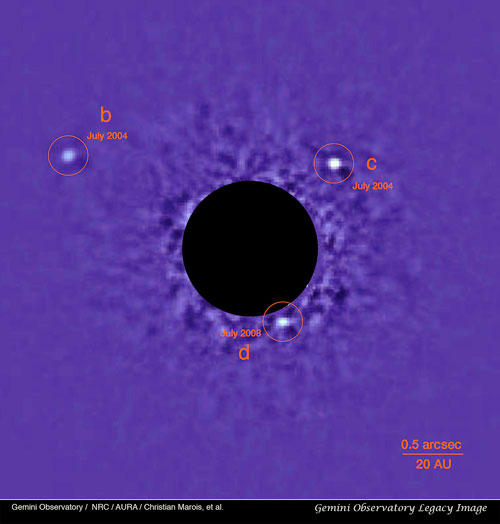
dtolman writes "Scientists at the Keck and Gemini telescopes stole the thunder of Hubble scientists announcing the first picture of an extrasolar world orbiting a star. Hubble scientists announced today that they were able to discover an extrasolar world for the first time by taking an actual image of the newly discovered exoplanet orbiting Fomalhaut — previous discoveries have always been made by detecting changes in the parent star's movement, or by watching the planet momentarily eclipse the star — not by detecting them in images. Hubble's time to shine was overshadowed though by the Keck and Gemini observatories announcing that they had taken pictures of not just one planet, but an entire alien solar system. The images show multiple planets orbiting the star HR 8799 — 3 have been imaged so far."
From your friendly neighborhood grammar nazi
How is it that pictures can be taken of a planet 26 light years away, yet the moon landing site cannot be photographed?
One of the worn out excuses is that the pixel angle is too small to see things that small.
Well, I would like to counter with the argument that seeing a 3m object 250,000 miles away is just as easy, if not easier, than seeing a planet many light years away.
And they did this optically?
Let's see if my math is wrong:
3m/400km = 7.45e-9 radians. This is what "can't" be done
x/26 light years = 7.45e-9 radians: x = 1,840,000 km. That KM, not meters.
So, if the camera can't take a picture of a 3m object on the moon [the size of the rover], it also shouldn't be able to take a picture of anything less than 1.84e9 meters in diameter 26 light years away.
What am I missing?