 Slashdot Mirror
Hubble's Exoplanet Pics Outshined by Keck's
dtolman writes "Scientists at the Keck and Gemini telescopes stole the thunder of Hubble scientists announcing the first picture of an extrasolar world orbiting a star. Hubble scientists announced today that they were able to discover an extrasolar world for the first time by taking an actual image of the newly discovered exoplanet orbiting Fomalhaut — previous discoveries have always been made by detecting changes in the parent star's movement, or by watching the planet momentarily eclipse the star — not by detecting them in images. Hubble's time to shine was overshadowed though by the Keck and Gemini observatories announcing that they had taken pictures of not just one planet, but an entire alien solar system. The images show multiple planets orbiting the star HR 8799 — 3 have been imaged so far."
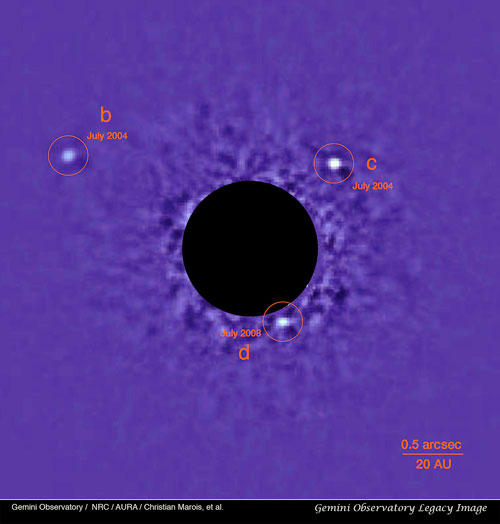
This is exhilarating news, that we are most likely not alone in the universe (and beyond). Our solar system is not unique!!
This whole galactic mess has some more meaning, today. We are like infants, opening our eyes for the first time -- how far we have to go (if we don't destroy ourselves soon).
The dangers of knowledge trigger emotional distress in human beings.
If the "noise" obeys Kepler's laws, it's probably an image of something real.
Not entirely sure why the summary touches on one being overshadowed by the other.
On the contrary, the two works are complimentary, and it is thus no coincidence that they have been released at the same time. Hubble shows an old cold planet on the edge of a solar system, while Keck shows some very young hot infra-red emitting planets close to their star. The two discoveries help elucidate the workings of other solar systems - and each is just as valuable as the other.
"pictures of not just one planet, but an entire alien solar system"
Isn't there just 1 Solar system? The one with the star Sol. All the rest are just planetary systems.
What they have right now can give a pretty accurate idea of the atmosphere on that planet. Pass the light from that dot through a diffraction grating and the spectrum will tell you which gases are present in what proportion in the atmosphere, and what is their temperature.
Funny thing is, it grabs *my* imagination! To see something, we have been doing this since eyes evolved on animals. But to perform careful calculations and realize that the results imply the existence of a planet, well, that's what I call awesome.
Go ahead and write a proposal for telescope time on Keck II for an Apollo landing site observation run. You'd better have some funding from the moon conspiracy theorists in hand to pay for that expensive time, since it's not likely to lead to a paper in the ApJ.
The determined Real Programmer can write Fortran programs in any language.
Maybe not. It might be easier to name them in the order of discovery. If nothing else, that eliminates any possible confusion down the road.
Good, inexpensive web hosting