 Slashdot Mirror
The Hairy State of Linux Filesystems
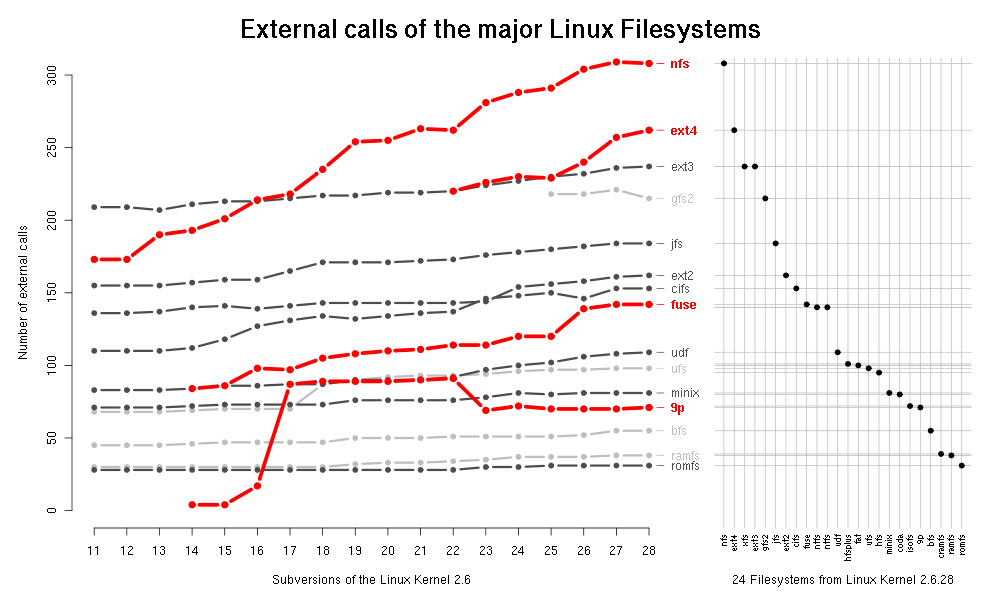
RazvanM writes "Do the OSes really shrink? Perhaps the user space (MySQL, CUPS) is getting slimmer, but how about the internals? Using as a metric the number of external calls between the filesystem modules and the rest of the Linux kernel I argue that this is not the case. The evidence is a graph that shows the evolution of 15 filesystems from 2.6.11 to 2.6.28 along with the current state (2.6.28) for 24 filesystems. Some filesystems that stand out are: nfs for leading in both number of calls and speed of growth; ext4 and fuse for their above-average speed of growth and 9p for its roller coaster path."
In the case of NFS for instance, hasn't there been a performance improvement? Isn't that the thing that matters?
The briefness of the article and lack of actual functional analysis make me think this should have been a comment on the original /. article rather than a whole new article of its own.
Slow news day?
got to make one call...
Everybody Wang-Chung tonight!
While OSes may be "sliming down" as the article says, what does the removal of standard db packages from Ubuntu have to do with filesystem-related kernel calls?
The article doesn't seem to mention the possiblity that more functionality may be pushed into the kernel from userspace, which might make sense in other situations, but I don't think that argument would hold up here.
I am struggling to make the connection between the summary and the so-called article. The fact that they are not stripping/locking fs functionality means that OSes aren't shrinking? That's the hypothesis?
You are kidding arent you ?
Are you saying that this linux can run on a computer without windows underneath it, at all ? As in, without a boot disk, without any drivers, and without any services ?
That sounds preposterous to me.
If it were true (and I doubt it), then companies would be selling computers without a windows. This clearly is not happening, so there must be some error in your calculations. I hope you realise that windows is more than just Office ? Its a whole system that runs the computer from start to finish, and that is a very difficult thing to acheive. A lot of people dont realise this.
Microsoft just spent $9 billion and many years to create Vista, so it does not sound reasonable that some new alternative could just snap into existence overnight like that. It would take billions of dollars and a massive effort to achieve. IBM tried, and spent a huge amount of money developing OS/2 but could never keep up with Windows. Apple tried to create their own system for years, but finally gave up recently and moved to Intel and Microsoft.
Its just not possible that a freeware like the Linux could be extended to the point where it runs the entire computer fron start to finish, without using some of the more critical parts of windows. Not possible.
I think you need to re-examine your assumptions.
Thoughts:
- This is measuring, I believe, calls to different functions; a call to one function from multiple places is only counted once. So it's really a measure of the diversity of external calls.
- Size and complexity aren't necessarily the same thing. It's actually possible that as common functionality is abstracted out of filesystems, they get smaller but make more external calls. There was a point a few years ago when this was happening at quite a rapid pace in the fs code, I don't know if it is still true.
- Journalled filesystems and networked filesystems are pretty complex creatures by their nature, the quoted numbers don't seem unreasonable. NFS in particular implements (IIRC) protocol versions 2, 3 and 4, and 4 had a lot of new stuff.
There is little calling overhead from using multiple calls. Of course these interface changes are all done for a good reason: performance, stability, security.
Engineering is the art of compromise.
What's your argument here? That filesystem code in the kernel shouldn't be growing more sophisticated over time?
This rings of the armchair-pundit argument that the kernel is getting more and more "bloated" and a breath later crying out that there still aren't Linux hardware drivers for every computing device ever made.
The state of Linux filesystems may be in disarray, but it's nothing to kill your wife over...
*rimshot*
Not being a filesystem/db geek, I honestly can't tell if "speed of growth" refers to "how frequently it's updated" or to "how rapidly it allocates space to store things". And I don't understand what the number of external calls means at ALL. Is that a bad thing? A good thing? Why? Can someone please provide some context? This doesn't have any at all!
While Tux3 is not yet ready to run on your desktop, and won't be for a good many months, it is relatively trim at around 6K lines, and is expected to be somewhere around 10K complete with versioning, recovery and proper code comments. Of course, that will still be significant growth in a few months, and nothing says it won't just keep growing. But Tux3 is starting much smaller than its peers, and already has a pretty good range of "big filesystem" features. One of our guiding principles is to keep it tight, therefore leaving fewer places for bugs to hide.
Have you got your LWN subscription yet?
The author of the article takes the position that filesystem external calls == "operating system size", and then proceeds to start measuring his new definition.
What he never mentioned or even tries to justify was his metric. Why does more external calls (or as someone more accurately pointed out, diversity of external calls) equate to "operating system size"? Why does this equate to an even more abstract concept of "simple"?
I don't see any reason to equate these measurements to such conclusions. "size" and "simple" are abstract concepts that involve a lot more than a simple count of external references.
AccountKiller
I didn't see anything in the article where the author made a value statement, that it is bad (or good) that system calls are increasing. He was just pointing out that the trend is not towards simplicity in this area.
I would also point out, that ext4 is very new and ntfs may not be new but never has been quite completed so active feature development could explain away the upward curves in their call counts, though not the absolute values.
I think that you can compile only the filesystem you want in the kernel..
So the only complexity which matter to an user is the one of the filesystem they select to compile in the kernel!
Sorry to disrupt the trolling copy-pasta, but :
Is this post on ZDNet's forum the original form of this troll ?
Or is this troll older, and jerryleecooper was already copying it from somewhere else ?
I'm just curious to know where this fine piece of humorous trolling was originally born.
"Sufficiently advanced satire is indistinguishable from reality." - [Tips: 1DrYakQDKCQ6y52z6QbnkxHXAocMZJE61o ]
Nevermind COMPILING stuff. You can just plain choose not to USE stuff.
Don't want the "bloat" of NFS or ext4, then don't bloody use them.
Yeah, the spiffy new things or inherently complex things might
show that complexity in the code. Imagine that. The source for
Halo looks bigger than the source for Pacman.
There is no news here.
As an nvidia user, ATI can make their Linux drivers as bad and
as bloated as they want. I don't care. It really doesn't effect
me.
A Pirate and a Puritan look the same on a balance sheet.
Imma firin' mah Reiser!
Unless I've misread it, TFA's definition of "size" for a filesystem is "how many distinct external/kernel subroutines does it call?"
That seems to be a very strange metric. Seems to me that a well-designed filesystem will have little code and make extensive (re)use of well-defined services elsewhere (rather than reinventing those wheels). This "slims" the filesystem's own unique code down to its own core functionality.
Now maybe, if the functions are hooks in the OS for the filesystem, a larger number of them implies a poorer abstraction boundary. But it's not clear to me, absent more explanation, that this is what TFA is claiming.
Bantam Dominique roosters crow a four-note song. Once you've heard it as "Happy BIRTHday" you can't NOT hear it that way
I'll thank you not to tell me what I need in the future, no matter how amazingly insightful you find your own opinion on the matter.