 Slashdot Mirror
Sunspots May Be Different During This Solar Minimum
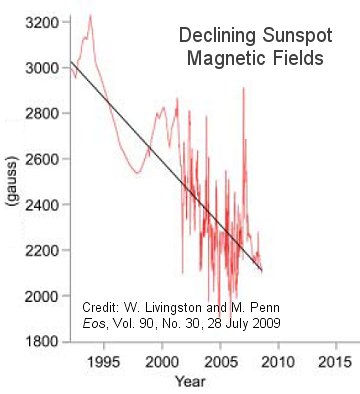
PhreakOfTime writes "According to Bill Livingston and Matt Penn of the National Solar Observatory in Tucson, Arizona, sunspot magnetic fields are waning. The two respected solar astronomers have been measuring solar magnetism since 1992. Their technique is based on Zeeman splitting of infrared spectral lines in radiation emitted by iron atoms in the vicinity of sunspots. Extrapolating their data (PDF) into the future suggests that sunspots could completely disappear within decades." To motivate their interest the researchers mention the Maunder Minimum, which occurred beginning in 1645 and coincided with the coldest part of the so-called "Little Ice Age." Sunspot counts during this period were as low as 1/1,000 of the numbers seen in modern times.
Al Gore seems to have been barking up the wrong tree. This chart (http://en.wikipedia.org/wiki/File:Temp-sunspot-co2.svg) shows a much better correlation between sunspots and temperature, than between CO2 and termperature.
Mean global temperatures have been rising throughout the 2000s
Not according to NASA's satellites: http://www.mcclatchydc.com/226/story/74019.html
Except that no, we didn't have a "little ice age". We had a mild cooling period in the Northern Hemisphere, which had intense effects in some areas; but, according to to IPCC, "current evidence does not support globally synchronous periods of anomalous cold or warmth over this timeframe, and the conventional terms of 'Little Ice Age' and 'Medieval Warm Period' appear to have limited utility in describing trends in hemispheric or global mean temperature changes in past centuries."
Tom Swiss | the infamous tms | my blog
You cannot wash away blood with blood
Still rising is a misnomer. The data in that graph ended in 2006 and doesn't reflect anything present or the past two years. More accurately would be the global temperatures were still rising until 2006. But again, that was before the solar cycles switched and these observations.
Here's a hint: think about what a greenhouse is -- an actual greenhouse like you'd build in your garden -- and why CO2 is called a "greenhouse gas."
The correlation between ignorance of statistics and using "correlation is not causation" as an argument is close to 1.
It would seem that Co2 in the upper atmosphere would absorb more heat and prevent it from hitting the earth in the first place before it bounces back and gets traped by the Co2 on the way out.
The energy doesn't "bounce off*" - it is absorbed by the Earth and re-radiated. All objects radiate energy, but the frequency spectrum of that radiation depends on the temperature.
Because the sun is very hot, it radiates a lot of energy in the form of visible light.
Because the Earth isn't as hot as the sun, most of the energy it re-radiates is as lower frequency infra-red.
CO2 is transparent to visible light, but absorbs infra-red. So it acts as a one-way valve: the visible light from the sun gets in, the re-radiated infra-red from the Earth can't get out.
(* It only bounces off the white shiny bits - which unfortunately tend to melt as the earth 'warms up'...)
In a survey of 100 programmers, 111111 thought that duck-typing was a good idea.
Personally, I'm not going to worry until and unless I can do so while sipping a nice, light wine from a Scottish vineyard and nibbling on a sharp Greenland Chedder. These were both possible during The Early Medieval Warm Period, but quickly became impossible during The Little Ice Age that followed. The climate is always changing; sometimes it's getting warmer, sometimes cooler. Deal with it and stop pretending that mankind has any meaningful effect on it.
Good, inexpensive web hosting