 Slashdot Mirror
Sunspots May Be Different During This Solar Minimum
PhreakOfTime writes "According to Bill Livingston and Matt Penn of the National Solar Observatory in Tucson, Arizona, sunspot magnetic fields are waning. The two respected solar astronomers have been measuring solar magnetism since 1992. Their technique is based on Zeeman splitting of infrared spectral lines in radiation emitted by iron atoms in the vicinity of sunspots. Extrapolating their data (PDF) into the future suggests that sunspots could completely disappear within decades." To motivate their interest the researchers mention the Maunder Minimum, which occurred beginning in 1645 and coincided with the coldest part of the so-called "Little Ice Age." Sunspot counts during this period were as low as 1/1,000 of the numbers seen in modern times.
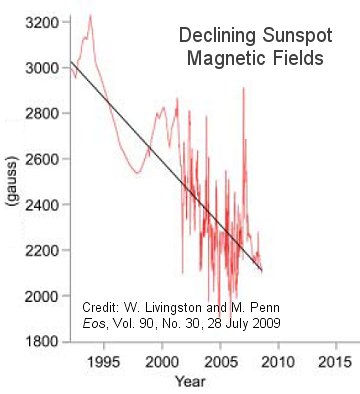
This should counteract global warming.
Some look at ice core samples. Others count sunspots. This suggests that we will have "lower than average global temperatures". Call me a heretic, but I think that we get better data from counting sun spots.
At least it stomps right on all the "it's just solar activity!" claims when it comes to temperature differences.
Justice is the sheep getting arrested while an impartial judge declares the vote void.
I think the controversy basically boils down to the following: Correlation is not causation.
GAAH! MY PRINTER IS ON FIRE!!! PUT IT OUT! PUT IT OUT!
I don't see what's "unscientific" about claiming that low numbers of sunspots cause global cooling. Fewer sunspots mean less energy from the sun. Although the spot is relatively cool, the area around it is very much hotter.
But something is unusual about the current sunspot cycle. The current solar minimum has been unusually long, and with more than 670 days without sunspots through June 2009, the number of spotless days has not been equaled since 1933
As to the "low number of sun spots and a temperature spike", more from TFA:
...posted on the Internet and led to some misunderstanding when a few authors from other fields cited that post and erroneously concluded that a lack of sunspots could explain global warming
This is something worth following closely:
Four years after the first draft paper, the predicted cycle-independent dearth in sunspot numbers has proven accurate. The vigor of sunspots, in terms of magnetic strength and area, has greatly diminished...Whether this is an omen of long-term sunspot decline, analogous to the Maunder Minimum, remains to be seen.
Note in this chart on Wikipedia that temps have been trending downward for thousands of years, as if we are plunging into the next glacial period.
Chart: http://en.wikipedia.org/wiki/File:Holocene_Temperature_Variations.png
See here in general about the time since the most recent glacial period: http://en.wikipedia.org/wiki/Holocene
According to data from the National Space Science and Technology Center in Huntsville, Ala., the global high temperature in 1998 was 0.76 degrees Celsius (1.37 degrees Fahrenheit) above the average for the previous 20 years. So far this year, the high has been 0.42 degrees Celsius (0.76 degrees Fahrenheit), above the 20-year average, clearly cooler than before.
Uh, no, it doesn't. The trend line for sunspots on that chart, peaked in 1960, and have been on a declining trend ever since. Meanwhile temperatures (on that chart) have been on the upswing.
Solar variations over the past 20 years should have had a cooling effect, but instead we've seen warming. Solar variations are not the main driver of the climate change we are currently experiencing.
Tom Swiss | the infamous tms | my blog
You cannot wash away blood with blood