Slashdot Mirror


ITER Fusion Reactor Enters Existential Crisis

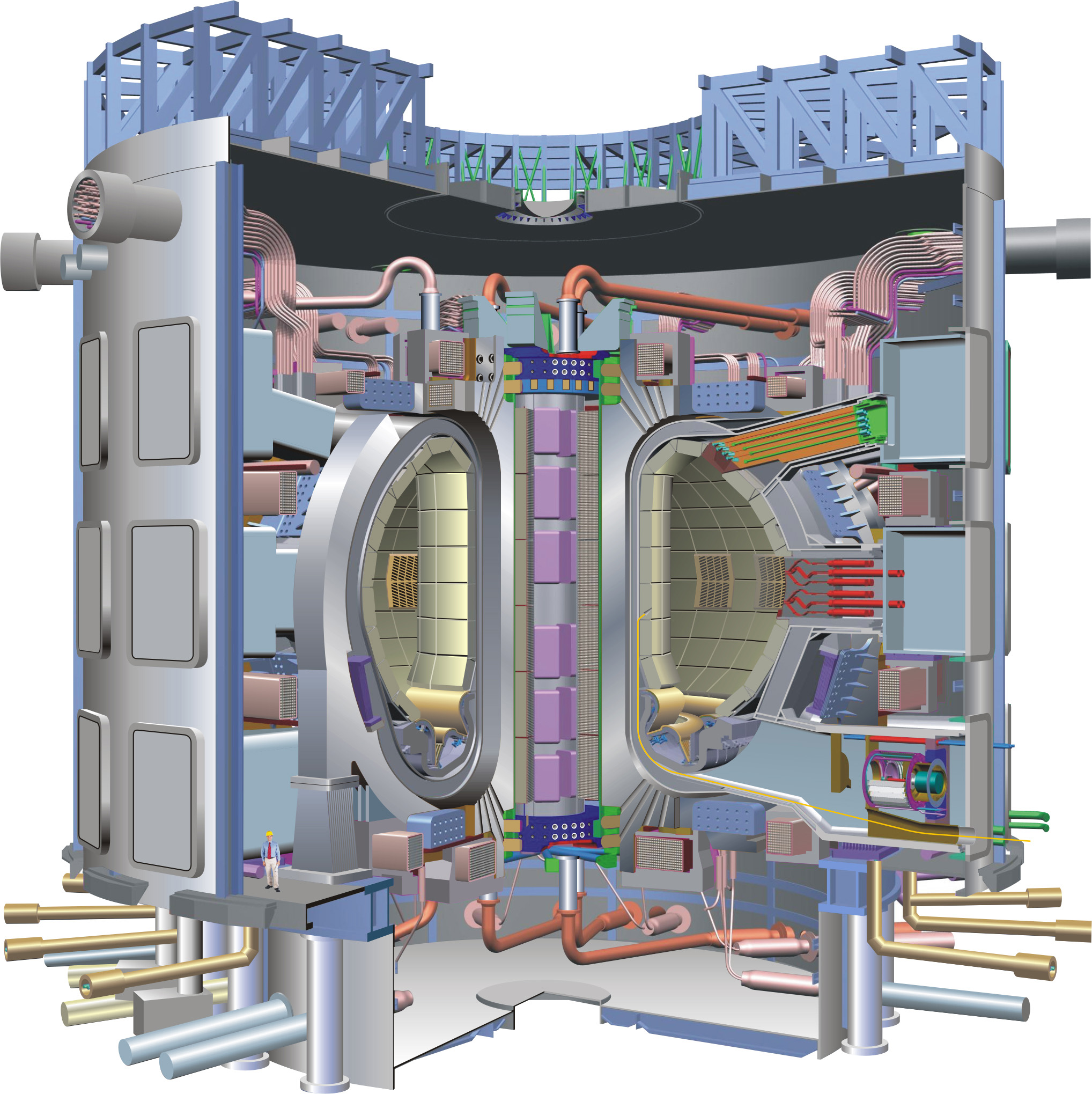
deglr6328 writes "The long beleaguered experimental magnetic confinement fusion reactor ITER is currently in what some are calling the worst crisis of its 25 year history. Still existing only on the paper of thousands of proposed design documents, the latest cost estimates for the superconducting behemoth are soaring to nearly 20 billion USD — roughly twice the estimates from as recently as a few years ago. Anti-nuclear environmentalist organizations have seized upon the moment as an opportunity to use the current global economic crisis as a means to push for permanently killing the project. If ITER is not built, the prospect of magnetic confinement fusion as a technique to reach thermonuclear breakeven and ignition in the laboratory would be in serious question. Meanwhile, the largest laser-driven inertial confinement fusion project, the National Ignition Facility, has demonstrated the ability to use self-generated plasma optical gratings to control capsule implosion symmetry with high finesse, and is on schedule to achieve ignition and potentially high gain before the end of the year."
10 of 470 comments (clear)

  1. So let me get this right... by Darkness404 · · Score: 4, Informative

    Anti-nuclear environmentalist organizations...

    So let me get this right, despite the fact that nuclear is incredibly safe, low-polluting, we still can't do research on it to make it safer and to increase "green" energy? How do these people expect us to get electricity?

    Can't do coal because that pollutes, can't do oil/gas/diesel because that pollutes, can't use hydroelectric power because that can damage ecosystems, can't use wind power because it poses a risk to birds/bats, can't use biomass because if used at an industrial scale it still pollutes, and I'm sure if solar was halfway economical they would be protesting them because they were "ruining" the beauty/ecosystem of the desert.

    Really, if you want "green" energy in our lifetime, support nuclear power. If not we still have way more than enough coal/oil to use...

    --
    Taxation is legalized theft, no more, no less.
    1. Re:So let me get this right... by girlintraining · · Score: 4, Informative

      But its pretty easy to desalinate water if need be, its non-trivial to make more oil.

      Easy? No. What follows is a lot of statistics I pulled from a lot of sources. I can't footnote them all here, because it would make the post hideously long and unintelligible.

      The largest desalination plant on the planet is the Jebel Ali Desalination Plant in Dubai, United Arab Emirates. It is scheduled to go online this month. The estimated cost construction cost is $550m USD and requires 2,000MW of power. It houses 8 desalination plants, each capable of producing 17.5m gallons of water. The power plant will cost another $1.7B USD. There was also a 400/132kW substation built for the project, at a cost of $60m USD.

      Operating costs for the project cannot yet be determined, however in the past about 45-50% of the operating costs of a desalination plant was energy costs. Right now, a coal-fired base plant costs about $1.6-2m per MW of output. For simplicity and to low-ball our estimate, we'll say that it costs $1.6 per MW. $1.6m x 2k = $3.2B USD, or a yearly operating cost estimate of $6.4B

      Total construction cost: $2.31B USD.
      Water purified daily: 140m gallons
      Operating costs: $6.4B/yr
      Cost per gallon per day: $0.13

      Now, let's assume that we had to switch to desalination and purification of potable water in this country. The per capita usage of water in the United States from 1996-1998 was 160.6 gallons per day. We'll ignore any adjustments or looking for more recent data in the interests of getting a ballpark estimate. The current estimated population in the US as of July is ~310.2m. That means our yearly use of water is somewhere around 49.82B gallons of water, per day. To purify that much water using desalination would cost us around $236.4B USD per year, just in maintenance costs.

      Still think desalination is "easy" ?

      --
      #fuckbeta #iamslashdot #dicemustdie
    2. Re:So let me get this right... by Anonymous Coward · · Score: 5, Informative

      Sorry, your numbers are orders of magnitude off. You concluded that UAE desalinated water costs $0.13/gallon ($34/meter^3) to make; when in fact production costs are 3 - 4 UAE Dirhams/m^3, or $0.82-$1.09/m^3.

      http://www.thenational.ae/apps/pbcs.dll/article?AID=/20090322/NATIONAL/684266544/1080

      Your main error is here:

      Operating costs for the project cannot yet be determined, however in the past about 45-50% of the operating costs of a desalination plant was energy costs. Right now, a coal-fired base plant costs about $1.6-2m per MW of output. For simplicity and to low-ball our estimate, we'll say that it costs $1.6 per MW. $1.6m x 2k = $3.2B USD, or a yearly operating cost estimate of $6.4B

      You incorrectly conflated "$1.6M per megawatt" with "$1.6M per megawatt PER YEAR". The construction cost ($1.6M/MW) is only paid once.

    3. Re:So let me get this right... by hey! · · Score: 4, Informative

      "Anti-nuclear environmentalist organizations" is just hand waving propaganda. *Which* organizations took *what* positions?

      Insofar as fusion power is concerned, its certainly a myth that environmental organizations are holding us back. Nobody knows what a commercially viable fusion plant would look like, so how could those mean old environmentalists be spoiling everything again?

      Now as an environmentalist myself, when we get to the point of building the first fusion power plant, I'd like to see a proper environmental impact analysis done, just because we've never built one. Surely we'll have to deal with the issue of plant decommissioning. Also, before we decide that fusion power is going to replace everything, we should think through the consequences to see if we've missed anything. But insofar as fusion will be replacing fossil fuels, the bar for "do no harm" is pretty low.

      Insofar as fission is concerned, I'm not against further research and a conservative program of new plant building. What I'm against is jumping to the conclusion that a crash program building the kind of plants we built thirty years ago is going to magically solve all our problems. There's be a lot of problems with uranium dependency, and we'd be storing up problems for the future.

      What I'd really like to see if more investments in the electricity distribution grid. This will prepare us for a future in which we have more diverse energy sources. That would be good for the country, good for humanity and good for the environment. Combined with greater energy efficiency and conservation, that would help us face declining global oil production without resorting to rash and desperate measures.

      --
      Post may contain irony: discontinue use if experiencing mood swings, nausea or elevated blood pressure.
  2. Re:Terrible summary by deglr6328 · · Score: 5, Informative

    I dispute your assertion that my phrasing was ad-hominem. Greenpeace's current stance on the matter is thus: "Governments should not waste our money on a dangerous toy which will never deliver any useful energy" Sortir du nucleaire's stance is that ITER is a hazard "because scientists do not yet know how to control DT reactions", a statement so laughably stupid I don't even know where to begin with it. There's a whole website devoted to trying to use scare tactics to shut it down at http://www.stop-iter.org/ These people are dangerous and calling them out on their dogmatic bullshit ideology isn't ad-hominem, it's an urgent necessity.

    --
    - "Hear that?! The percolations are imminent! Cease your ingress!"
  3. Re:Fusion Reactor... Crisis?! by Dahamma · · Score: 4, Informative

    I'm not sure, were you picking those as examples of countries with no chance for a nuclear power program, or those with a promising start?

    Sure, Haiti is lucky to have ANY electricity these days, but Morocco and Bangladesh are actively pursuing nuclear power, and Mexico already has several nuclear reactors used both for research and power generation.

  4. Re:Fusion Reactor... Crisis?! by KonoWatakushi · · Score: 5, Informative

    Two options? This isn't US politics; there are a number of methods by which we may achieve fusion, and no doubt, more will be imagined. The main problem, is that nothing outside of the two methods you mention have received serious funding.

    Here are a few other methods, all of which hold promise for solving the energy crises. We should know within a few years which are practical.

    Polywell
    Magnetized Target Fusion (General Fusion)
    Colliding Beam Fusion/FRC (Tri Alpha Energy)
    Dense Plasma Focus

    Even if none work out, their combined cost is a pittance compared to the funds being poured into ITER.

  5. Re:Fusion Reactor... Crisis?! by Sizzlebeast · · Score: 5, Informative

    I work on a project related to ITER. and we had a discussion about this yesterday. The funding will very likely show up. Some of the countries are just complaining about the amount they must contribute, but the funds will show up. ITER is a long way out, but it should at least get the funding to make it happen.

  6. Re:Anti-nuclear environmentalist organizations by SETIGuy · · Score: 5, Informative

    Since I've been through 50 posts and haven't seen a reasonable answer....

    First let me say that I'm very much in favor of nuclear power generation, so even though I think fusion has an environmental cost, other options are often far worse.

    There is no such thing as clean energy. An environmental cost must always be paid.

    • Fusion reactors would be powered by a deuterium-tritium reaction. Deuterium is plentiful, and can be extracted from water for little more than the energy and facilities cost. Tritium is more problematic. It's radioactive with a 12 year half life. Most reactor designs are not entirely closed cycle, so some of that tritium will escape. Fortunately the escape rate will be small in normal operations. A larger problem is that currently most tritium is obtained from fission reactors. Maintaining enough fission reactors to generate enough tritium to fuel fusion reactors might be infeasible in a fusion only world so other sources have been suggested.
    • The first source is lithium, which, when bombarded with neutrons undergoes fission into tritium and helium. Since the D-T reaction generates neutrons, there are plenty of neutrons in a fusion reactor to support this reaction. Most designs suggest molten lithium as a coolant. The most likely disaster in a plant of that variety is a lithium fire. Lithium is very reactive, and hot molten lithium would burn upon exposure to air or water. Any breech in the cooling system would likely start a fire. The fire would release T2O, THO, LiOT and Li2O (which will decompose to lithium hydroxide from atmospheric water), so you've got nearby toxic effects from lithium and you've released radioactive water (in small amounts). Also, Lithium must be mined, refined, and processed, which required industrial processes that are not clean.
    • Because it would be continuously bombarded with neutrons, the structure of a fusion reactor would become as radioactive as the structure of a fusion reactor. Although because of the smaller atomic weights, the half lives of the elements involved are mostly shorter than those in a fusion reactor. So you're talking 500 years before its safe rather than 10,000 or more.

    Asked and answered.

  7. Re:Fusion Reactor... Crisis?! by TheTurtlesMoves · · Score: 5, Informative

    I am a physicist. Out of that list the only one that doesn't need a pretty enormous piece of magic is option 2. In fact its the best bet for a fusion dark horse out there. It requires no magic, other than a stable plasma (harder than it looks).

    Polywell needs entropy to go away. The probability of scattering is *much* higher than fusing, hence you need to pump in more energy than you get out. You can arm wave all you like. There is a lot of *experimentally* verified theory to back up that it won't work. The assumption that it will, would require that a *lot* of different experiments to get completely different results (and to still be getting different results).

    The same experimentally verified theory that dooms polywell, also dooms colliding beam fusion. Again we would see vastly different results from many different experiments over the years if it would even be within an order of magnitude of working. The probability of scattering is still much higher than the probability of fusion. It is just a fact of nature. The probability of fusion is really low.

    Note that you don't even need to go into xray losses to show that the previous options can't work. But xray losses make the problem totally untenable. And if you want the device to be smaller than a planet, you are going to need elections around hot ions. The hot ions will heat the electrons and you will get xray losses. Run the numbers and it looks pretty bad for all currently proposed exotic fusion devices. Many people who like the exotic options just pretend that these results don't apply, without any justification or experimental data. It doesn't work that way.

    The Dense Plasma Focus is interesting. If they would stick with DT fusion or even DD fusion they have a fighting chance and no magic would be required. However he keeps pushed B-p fusion in a thermal plasma. And to suppress the xray losses you need mega-Tesla fields. That a bit of magic. However the issues is not just ignored or sweep under the carpet like proponents of other devices. He does know about it and is theoretically trying work the problem.

    The good news is that he is testing with DD first. If you can do B-p, DD fusion is easy by comparison, and would be the energy breakthrough of our age. If you can do DD fusion you can do DT even easier and with much higher power density. It would be all gold. This is dark horse option number 2.

    Personally its crazy that we rant on about the future with global warming and stuff. Talk about multi-billion dollar carbon credits, bail out failed banks to the tune of hundreds of billions, and then can't fund a 20 year project 20-40billion over the *lifetime* of the project.

    And yes, i propose we have serious money going into both fusion and fission research *now*, so we have options to choose from later.

    --
    The Grey Goo disaster happened 3 billion years ago. This rock is covered in self replicating machines!