 Slashdot Mirror
ITER Fusion Reactor Enters Existential Crisis
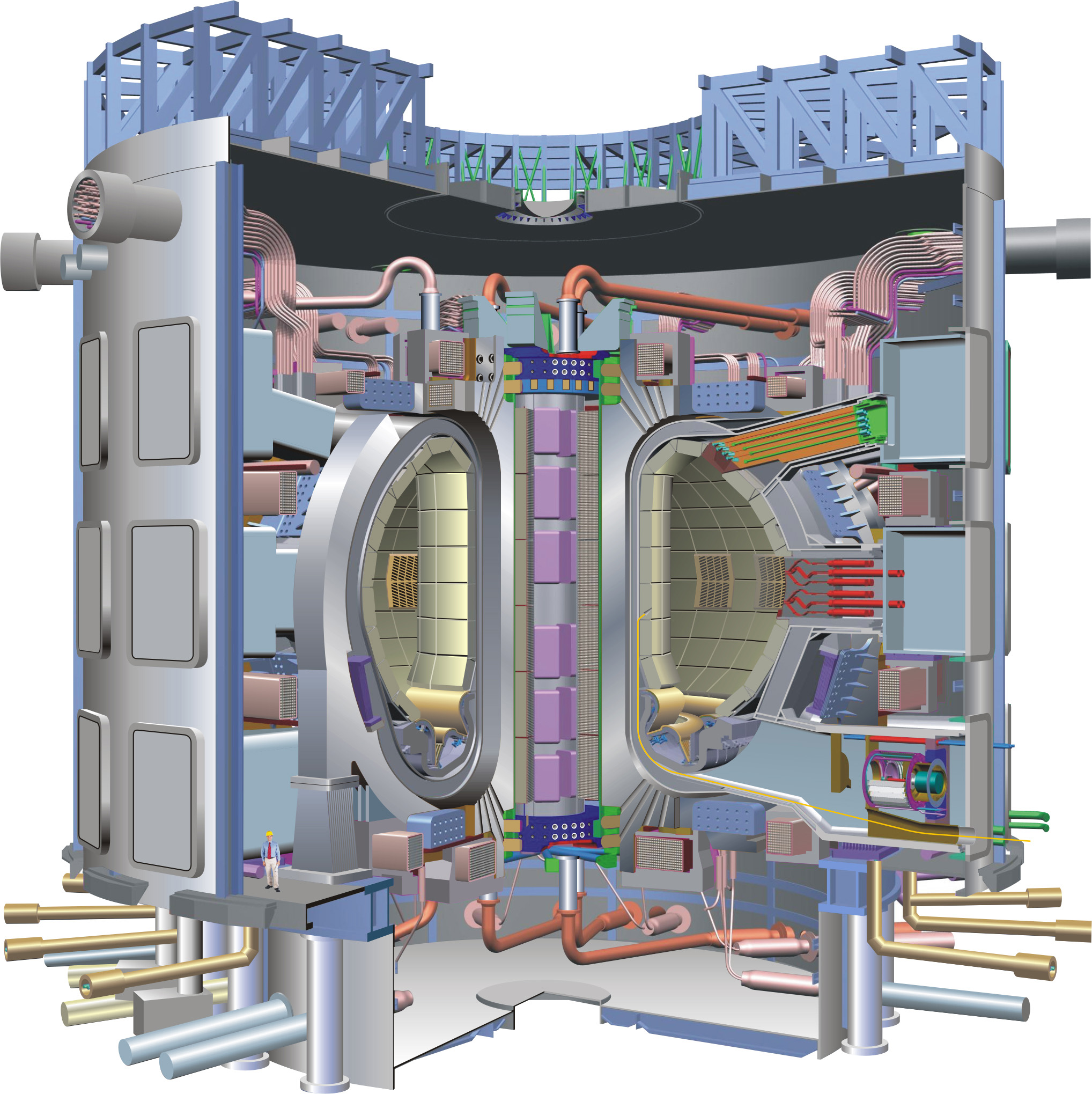
deglr6328 writes "The long beleaguered experimental magnetic confinement fusion reactor ITER is currently in what some are calling the worst crisis of its 25 year history. Still existing only on the paper of thousands of proposed design documents, the latest cost estimates for the superconducting behemoth are soaring to nearly 20 billion USD — roughly twice the estimates from as recently as a few years ago. Anti-nuclear environmentalist organizations have seized upon the moment as an opportunity to use the current global economic crisis as a means to push for permanently killing the project. If ITER is not built, the prospect of magnetic confinement fusion as a technique to reach thermonuclear breakeven and ignition in the laboratory would be in serious question. Meanwhile, the largest laser-driven inertial confinement fusion project, the National Ignition Facility, has demonstrated the ability to use self-generated plasma optical gratings to control capsule implosion symmetry with high finesse, and is on schedule to achieve ignition and potentially high gain before the end of the year."
ITER Fusion Reactor Enters Existential Crisis
Yeah, I read that and thought a fusion reactor had taken to wearing black clothes (from a thrift store), smoking (but only for affectation's sake) and contemplating existence in the face of this dark, heartless world.
Who knew fusion reactors were so...emo?
Well, Brett, I see you didn't even bother to read the articles. The summary blatantly misrepresents the environmentalist groups.
Based on the quotes in the articles, they're clearly not anti-nuclear. They're just asking for proper government regulation of any installations that are in fact built. Now, it's debatable whether the US government is capable of offering such regulation, especially after the BP disaster. But nevertheless, asking for regulation does not make them "anti-nuclear".
Don't be fooled it is frightening.
Nuclear fusion is pretty much a potential infinite source of clean electrical energy and we have 2 options to try to master plasma confinement long enough to harvest that energy. One is investigated with ITER and the other is the inertial confinement. I don't think anyone has the authority to tell whether one or the other is more likely to be successful because it's very new and to test it you actually have to build huge tokamak reactors that cost billions and it has not been done before.
So as Pascal I'll assume it's a 50/50 draw.
Now put that piece of news back in context : humanity is maybe about to give up on half its chances to secure a clean source of energy for the forseable future.
Does that make you scared ?
Let me just say that fusion power is aweful; we should be using solar power instead.
I'll just wait for the irony to sink in. Yeah.
it makes me want to kill myself over and over. It really does. also the caps limit thing is retarded also the caps limit thing is retarded also the caps limit thing is retarded also the caps limit thing is retarded also the caps limit thing is retarded also the caps limit thing is retarded also the caps limit thing is retarded also the caps limit thing is retarded
I dispute your assertion that my phrasing was ad-hominem. Greenpeace's current stance on the matter is thus: "Governments should not waste our money on a dangerous toy which will never deliver any useful energy" Sortir du nucleaire's stance is that ITER is a hazard "because scientists do not yet know how to control DT reactions", a statement so laughably stupid I don't even know where to begin with it. There's a whole website devoted to trying to use scare tactics to shut it down at http://www.stop-iter.org/ These people are dangerous and calling them out on their dogmatic bullshit ideology isn't ad-hominem, it's an urgent necessity.
- "Hear that?! The percolations are imminent! Cease your ingress!"
ITER is terribly expensive.
Compared to what? The LHC cost around 9 billion and isn't expected to have any real tangible benefit to anyone other than the knowledge. The cost of a couple nuclear reactors is about 10-14 billion.
Compared to that, this thing sounds CHEAP. These "anti-nuclear activists" need to start asking themselves what we're going to replace base-load power generation with. Sorry, but wind just isn't going to do it since the wind doesn't blow all the time. Unless they like fission, coal, or natural gas, I don't see what else is going to substitute for generating a base load power. This is really a long term investment, and even though it's not guaranteed, we need to pursue multiple different strategies. Betting on one horse is just stupid.
AccountKiller
Now, it's debatable whether the US government is capable of offering such regulation, especially after the BP disaster. But nevertheless, asking for regulation does not make them "anti-nuclear".
Okay, but the problem is that if you think you need successful regulation to prevent a BP spill-like disaster, then you still kinda don't understand fusion power.
The problem with the BP spill is that once a problem occurred and oil leaked, the oil does what it naturally does and continues to be pushed out by the pressure underground. The problem with fission reactors is that when the control rods fail, the enriched uranium does what it naturally does and continues to release neutrons in a chain reaction.
When a fusion reactor fails, the fusion stops on a timescale that to human eyes would be called "instantly". The whole reason nuclear fusion is such a hard thing to make into a power source is that it takes so much damn effort to make the source material actually fuse because that is not it's natural state until you get enough of it in one place that you call it a star. It's inherent in the nature of the power source that it can't go out of control. "Out of control" means "stopped".
I'm an environmentalist, but also pro-fission. Yet I do think concerns about regulation of fission reactors are valid. How worried am I about regulation of fusion reactors? None worried.
The enemies of Democracy are
It's the "blame the smelly hippies" thing all over again, and once again the people you are blaming do not have the political power to do anything but make a mostly ignored noise as they complain.
Some would like to do exactly what you say, but that doesn't matter - how the hell are they going to?
They are insignificant and politically weak, so blaming them is just kicking a cat.
You have out-obtused me, I have little idea what your localities share in common.
Do you mean to insist that they lack the money or stability to operate nuclear plants? That isn't exactly entirely attributable to fission itself. And Toshiba wants to sell them safe, small scale, self contained nuclear generation. The U.S. could be tasked with providing the islands with power, the U.S. Navy has long experience safely operating floating reactors (money is an issue there, but if we want to 'continue living in a civilization', we might have to stop worrying about it so much).
I'm about evenly split on governments spending $20 billion on new fission generation vs fusion research, but I'm not very optimistic about fusion, mostly based on the numbers in a recent Scientific American article:
http://www.scientificamerican.com/article.cfm?id=fusions-false-dawn
The engineering requirements for the jacket on a tritium consuming fusion reactor are 'hilarious'. There is no better word. The targets for laser ignition also present 'interesting' production challenges. Meanwhile, uranium reactors 'fucking work', with political problems preventing them from being built, not fundamental technical challenges.
Nerd rage is the funniest rage.
Two options? This isn't US politics; there are a number of methods by which we may achieve fusion, and no doubt, more will be imagined. The main problem, is that nothing outside of the two methods you mention have received serious funding.
Here are a few other methods, all of which hold promise for solving the energy crises. We should know within a few years which are practical.
Polywell
Magnetized Target Fusion (General Fusion)
Colliding Beam Fusion/FRC (Tri Alpha Energy)
Dense Plasma Focus
Even if none work out, their combined cost is a pittance compared to the funds being poured into ITER.
I work on a project related to ITER. and we had a discussion about this yesterday. The funding will very likely show up. Some of the countries are just complaining about the amount they must contribute, but the funds will show up. ITER is a long way out, but it should at least get the funding to make it happen.
Sorry, your numbers are orders of magnitude off. You concluded that UAE desalinated water costs $0.13/gallon ($34/meter^3) to make; when in fact production costs are 3 - 4 UAE Dirhams/m^3, or $0.82-$1.09/m^3.
http://www.thenational.ae/apps/pbcs.dll/article?AID=/20090322/NATIONAL/684266544/1080
Your main error is here:
You incorrectly conflated "$1.6M per megawatt" with "$1.6M per megawatt PER YEAR". The construction cost ($1.6M/MW) is only paid once.
Since I've been through 50 posts and haven't seen a reasonable answer....
First let me say that I'm very much in favor of nuclear power generation, so even though I think fusion has an environmental cost, other options are often far worse.
There is no such thing as clean energy. An environmental cost must always be paid.
Asked and answered.
Support SETI@home
It's also 8 light-minutes away and has an average power density on the order of 1 kW/m2. Who wants to cover the land in PV cells as far as the eye can see when you can build a few miniature stars with a few tonnes of superconducter and a vacuum chamber and have done with it?*
*Go Polywell! It'd be nice if Dr. B. turned out to be right.
If God forks the Universe every time you roll a die, he'd better have a damned good memory.
I am a physicist. Out of that list the only one that doesn't need a pretty enormous piece of magic is option 2. In fact its the best bet for a fusion dark horse out there. It requires no magic, other than a stable plasma (harder than it looks).
Polywell needs entropy to go away. The probability of scattering is *much* higher than fusing, hence you need to pump in more energy than you get out. You can arm wave all you like. There is a lot of *experimentally* verified theory to back up that it won't work. The assumption that it will, would require that a *lot* of different experiments to get completely different results (and to still be getting different results).
The same experimentally verified theory that dooms polywell, also dooms colliding beam fusion. Again we would see vastly different results from many different experiments over the years if it would even be within an order of magnitude of working. The probability of scattering is still much higher than the probability of fusion. It is just a fact of nature. The probability of fusion is really low.
Note that you don't even need to go into xray losses to show that the previous options can't work. But xray losses make the problem totally untenable. And if you want the device to be smaller than a planet, you are going to need elections around hot ions. The hot ions will heat the electrons and you will get xray losses. Run the numbers and it looks pretty bad for all currently proposed exotic fusion devices. Many people who like the exotic options just pretend that these results don't apply, without any justification or experimental data. It doesn't work that way.
The Dense Plasma Focus is interesting. If they would stick with DT fusion or even DD fusion they have a fighting chance and no magic would be required. However he keeps pushed B-p fusion in a thermal plasma. And to suppress the xray losses you need mega-Tesla fields. That a bit of magic. However the issues is not just ignored or sweep under the carpet like proponents of other devices. He does know about it and is theoretically trying work the problem.
The good news is that he is testing with DD first. If you can do B-p, DD fusion is easy by comparison, and would be the energy breakthrough of our age. If you can do DD fusion you can do DT even easier and with much higher power density. It would be all gold. This is dark horse option number 2.
Personally its crazy that we rant on about the future with global warming and stuff. Talk about multi-billion dollar carbon credits, bail out failed banks to the tune of hundreds of billions, and then can't fund a 20 year project 20-40billion over the *lifetime* of the project.
And yes, i propose we have serious money going into both fusion and fission research *now*, so we have options to choose from later.
The Grey Goo disaster happened 3 billion years ago. This rock is covered in self replicating machines!