Slashdot Mirror


ITER Fusion Reactor Enters Existential Crisis

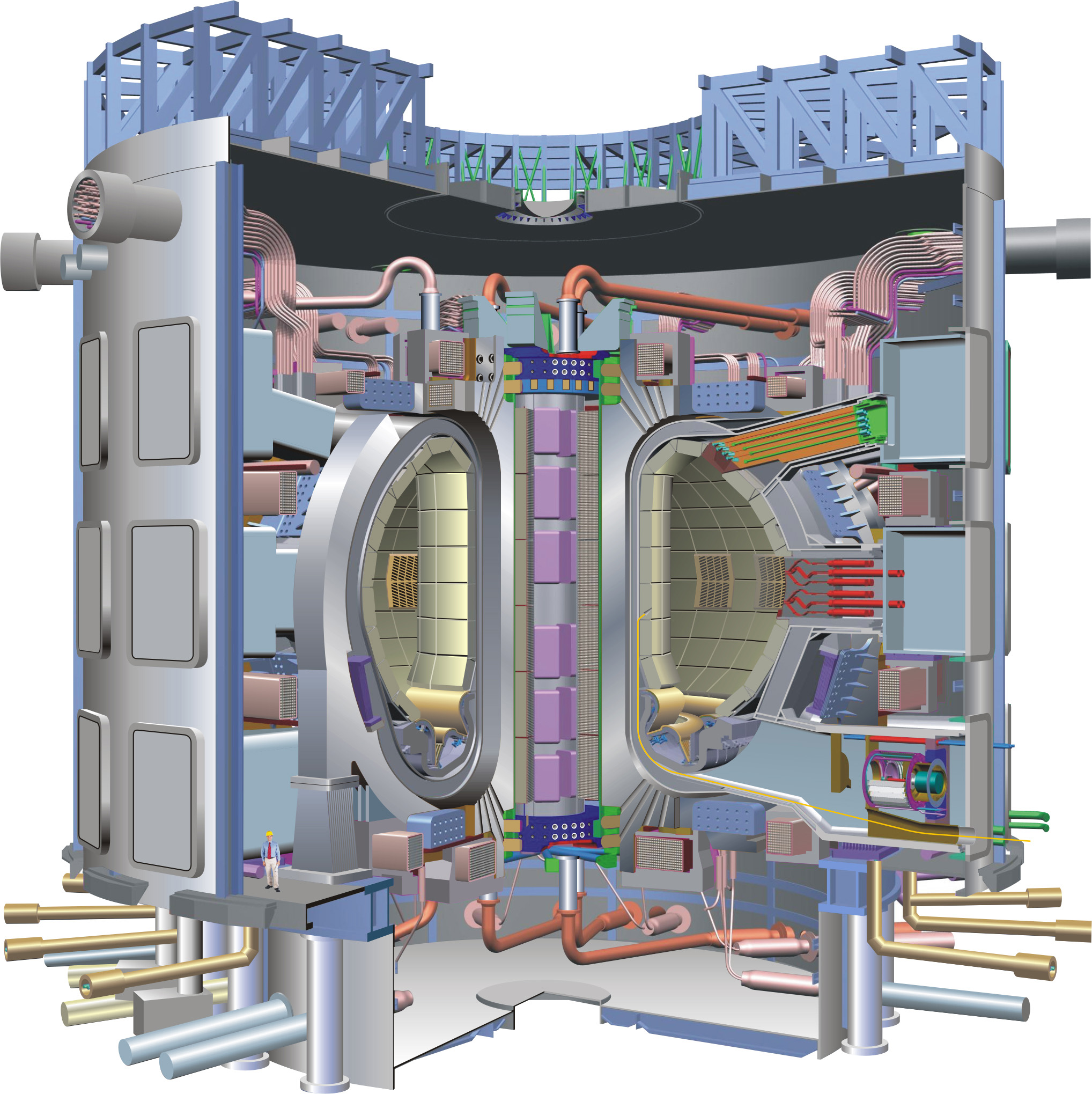
deglr6328 writes "The long beleaguered experimental magnetic confinement fusion reactor ITER is currently in what some are calling the worst crisis of its 25 year history. Still existing only on the paper of thousands of proposed design documents, the latest cost estimates for the superconducting behemoth are soaring to nearly 20 billion USD — roughly twice the estimates from as recently as a few years ago. Anti-nuclear environmentalist organizations have seized upon the moment as an opportunity to use the current global economic crisis as a means to push for permanently killing the project. If ITER is not built, the prospect of magnetic confinement fusion as a technique to reach thermonuclear breakeven and ignition in the laboratory would be in serious question. Meanwhile, the largest laser-driven inertial confinement fusion project, the National Ignition Facility, has demonstrated the ability to use self-generated plasma optical gratings to control capsule implosion symmetry with high finesse, and is on schedule to achieve ignition and potentially high gain before the end of the year."
82 of 470 comments (clear)

  1. Fusion Reactor... Crisis?! by SomeJoel · · Score: 3, Funny

    That sounds terrifying. Then I read that it is just going to go unfunded. Not quite as interesting. Well played, headline writer, well played.

    --
    <Complete your profile by adding a signature!>
    1. Re:Fusion Reactor... Crisis?! by by+(1706743) · · Score: 5, Funny

      ITER Fusion Reactor Enters Existential Crisis

      Yeah, I read that and thought a fusion reactor had taken to wearing black clothes (from a thrift store), smoking (but only for affectation's sake) and contemplating existence in the face of this dark, heartless world.

      Who knew fusion reactors were so...emo?

    2. Re:Fusion Reactor... Crisis?! by LaRainette · · Score: 5, Insightful

      Don't be fooled it is frightening.
      Nuclear fusion is pretty much a potential infinite source of clean electrical energy and we have 2 options to try to master plasma confinement long enough to harvest that energy. One is investigated with ITER and the other is the inertial confinement. I don't think anyone has the authority to tell whether one or the other is more likely to be successful because it's very new and to test it you actually have to build huge tokamak reactors that cost billions and it has not been done before.
      So as Pascal I'll assume it's a 50/50 draw.
      Now put that piece of news back in context : humanity is maybe about to give up on half its chances to secure a clean source of energy for the forseable future.

      Does that make you scared ?

    3. Re:Fusion Reactor... Crisis?! by maxume · · Score: 3, Insightful

      Not really. Energy unity is a big challenge, but fuel-in fuel-out is a bigger one.

      If we wanted to, we could start operating a bunch more of those fission reactors; they don't necessarily make economic sense given current market prices, but those markets probably don't accurately capture the consequences of other forms of energy production, and fission is certainly still energy positive (and it is probably energy positive to pull uranium out the sea).

      We have millions of hours of operational experience on fail-crazy plant designs resulting in 2 major safety incidents, 1 of which was a medium sized disaster and 1 of which was successfully contained, and we can move on to building actual fail-safe designs.

      The waste is certainly a significant issue, but it is entirely manageable, at least from a technical perspective.

      --
      Nerd rage is the funniest rage.
    4. Re:Fusion Reactor... Crisis?! by maxume · · Score: 5, Interesting

      You have out-obtused me, I have little idea what your localities share in common.

      Do you mean to insist that they lack the money or stability to operate nuclear plants? That isn't exactly entirely attributable to fission itself. And Toshiba wants to sell them safe, small scale, self contained nuclear generation. The U.S. could be tasked with providing the islands with power, the U.S. Navy has long experience safely operating floating reactors (money is an issue there, but if we want to 'continue living in a civilization', we might have to stop worrying about it so much).

      I'm about evenly split on governments spending $20 billion on new fission generation vs fusion research, but I'm not very optimistic about fusion, mostly based on the numbers in a recent Scientific American article:

      http://www.scientificamerican.com/article.cfm?id=fusions-false-dawn

      The engineering requirements for the jacket on a tritium consuming fusion reactor are 'hilarious'. There is no better word. The targets for laser ignition also present 'interesting' production challenges. Meanwhile, uranium reactors 'fucking work', with political problems preventing them from being built, not fundamental technical challenges.

      --
      Nerd rage is the funniest rage.
    5. Re:Fusion Reactor... Crisis?! by h4rr4r · · Score: 4, Insightful

      I highly suggest you remove 1 human right away. Practice what you preach.

    6. Re:Fusion Reactor... Crisis?! by Dahamma · · Score: 4, Informative

      I'm not sure, were you picking those as examples of countries with no chance for a nuclear power program, or those with a promising start?

      Sure, Haiti is lucky to have ANY electricity these days, but Morocco and Bangladesh are actively pursuing nuclear power, and Mexico already has several nuclear reactors used both for research and power generation.

    7. Re:Fusion Reactor... Crisis?! by KonoWatakushi · · Score: 5, Informative

      Two options? This isn't US politics; there are a number of methods by which we may achieve fusion, and no doubt, more will be imagined. The main problem, is that nothing outside of the two methods you mention have received serious funding.

      Here are a few other methods, all of which hold promise for solving the energy crises. We should know within a few years which are practical.

      Polywell
      Magnetized Target Fusion (General Fusion)
      Colliding Beam Fusion/FRC (Tri Alpha Energy)
      Dense Plasma Focus

      Even if none work out, their combined cost is a pittance compared to the funds being poured into ITER.

    8. Re:Fusion Reactor... Crisis?! by Sizzlebeast · · Score: 5, Informative

      I work on a project related to ITER. and we had a discussion about this yesterday. The funding will very likely show up. Some of the countries are just complaining about the amount they must contribute, but the funds will show up. ITER is a long way out, but it should at least get the funding to make it happen.

    9. Re:Fusion Reactor... Crisis?! by newcastlejon · · Score: 5, Insightful

      It's also 8 light-minutes away and has an average power density on the order of 1 kW/m2. Who wants to cover the land in PV cells as far as the eye can see when you can build a few miniature stars with a few tonnes of superconducter and a vacuum chamber and have done with it?*

      *Go Polywell! It'd be nice if Dr. B. turned out to be right.

      --
      If God forks the Universe every time you roll a die, he'd better have a damned good memory.
    10. Re:Fusion Reactor... Crisis?! by Shark · · Score: 2, Interesting

      The waste is entirely manageable? So you've found a method to reduce physically hot, and radioactive hot materials to safe standards within... say, 100 years? Oh no... OK, so you've found a way to store these materials that doesn't expose the environment, people, or significant sections of aquifer to the lethal materials? Oh... you want to put it in tanks and cool those tanks with AC units for the next 5,000 years or so. Gotcha, Technical perspective absorbed.

      He might not have, but apparently, the French have. I'm no expert in the matter, but this is definitely not a bad step forward if it's got any truth to it.

      --
      Mind the frickin' laser...
    11. Re:Fusion Reactor... Crisis?! by timeOday · · Score: 2, Interesting

      Who wants to cover the land in PV cells as far as the eye can see when you can build a few miniature stars with a few tonnes of superconducter and a vacuum chamber and have done with it?*

      The land is already covered as far as the eye can see, with roofs, roads, and parking lots. (Which is why cities are so unnaturally hot and a second reason harvesting that energy would be nice to do).

      And, though I make no guarantees for the distant future, for the foreseeable future solar is incontrovertibly cheaper than home-grown fusion.

      Granted, solar isn't really an option until we can make it cheaper and store it and distribute it better. A lot of that technology exists but maybe not quite good enough yet, but again... compared to fusion?

    12. Re:Fusion Reactor... Crisis?! by TheTurtlesMoves · · Score: 5, Informative

      I am a physicist. Out of that list the only one that doesn't need a pretty enormous piece of magic is option 2. In fact its the best bet for a fusion dark horse out there. It requires no magic, other than a stable plasma (harder than it looks).

      Polywell needs entropy to go away. The probability of scattering is *much* higher than fusing, hence you need to pump in more energy than you get out. You can arm wave all you like. There is a lot of *experimentally* verified theory to back up that it won't work. The assumption that it will, would require that a *lot* of different experiments to get completely different results (and to still be getting different results).

      The same experimentally verified theory that dooms polywell, also dooms colliding beam fusion. Again we would see vastly different results from many different experiments over the years if it would even be within an order of magnitude of working. The probability of scattering is still much higher than the probability of fusion. It is just a fact of nature. The probability of fusion is really low.

      Note that you don't even need to go into xray losses to show that the previous options can't work. But xray losses make the problem totally untenable. And if you want the device to be smaller than a planet, you are going to need elections around hot ions. The hot ions will heat the electrons and you will get xray losses. Run the numbers and it looks pretty bad for all currently proposed exotic fusion devices. Many people who like the exotic options just pretend that these results don't apply, without any justification or experimental data. It doesn't work that way.

      The Dense Plasma Focus is interesting. If they would stick with DT fusion or even DD fusion they have a fighting chance and no magic would be required. However he keeps pushed B-p fusion in a thermal plasma. And to suppress the xray losses you need mega-Tesla fields. That a bit of magic. However the issues is not just ignored or sweep under the carpet like proponents of other devices. He does know about it and is theoretically trying work the problem.

      The good news is that he is testing with DD first. If you can do B-p, DD fusion is easy by comparison, and would be the energy breakthrough of our age. If you can do DD fusion you can do DT even easier and with much higher power density. It would be all gold. This is dark horse option number 2.

      Personally its crazy that we rant on about the future with global warming and stuff. Talk about multi-billion dollar carbon credits, bail out failed banks to the tune of hundreds of billions, and then can't fund a 20 year project 20-40billion over the *lifetime* of the project.

      And yes, i propose we have serious money going into both fusion and fission research *now*, so we have options to choose from later.

      --
      The Grey Goo disaster happened 3 billion years ago. This rock is covered in self replicating machines!
    13. Re:Fusion Reactor... Crisis?! by TheTurtlesMoves · · Score: 2, Insightful

      Because it illustrates the problem perfectly. One *person* claims that the worlds problems are caused by all the people. When in reality they believe the worlds problems are caused by all the *other people*.

      If someone really thinks genocide is the solution, you better be first in line. Otherwise you are a hypocrite.

      --
      The Grey Goo disaster happened 3 billion years ago. This rock is covered in self replicating machines!
    14. Re:Fusion Reactor... Crisis?! by Frnknstn · · Score: 2, Insightful

      smoking (but only for affectation's sake)

      This may be a silly question, but is there any /other/ reason to start smoking?

      --
      If it's in you sig, it's in your post.
    15. Re:Fusion Reactor... Crisis?! by KonoWatakushi · · Score: 2, Informative

      There has been a rather polarized set of opinions on the topic of the Polywell, or any P-b device for that matter, but as of yet, the experimental evidence seems to be promising, and the Navy continues to fund it. Rather than going into detail, I will point those interested to talk-polywell.org, where a lot of discussion on the various criticisms has taken place.

      In particular, rnebel's comments have been illuminating. Dr. Nebel is responsible for continuing Dr. Bussard's Polywell research, and has made it clear that there are no show stoppers thus far. He is also a well respected physicist, so I am willing to give him the benefit of the doubt.

      Anyway, the electron scattering and xray losses turn out to be considerably less than one would expect in the Polywell. Furthermore, it is not a thermal system, so much of the conventional wisdom does not apply. It isn't that entropy needs to go away, but it doesn't play a big part at the timescales in question. (ie. it doesn't thermalize quickly enough to matter, and there may even be a mechanism which prevents it from thermalizing.)

      I'm not sure what experimental counter evidence you are referring to, as this is a rather unique system which has not been studied elsewhere. It is also a computationally intractable problem, so there are no shortcuts in this case.

      As for the Tri Alpha's FRC device, I admit to having little knowledge. However, there are well respected physicists who do take it very seriously; one of whom was extremely skeptical on the talk-polywell forums. While still not optimistic, even he was convinced that the Polywell may in fact work.

      I completely agree with your comment on further funding though.

    16. Re:Fusion Reactor... Crisis?! by ultranova · · Score: 2, Interesting

      Just imagine how bad a sane Hitler could have been.

      Not bad at all? He wouldn't had started the Holocaust, wouldn't had started WWII, and would likely not have sought dictatorial power in the first place. He'd been just a politician amongst many, or possibly a painter as he originally wanted to be.

      --

      Forget magic. Any technology distinguishable from divine power is insufficiently advanced.

    17. Re:Fusion Reactor... Crisis?! by TheTurtlesMoves · · Score: 2, Informative

      Fission is a dead end with the seemingly insoluble issue of nuclear waste.

      Not true. There are ways to deal with the waste, but they involve reprocessing in one way or another and generally fast reactors. These are *poltical* problematic. With a fast reactor and transmutation, you could have the pretty small amount of waste (a few tons per GW per year) safe in just 100 years or so. Considering that the church down the road is 400 years old, this is practical technically. There are other options.

      But speaking as a physicist you state that the polywell is doomed?

      The vast majority of physicists agree with me (even the physicists that think AGW is bunk). A huge number of experiments agree with me (The Russians worked on this a long time ago). The theory that matches the experiments agrees with me. It not that fusion can't work. Its that the polywell in its current incarnation can't work.

      Now add the fact that the published results from the polywell don't even get close to matching the claims of proponents. In fact home made fusors have got far better neutron yields.

      And would you say that it is as doomed as the Tokamak?

      A tokamak can at least work in theory. A polywell can't. Polywell proponents refuse to even acknowledge all this theory and experimental data let along demonstrate how it is not applicable to a polywell.

      Furthermore, the US military is already funding polywell technology..

      They have also funded cold fusion, and some quite bizarre and sometimes stupid things. US military funding is not an indication of scientific merit.

      --
      The Grey Goo disaster happened 3 billion years ago. This rock is covered in self replicating machines!
    18. Re:Fusion Reactor... Crisis?! by TheTurtlesMoves · · Score: 3, Informative

      ..but as of yet, the experimental evidence seems to be promising

      What evidence? The published results have been nonexistent to no positive results. In fact all the current results show that the rest of the physics community is correct. There is also quite a bit of data on this sort of thing, its not as new as some think.

      , and the Navy continues to fund it.

      They also funded cold fusion. The navy giving funding to something is not a vote of scientific merit.

      Dr. Nebel is responsible for continuing Dr. Bussard's Polywell research, and has made it clear that there are no show stoppers thus far.

      And is there any published data? Any published papers? Anything other than a media PR press release?

      Anyway, the electron scattering and xray losses turn out to be considerably less than one would expect in the Polywell.

      Well all the data on this i have seen does not suggest this at all. In fact the losses look about right from theory. Massively higher than the fusion yield.

      Furthermore, it is not a thermal system, so much of the conventional wisdom does not apply.

      Got anything other than an assertion to back that up. Because I have data, and some pretty well tested theory that says this is not the case.

      It isn't that entropy needs to go away, but it doesn't play a big part at the timescales in question. (ie. it doesn't thermalize quickly enough to matter, and there may even be a mechanism which prevents it from thermalizing.)

      Since fusion requires a *collision*, and thermalizing is via *collisions* this is quite false. You can't change the fact that the probability of scattering is *much* higher than the probability of fusion. This means that thermalization is the faster process.

      I'm not sure what experimental counter evidence you are referring to, as this is a rather unique system which has not been studied elsewhere. It is also a computationally intractable problem, so there are no shortcuts in this case.

      Both statements are incorrect in any practical sense. First the Russians have worked on this stuff. Buzzards original paper even cites them. They developed the idea of virtual electrodes in a plasma. Also the system is as far as collision process are concerned, similar to other electrostatic confinement methods. They get fusion easily, but fail at anything other than a neutron source.

      The polywell is quite tractable numerically in any practical sense. If its not, where are all the predictions coming from? We can simulate tokamaks with some degree of success. The plasma parameters of a polywell make it easier, not harder.

      --
      The Grey Goo disaster happened 3 billion years ago. This rock is covered in self replicating machines!
    19. Re:Fusion Reactor... Crisis?! by DavidTC · · Score: 2, Insightful

      Also, coal mines themselves release a lot of radon, a naturally occurring underground radioactive gas. It's not just the burning that's radioactive...the actual mining releases more radioactivity than the equivalent in nuclear power. (And then, as you said, burning releases a lot more.)

      Of course, any mine does that, (In fact, any sort of digging can...don't forget to have your basement checked for radon.) but coal mines dwarf all other sorts of mining put together.

      Obviously with nuclear the dangerous stuff is kept contained and in solid form.

      Whereas with coal even more dangerous stuff, fly ash, ends up in giant containment units, which then spill repeatedly and poisons rivers and groundwater.

      --
      If corporations are people, aren't stockholders guilty of slavery?
  2. Point proven by Brett+Buck · · Score: 2, Insightful

    "Anti-nuclear environmentalists"? Having them argue against a *fusion* project pretty much proves that these idiots are not qualified to remember to breathe, much less protect the environment.

          Brett

    1. Re:Point proven by garyisabusyguy · · Score: 2, Insightful

      All you have to do is wipe out 90% of the human population and the whole energy-problem goes away... for a few decades at least

      Other than that... Most forms of energy generation besides nuclear are either too dirty, too expensive or too widely displaced to be of much use to our crowded population centers.

      As far as nuclear goes, the same people who argue that 'there is no safe place to store the waste' actually work to block the creation of a safe place to store the waste, and will continue to do everyting possible to prevent the use of (provenly) safe nuclear energy.

      So, what's the deal with that? Irrational fear or nuclear energy, or just a general hatred for humanity?

      --
      Wherever You Go, There You Are
    2. Re:Point proven by h4rr4r · · Score: 3, Insightful

      It's not waste that is perfectly good fuel in most cases. Build the right reactors people.

    3. Re:Point proven by Captain+Splendid · · Score: 3, Interesting

      So, what's the deal with that? Irrational fear or nuclear energy, or just a general hatred for humanity?

      (Relatively) cheap oil. Give it another 5-10 years and those same clueless environmentalists will be the first ones calling for fission.

      That's right kids, Nuclear power plants are the next 'tech boom' so be sure to bone up on your physics and chemistry and math. There's money in them thar cooling towers!

      --
      Linux, you magnificent bastard, I read the fucking manual!
    4. Re:Point proven by martas · · Score: 2, Insightful

      according to larry niven, there's a special place in hell for those kinds of "environmentalists" (see Inferno)

    5. Re:Point proven by CrimsonAvenger · · Score: 2, Insightful

      All you have to do is wipe out 90% of the human population and the whole energy-problem goes away.

      Unless you're volunteering to be one of the 90%, I think I'll pass on that "solution".

      I've always been fascinated by people who think we could solve all our problems by killing bunch of OTHER people....

      --

      "I do not agree with what you say, but I will defend to the death your right to say it"
  3. So let me get this right... by Darkness404 · · Score: 4, Informative

    Anti-nuclear environmentalist organizations...

    So let me get this right, despite the fact that nuclear is incredibly safe, low-polluting, we still can't do research on it to make it safer and to increase "green" energy? How do these people expect us to get electricity?

    Can't do coal because that pollutes, can't do oil/gas/diesel because that pollutes, can't use hydroelectric power because that can damage ecosystems, can't use wind power because it poses a risk to birds/bats, can't use biomass because if used at an industrial scale it still pollutes, and I'm sure if solar was halfway economical they would be protesting them because they were "ruining" the beauty/ecosystem of the desert.

    Really, if you want "green" energy in our lifetime, support nuclear power. If not we still have way more than enough coal/oil to use...

    --
    Taxation is legalized theft, no more, no less.
    1. Re:So let me get this right... by girlintraining · · Score: 2, Insightful

      How do these people expect us to get electricity?

      You might be a little behind the curve here. The purpose of the Green movement isn't to create economical and sustainable energy; It's to allow the Boomers to purchase indulgences in the form of carbon credits and other non-sense to relieve their guilt over having cut investments in every major social institution from education to medicine, so that they could live the most hedonistic lifestyle possible.

      If they were serious about creating sustainable and renewable energy, they would invest more in physics to prevent the eventual heat death of the universe. Or, of more immediate concern, how we're going to survive as a civilization when we run out of drinkable water. Because of all the resources we have on the planet, oil is not the one I'm worried about: I can live without oil. I can't live without water. And guess which one's disappearing faster? /sarcasm

      --
      #fuckbeta #iamslashdot #dicemustdie
    2. Re:So let me get this right... by Darkness404 · · Score: 2, Insightful

      But its pretty easy to desalinate water if need be, its non-trivial to make more oil.

      --
      Taxation is legalized theft, no more, no less.
    3. Re:So let me get this right... by dondelelcaro · · Score: 2, Informative

      if solar was halfway economical they would be protesting them because they were "ruining" the beauty/ecosystem of the desert

      Actually, there already are groups who are concerned about solar in the desert, precisely because of the harm the vehicles and associated traffic can cause to desert tortoises and other fauna which are relatively fragile.

      --
      http://www.donarmstrong.com
    4. Re:So let me get this right... by Vellmont · · Score: 3, Insightful


      Or, of more immediate concern, how we're going to survive as a civilization when we run out of drinkable water.

      Huh. Where I live the stuff falls from the sky, quite regularly. If I really had to I could pretty easily collect the stuff and store it. Do you not have rain where you live?

      Also, if I'm not mistaken, I believe when the water goes down the drain, it's not actually destroyed. I've heard from good sources that it winds up somewhere downstream, and not as some people believe sucked into a black hole and destroyed. I'm not quite sure about the water that goes on the lawn... some people say that's not destroyed either, but I don't believe them.

      --
      AccountKiller
    5. Re:So let me get this right... by NotQuiteReal · · Score: 2, Funny

      I heard that every bird struck by a windmill trickles down into the earth as another barrel of oil.

      --
      This issue is a bit more complicated than you think.
    6. Re:So let me get this right... by bheekling · · Score: 2, Informative

      De-salination is also quite costly. It costs around $0.5/m to de-salinate in Israel, Saudi Arabia etc. On the other hand, as I learnt (and calculated) in my water treatment course last year, fresh water treatment costs Rs.~5/m which is around $0.1/m.

      So, it currently costs 3-5 times as much to de-salinate than to just treat underground/river water for human consumption. Of course, it'll get cheaper as the demand increases, but that will take time.

      --
      "..."
    7. Re:So let me get this right... by Krahar · · Score: 2, Insightful

      If you have enough energy at your disposal, both oil and water are non-issues. Water is H20 and there is H and O2 floating about in the air. All it takes to make it into H20 is energy. Oil is also made of H and O, and all it takes to turn air into oil is energy. Hell, if you have enough energy, you can make the H and O from scratch if you really want to due to E=MC2. Energy is all you need.

    8. Re:So let me get this right... by Anonymous Coward · · Score: 2, Funny


      Or, of more immediate concern, how we're going to survive as a civilization when we run out of drinkable water.

      Huh. Where I live the stuff falls from the sky, quite regularly.

      Wait for hurricane season. I hear oil's going to fall from the sky pretty impressively.

    9. Re:So let me get this right... by girlintraining · · Score: 4, Informative

      But its pretty easy to desalinate water if need be, its non-trivial to make more oil.

      Easy? No. What follows is a lot of statistics I pulled from a lot of sources. I can't footnote them all here, because it would make the post hideously long and unintelligible.

      The largest desalination plant on the planet is the Jebel Ali Desalination Plant in Dubai, United Arab Emirates. It is scheduled to go online this month. The estimated cost construction cost is $550m USD and requires 2,000MW of power. It houses 8 desalination plants, each capable of producing 17.5m gallons of water. The power plant will cost another $1.7B USD. There was also a 400/132kW substation built for the project, at a cost of $60m USD.

      Operating costs for the project cannot yet be determined, however in the past about 45-50% of the operating costs of a desalination plant was energy costs. Right now, a coal-fired base plant costs about $1.6-2m per MW of output. For simplicity and to low-ball our estimate, we'll say that it costs $1.6 per MW. $1.6m x 2k = $3.2B USD, or a yearly operating cost estimate of $6.4B

      Total construction cost: $2.31B USD.
      Water purified daily: 140m gallons
      Operating costs: $6.4B/yr
      Cost per gallon per day: $0.13

      Now, let's assume that we had to switch to desalination and purification of potable water in this country. The per capita usage of water in the United States from 1996-1998 was 160.6 gallons per day. We'll ignore any adjustments or looking for more recent data in the interests of getting a ballpark estimate. The current estimated population in the US as of July is ~310.2m. That means our yearly use of water is somewhere around 49.82B gallons of water, per day. To purify that much water using desalination would cost us around $236.4B USD per year, just in maintenance costs.

      Still think desalination is "easy" ?

      --
      #fuckbeta #iamslashdot #dicemustdie
    10. Re:So let me get this right... by Anonymous Coward · · Score: 5, Informative

      Sorry, your numbers are orders of magnitude off. You concluded that UAE desalinated water costs $0.13/gallon ($34/meter^3) to make; when in fact production costs are 3 - 4 UAE Dirhams/m^3, or $0.82-$1.09/m^3.

      http://www.thenational.ae/apps/pbcs.dll/article?AID=/20090322/NATIONAL/684266544/1080

      Your main error is here:

      Operating costs for the project cannot yet be determined, however in the past about 45-50% of the operating costs of a desalination plant was energy costs. Right now, a coal-fired base plant costs about $1.6-2m per MW of output. For simplicity and to low-ball our estimate, we'll say that it costs $1.6 per MW. $1.6m x 2k = $3.2B USD, or a yearly operating cost estimate of $6.4B

      You incorrectly conflated "$1.6M per megawatt" with "$1.6M per megawatt PER YEAR". The construction cost ($1.6M/MW) is only paid once.

    11. Re:So let me get this right... by girlintraining · · Score: 3, Insightful

      Well, I tried. :\ Thanks.

      --
      #fuckbeta #iamslashdot #dicemustdie
    12. Re:So let me get this right... by bheekling · · Score: 2, Informative

      Human water demand per capita is 200-300 liters per day. You need water for more than just drinking.

      You must be thinking "That's still pretty cheap". And you're absolutely right. Except, people don't want to pay even that. If they were willing, we'd just recycle waste-water, reducing our water consumption drastically. It only costs $0.2/m^3 to do so.

      But we don't. Partly because idiots go "eewww" when you tell them what is intended, but mostly because they don't want to pay the extra "Water tax" which will result.

      PS: I meant m^3 in the original comment, and I used unicode for that, but slashdot's comment system ate that up nicely

      --
      "..."
    13. Re:So let me get this right... by hey! · · Score: 4, Informative

      "Anti-nuclear environmentalist organizations" is just hand waving propaganda. *Which* organizations took *what* positions?

      Insofar as fusion power is concerned, its certainly a myth that environmental organizations are holding us back. Nobody knows what a commercially viable fusion plant would look like, so how could those mean old environmentalists be spoiling everything again?

      Now as an environmentalist myself, when we get to the point of building the first fusion power plant, I'd like to see a proper environmental impact analysis done, just because we've never built one. Surely we'll have to deal with the issue of plant decommissioning. Also, before we decide that fusion power is going to replace everything, we should think through the consequences to see if we've missed anything. But insofar as fusion will be replacing fossil fuels, the bar for "do no harm" is pretty low.

      Insofar as fission is concerned, I'm not against further research and a conservative program of new plant building. What I'm against is jumping to the conclusion that a crash program building the kind of plants we built thirty years ago is going to magically solve all our problems. There's be a lot of problems with uranium dependency, and we'd be storing up problems for the future.

      What I'd really like to see if more investments in the electricity distribution grid. This will prepare us for a future in which we have more diverse energy sources. That would be good for the country, good for humanity and good for the environment. Combined with greater energy efficiency and conservation, that would help us face declining global oil production without resorting to rash and desperate measures.

      --
      Post may contain irony: discontinue use if experiencing mood swings, nausea or elevated blood pressure.
    14. Re:So let me get this right... by Vellmont · · Score: 2, Insightful


      Potable water supplies are a big issue in many parts of the world, and to "run out" can easily mean to have insufficient capacity to fulfill the needs of a growing population.

      Absolutely true. The OP however was trying to push some bizarre story about water suddenly being the new doomsday scenario, which is just utterly ridiculous. Water has always been an issue for humans, and we're used to dealing with it. If things REALLY get bad, there's always filtration and recycling, or just plain move to where the water is. The comparison to our reliance on nonrenewable fossil fuels is completely laughable.


      It's, in short, a big deal.

      Meh. In some places I'm sure it is. Trying to act like it's a big deal everywhere, or that suddenly we're all going to start dying of dehydration is stupid.

      --
      AccountKiller
    15. Re:So let me get this right... by tenco · · Score: 2, Interesting

      There's a reason why the air smells so fresh after it rained. The rain literally cleans the air by collecting particles on the way down. Rain is far from being clean like the stuff that springs from your water tab.

  4. Terrible summary by John+Whitley · · Score: 4, Insightful

    Anti-nuclear environmentalist organizations

    The above statement appears to be ad-hominem nonsense. Quoth TFA:

    green parliamentarians who believe that ITER is too costly and too speculative to warrant support. Rather than spending money on nuclear fusion, the greens would like to see ITER's funding spent on near-term renewable energy sources.

    ITER is terribly expensive. Combined with a substantial risk that the project could fail to produce valuable results, it seems that asking hard questions and investigating alternatives for that investment is a wise move.

    1. Re:Terrible summary by deglr6328 · · Score: 5, Informative

      I dispute your assertion that my phrasing was ad-hominem. Greenpeace's current stance on the matter is thus: "Governments should not waste our money on a dangerous toy which will never deliver any useful energy" Sortir du nucleaire's stance is that ITER is a hazard "because scientists do not yet know how to control DT reactions", a statement so laughably stupid I don't even know where to begin with it. There's a whole website devoted to trying to use scare tactics to shut it down at http://www.stop-iter.org/ These people are dangerous and calling them out on their dogmatic bullshit ideology isn't ad-hominem, it's an urgent necessity.

      --
      - "Hear that?! The percolations are imminent! Cease your ingress!"
    2. Re:Terrible summary by Vellmont · · Score: 5, Insightful


      ITER is terribly expensive.

      Compared to what? The LHC cost around 9 billion and isn't expected to have any real tangible benefit to anyone other than the knowledge. The cost of a couple nuclear reactors is about 10-14 billion.

      Compared to that, this thing sounds CHEAP. These "anti-nuclear activists" need to start asking themselves what we're going to replace base-load power generation with. Sorry, but wind just isn't going to do it since the wind doesn't blow all the time. Unless they like fission, coal, or natural gas, I don't see what else is going to substitute for generating a base load power. This is really a long term investment, and even though it's not guaranteed, we need to pursue multiple different strategies. Betting on one horse is just stupid.

      --
      AccountKiller
    3. Re:Terrible summary by NeutronCowboy · · Score: 2, Insightful

      Yes, and there are some environmentalists who think the LHC is going to destroy the earth. That doesn't mean that anyone who supports the environment thinks that the LHC will destroy the earth. Similarly, "Sortir du nucleaire" opposing ITER does not mean that everybody who falls under the same umbrella denomination of environmentalist is a science wacko. Not to mention that I find Greenpeace's stance fairly reasonable: so far, ITER is indeed a massive boondoggle where even the scientists who are involved aren't sure that it is the best way to achieve commercial fusion.

      Your phrasing was an ad hominem because it didn't identify the groups who made that claim,and instead preferred to make an unsubstantiated generalization.

      --
      Those who can, do. Those who can't, sue.
    4. Re:Terrible summary by Burdell · · Score: 2, Interesting

      And how do you get this enormous amount of power out of Nevada and into somewhere like Los Angeles

      I don't know, maybe the same way you get power out of the Hoover Dam in Nevada into Los Angeles. We have this thing call "the power grid" and "long distance transmission lines".

    5. Re:Terrible summary by quanminoan · · Score: 2, Insightful

      Greenpeace's stance on anything is mostly sensationalist rubbish.

    6. Re:Terrible summary by linzeal · · Score: 2, Interesting

      Greenpeace is a fringe group at best, the Green Party in Germany has nearly 200x the claimed membership of Germany's Greenpeace chapter.

  5. Actually read the articles next time, Brett. by Anonymous Coward · · Score: 5, Insightful

    Well, Brett, I see you didn't even bother to read the articles. The summary blatantly misrepresents the environmentalist groups.

    Based on the quotes in the articles, they're clearly not anti-nuclear. They're just asking for proper government regulation of any installations that are in fact built. Now, it's debatable whether the US government is capable of offering such regulation, especially after the BP disaster. But nevertheless, asking for regulation does not make them "anti-nuclear".

    1. Re:Actually read the articles next time, Brett. by khallow · · Score: 3, Insightful

      You know it's quite interesting that both the US energy lobby and Aleister Crowley espouse the same fundamental philosophy.

      The US energy lobby might, but in practice the US energy industry obeys a rather large number of regulations, concerning worker safety and the environment. I see no evidence that anyone has come up with a new problem of fusion reactors that isn't already incorporated into the law of most, if not all, developed world countries. Radioactivity? Plenty of laws on that covering worker exposure, release into the environment, even the handling of slightly radioactive gear and garb. Toxic chemicals? Ditto. Dangerous electrical equipment? Ditto. Every dangerous component of a fusion reactor is already covered. So why do we need discuss "proper government regulation"? These things will be regulated as a matter of course. If regulation is failing, for some reason, then there will be more urgent targets to focus on than a fusion prototype reactor.

    2. Re:Actually read the articles next time, Brett. by hey! · · Score: 5, Interesting

      Citations?

      I think it's very likely you've never worked in an environmental organization. I have. Let me tell you what the single thing they spend the most time obsessing about: the impact of degraded environmental quality on the quality of human life.

      Yes, it is true environmentalists value the environment for itself more than the general population does. There's a simple explanation for that. If you study something, you care more about it. Birders care more about bird conservation. Hunters care more about game conservation. Wildflower photographers care more about plant conservation. It's as simple as that. Of course, to outsiders, birders, hunters and nature photographers seem a little like crackpots.

      Caring about things is not a zero sum game. Just because you care *more* about the forests, or the bottom of the ocean, doesn't mean you care less about people. In fact it works the other way around. Caring isn't a resource, it's a habit of thought. The more you practice it, the better you get at it.

      I'll just leave you with a few quotes from a report I participated in developing:

      *A sustainable economy should provide for basic material requirements and a healthy quality of life.

      * Economic "progress" must be encouraged, measured and gauged in terms of quality of life and development of human potential...

      * The behavior of economic systems today should not diminish the potential enjoyment of life for future generations.

      * Appropriate market incentives (e.g., full cost accounting) are essential to achieve biophysical and economic sustainability, and subsidies for unsustainable practices should be eliminated.

      * The natural and physical environment is the platform which supports all communities and institutions.

      In my personal experience, this is mainstream consensus opinion in the environmental movement, although how such ideas apply to specific policies such as trading pollution credits is often a matter of debate. That's because details matter. It might seem like a minority position among environmentalists to you if your knowledge of environmentalists is second hand, through sources that are interested in playing up controversy or equating environmentalism with extremism.

      --
      Post may contain irony: discontinue use if experiencing mood swings, nausea or elevated blood pressure.
  6. We're in a financial crisis! by Alarindris · · Score: 4, Funny

    All progress must stop so we can, um, stay in the financial crisis forever?

    1. Re:We're in a financial crisis! by Trepidity · · Score: 2, Interesting

      Isn't proposing a reduction in government spending that would slow the economy actually primarily a thing conservatives are doing?

  7. Nuclear reactor creates Existentions... by girlintraining · · Score: 4, Funny

    ITER, Europe -- Physicists at the ITER Fusion Reactor announce new physics particle, known as the Existention. Previously only observed being emitted by cats placed in trap boxes filled with deadly acid, the creation of synthetic Existentions will open up a whole new line of research in quantum bogodynamics. An anonymous source close to the research team said it happened when the tight jeans worn by one of the research assistants distracted the operator of the reactor, causing what she loosely termed a "man event".

    --
    #fuckbeta #iamslashdot #dicemustdie
  8. As an anti-fusion environmentalist by by+(1706743) · · Score: 5, Funny

    Let me just say that fusion power is aweful; we should be using solar power instead.

    I'll just wait for the irony to sink in. Yeah.

  9. 20 billion USD... what's that expressed in by Anonymous Coward · · Score: 2, Funny

    Gulf of Mexico oil spill units?

  10. Re:ITER is too big by Anonymous Coward · · Score: 5, Funny
    Good point. I'm sure none of these top scientists have NEVER EVEN FUCKING THOUGHT OF THAT YOU RETARDED BASTARD. WHY THE FUCK ARE THERE SO MANY IDIOTS WHO SOMEHOW BELEIVE THAT THEIR DUMBASS THOUGHTS ARE OF ANY USE AND HAVE NOT BEEN CONSIDERED BEFORE.

    it makes me want to kill myself over and over. It really does. also the caps limit thing is retarded also the caps limit thing is retarded also the caps limit thing is retarded also the caps limit thing is retarded also the caps limit thing is retarded also the caps limit thing is retarded also the caps limit thing is retarded also the caps limit thing is retarded

  11. Re:bull by Zobeid · · Score: 2, Insightful

    Yes, Polywell is "unconfirmed" as to whether it can really work. Just like Focus Fusion, and Cold Fusion (which probably isn't even fusion as such, but some kind of effect seems to be happening), and all the other alternatives that are struggling to scrape together a shoestring budget -- they're all going to be "unconfirmed" until somebody spends some money to confirm or refute them. Now we see the folly of pouring tens of billions into one experiment while letting all the others starve.

  12. The only method of Fusion that appears to work by Anonymous Coward · · Score: 2, Interesting

    Is the Polywell, which uses inertial electrostatic and magnetic confinement. And if physicists cared about actually giving the world nuclear fusion power they would cease work on the futile ITER project, which at this point is little more than a jobs program for some nuclear physicists, and start work on the Polywell fusion device, which only needs millions of dollars to be proven correct, not the countless billions that have been squandered on the ITER.

    1. Re:The only method of Fusion that appears to work by fuzzyfuzzyfungus · · Score: 2, Interesting

      If the costs are that low, and the prospects that rosy, how is ITER stopping them? I would think that they'd be fending off the VCs with baseball bats, just to avoid being crushed by the piles of investment money...

  13. Re:ITER is too big by garyisabusyguy · · Score: 2, Insightful

    Right... I have NEVER seen commercial products made from experiments where the resulting product was smaller than the experimental rig...

    --
    Wherever You Go, There You Are
  14. Re:figures by OrangeTide · · Score: 3, Insightful

    Maybe they just like burning coal and oil? Or perhaps they think it's fun to dramatically alter a region's environment with dams and reservoirs for hydroelectric.
    Solar and wind is great but the sun doesn't shine 24 hours a day, and the wind doesn't blow every day. And I bet if you look hard enough you can find an environmentalist that is against geothermal power.

    --
    “Common sense is not so common.” — Voltaire
  15. Re:Secret motives? by HornWumpus · · Score: 2, Insightful

    Not an argument a fact.

    Here's a cite: http://www.energybulletin.net/51797

    I was looking for another specific example. Google returned this.

    I consider my position supported.

    Including the 'hard greens are undoubtedly morons...' part. (read some of that blither on the link)

    Finally fuck you moderator, Flamebait my ass. Hit too close to home.

    --
    John McAfee 'It was like that time I hired that Bangkok prostitute; to do my taxes, while I fucked my accountant'
  16. Still kinda dumb by Chris+Burke · · Score: 5, Interesting

    Now, it's debatable whether the US government is capable of offering such regulation, especially after the BP disaster. But nevertheless, asking for regulation does not make them "anti-nuclear".

    Okay, but the problem is that if you think you need successful regulation to prevent a BP spill-like disaster, then you still kinda don't understand fusion power.

    The problem with the BP spill is that once a problem occurred and oil leaked, the oil does what it naturally does and continues to be pushed out by the pressure underground. The problem with fission reactors is that when the control rods fail, the enriched uranium does what it naturally does and continues to release neutrons in a chain reaction.

    When a fusion reactor fails, the fusion stops on a timescale that to human eyes would be called "instantly". The whole reason nuclear fusion is such a hard thing to make into a power source is that it takes so much damn effort to make the source material actually fuse because that is not it's natural state until you get enough of it in one place that you call it a star. It's inherent in the nature of the power source that it can't go out of control. "Out of control" means "stopped".

    I'm an environmentalist, but also pro-fission. Yet I do think concerns about regulation of fission reactors are valid. How worried am I about regulation of fusion reactors? None worried.

    --

    The enemies of Democracy are
    1. Re:Still kinda dumb by MJMullinII · · Score: 3, Informative

      I dont think you read the whole post up there, nuclear fission would not stop until the uranium or plutonium or whathaveyou has completely run its course. Fusion on the other hand would stop if there was a pressure failure, or a heating failure.

      Thats why we make fission bombs, and cannot possibly ever make a fusion bomb(it just doesnt work that way)

      Actually we do make Fusion Bombs (they're technically called Thermonuclear Weapons -- commonly referred to as "Hydrogen Bombs").

      However, they do all require a small fission-based detonator to get the ball rolling. But once it gets going, the reaction is limited only to the supply of tritium and hydrogen.

      --
      "Don't be a martyr -- BE THE ONE WHO GOT AWAY!"
    2. Re:Still kinda dumb by Krahar · · Score: 2, Insightful

      That someone was wrong once somewhere does not invalidate all of human knowledge.

    3. Re:Still kinda dumb by calixaren · · Score: 2, Informative

      The problem with fission reactors is that when the control rods fail, the enriched uranium does what it naturally does and continues to release neutrons in a chain reaction.

      Nonsense, when in pressurized water reactor _all_ control rods fail and also and also _all_ rods for emergency shutdown (which are operated solely on gravity) fail causing the power output and so the temperature of reactor increasing, then the water (serving as coolant and moderator) does, what it naturally does - its density and so the moderator efficiency decreases which results in stopping the chain reaction. It is called "inherent safety"

    4. Re:Still kinda dumb by Chris+Burke · · Score: 2, Interesting

      You and basically every other respondent should learn the difference between the reaction being sub-critical due to a negative temperature coefficient, and the reaction actually stopping. It does not stop. The rate decreases as temperature increases so you don't get a runaway reaction, but it does not stop.

      Also you should stop assuming that when someone points out that fissile materials undergo fission naturally, they're saying the reactors will have meltdowns (I'm surprised nobody decided to "inform" me that meltdows != Hollywood nuclear explosions).

      I'm talking about an inherent difference between fission and fusion. In fission, you can design a reactor such that the reaction will slow if it gets out of control. In fusion, you cannot design a rector such that this doesn't occur, because the reaction actually stops as soon as anything goes wrong.

      --

      The enemies of Democracy are
    5. Re:Still kinda dumb by Bigjeff5 · · Score: 3, Insightful

      All the brilliant engineering in the world won't fix laziness, apathy, or corruption.

      Blowout Preventors of the type installed on the DeepWater rig are proven fail safe when properly tested and installed. However, when the company testing and installing the fail-safe equipment doesn't bother to finish all the tests or properly install the fail-safe and the Federal agency responsible for ensuring that all equipment was properly tested and installed signs off on the equipment even though the tests have not been completed and the installations haven't been verified, well, it's just a matter of time before a disaster happens. What's worse is there is no telling how many other BOP's are in exactly the same shape as the ones on the DeepWater rig.

      The GoM spill is 100% the fault of TransOcean (the rig operator) and Haliburton (who installed the BOP), and BP and Anadarko (the two owners) are ultimately responsible, but if the MMS had been doing its job instead of whatever the hell they were doing there would not have been a spill at all. In fact, more than likely the 11 people who died would not have, and the rig would still be operational - there would simply be a cut pipe at that particular well and a small slick of residual oil.

      I'll say that again in clearer terms: the Federal government was in a position to completely prevent the Gulf spill in its entirety, but due to laziness, apathy, corruption, or all three they failed to do so. The required tests were not completed, yet the equipment was signed off on by the Federal agency responsible. All of the corporations were also in a position to prevent this spill, don't mistake me, but it required laziness, apathy, and/or corruption from all parties involved to create the spill.

      The technology itself is foolproof when properly installed.

      --
      Security is mostly a superstition... Avoiding danger is no safer in the long run than outright exposure. - Helen Keller
  17. Come on now by dbIII · · Score: 5, Insightful

    It's the "blame the smelly hippies" thing all over again, and once again the people you are blaming do not have the political power to do anything but make a mostly ignored noise as they complain.
    Some would like to do exactly what you say, but that doesn't matter - how the hell are they going to?
    They are insignificant and politically weak, so blaming them is just kicking a cat.

  18. I smell a dirty troll by Required+Snark · · Score: 4, Insightful
    "Anti-fusion environmentalist organizations" I wonder who that is exactly? Care to name one? I took a quick look at the referenced article, and all it said was "the greens", which I assume means the Green Parties in Europe. If that is the case then why didn't they say so? Note that they did not say explicitly any Green Party member or refer to any specific Green Party platform.

    So now we have a mysterious un-named evil anti-intellectual, anti-rational, anti-scientific pressure group. How much power do these evil mysterious trouble makers have? Are they completely in control of whatever organization that they are in? Are there any other people in these groups that are in favor of fusion research? Is there any debate about the relative merits of fusion vs. other non-fossil energy sources among the "anti-fusion environmentalist organizations"?

    The article referred to is in Nature, the prestigious British science journal. Do you think that they have any self interest in this debate? What are the chances that they would support the ending of a major scientific research effort in Europe in any circumstances? It's not that they are corrupt, but there is no question what side of the issue they will support.

    And look how the Slashdot hoards start barking like a bunch of dogs who just caught a cat when they have a chance to trash "environmentalists". Some quotes:

    "Having them argue against a *fusion* project pretty much proves that these idiots are not qualified to remember to breathe, much less protect the environment."

    "The hard greens don't like what we do with power."

    "All progress must stop so we can, um, stay in the financial crisis forever?"

    Yes, according to the Slashdot Pundits, all environmentalists are the same: irrational anti-scientific scum who want to drive the planet into a new dark ages because of their ill founded personal vendetta against rational thought. No shades of gray here. No possibility that environmentalists can have various opinions. No possibility that there might be people in the environmental movement who are pro-fusion.

    For all the pretense that Slashdot readers are rationalist who use there intellect to examine all sides of an issue, all I see here is a bunch of prejudiced morons who are more interested in thumping their chests and screaming insults at a perceived enemy then actually thinking about issues. You are exactly the same as the people who you construe as your opposition: irrational pigheads who cling to their preconceived notions and would rather make baseless charges then engage in meaningful discussion.

    --
    Why is Snark Required?
    1. Re:I smell a dirty troll by deglr6328 · · Score: 2, Insightful

      "'Anti-fusion environmentalist organizations' I wonder who that is exactly? Care to name one?"

      Well here ya go Einstein: http://www.stop-iter.org/
      here's another: http://www.sierraclub.ca/national/programs/atmosphere-energy/nuclear-free/reactors/index.shtml
      and oh look, another: http://www.greenpeace.org/international/press/releases/ITERprojectFrance/

      Pro tip: before launching into a wildly hyperbolic rants, maybe do a 2 second search first.

      I find that virtually all anti-nuclear organizations (who, to a person, will consider themselves to be environmentalists) will, upon being asked of their opinion, gush forth an endless stream of FUD bullshit about fusion research so ridiculously stupid it would make a cat laugh. Notice how I qualified the word "environmentalist" in the story with the term "anti-nuclear" and never said anywhere that ALL environmentalists are thus inclined. I made this qualification because I CONSIDER MYSELF and environmentalist. By all means though, don't let any of this keep you from your fatuous ramblings about "pigheaded morons" though.

      --
      - "Hear that?! The percolations are imminent! Cease your ingress!"
  19. Re:ITER is too big by fuzzyfuzzyfungus · · Score: 2, Insightful

    Obviously, an ideal power generation technology would be one that neatly scales from "smart dust" to "dyson sphere" and everything in between; but we are still waiting for the magic pony to deliver that one.

    I think, though, that you underestimate the potential utility of technologies that can't easily be scaled down. Assuming an ITER-like fusion system actually works(obviously, if it doesn't, or is absurdly uneconomic, all bets are off), it isn't going to replace the legions of tiny, little, fast-spin-up gas turbine units; but there are still things you can do with it.

    In areas of very high population density, you can just run power lines. That won't work for the boonies; but much of the world population doesn't live in the boonies(they wouldn't be the boonies if they did).

    Of broader use, though, is the fact that a fair number of industrial and chemical processes are extremely energy intensive; but create a product that can be fairly easily transported, thus effectively "shipping electricity". Things like aluminum refining. Were some sort of very-large-scale fusion widget to work, one would expect to see a relatively small number of installations worldwide, each surrounded either by extremely dense populations, or by massive industrial hubs, shipping things in and out by (presumably electric) rail.

  20. Knowledge is power... by XiaoMing · · Score: 3, Interesting

    Sigh, I normally don't want to bother commenting on articles that have to do with fusion, but given the traffic that /. receives, it seems almost irresponsible to let such bullcrap have its way every time it rears its head.

    First off, even from the getgo, ITER is arguably more pointless than it is purposeful. It's nowhere near a stepping stone towards an actual powerplant, even if this sucker proves to be able to do pulsed Q>10 fusion, the technology required for heating won't be economically or thermodynamically feasible for energy production for decades to come. While it's politically a great way to blow a large sum of money (we pulled out of this program at first, but went back in because Bush needed to kiss France's ass for the Iraq war), the most useful science coming out of it will be materials science in trying to deal with high TC superconductors and blanket materials constantly suffering neutron damage; blanket materials we won't need until a real fusion powerplant comes along (once again, decades). That aside, since its original proposal of sustained thermonuc. fusion has been thrown out in favor of hour-long pulses, probably 90% of the physics it will undergo is either known predictable. (In other words, this is NOT the plasma physics equivalent of the LHC, which is actually necessary to set boundary conditions on many physical models).

    Now that's all a big clusterF* of he-said she-said that political spin gets to amplify 100-fold, but what really gets me is the comparison to NIF. Read the next few sentences very carefully:

    1. NIF requires its tiny fuel pellets to be perfectly symmetrical, encased in a gold hohlraum, and perfectly centered, then shot at by the most powerful laser system ever created in earth.

    2. NIF is a giant weapons research project, funded mostly by the DOD (Department, of, Defense) because we want to play nice and not test full blown warheads, and are instead simulating their fusion reactions in a laboratory (Go google NIF's funding, or enjoy the tid-bit that hohlraum was a classified word less than 30 years ago, the mention of which could get you interrogated by the FBI)

    3. The laser system used to beat the crap out of the carefully assembled perfect heavy-water pellet has less than 1% efficiency. I don't care how big your Q is, the technology to fix THAT problem is way more than decades away.

    4. Finally, a real powerplant, using the current studies NIF is undergoing, would require over ~60 perfectly frozen pellets (purpose is for yield, either of turbine-driving energy or more realistically better warhead modeling) per second fusion rate, lasers with a hundred times better efficiency (putting it at, oh say 10%? hah), and quite a bit of gold, that or another mechanism which they aren't studying.

    The next time someone talks NIF like we're not trying to figure out a better way to irradiate large plots of people or land, please just look at them like the idiots they are.
    I'm sorry fusion power is taking so long, we're working on it, and we're working pretty hard. But hey, and near-infinite supply of power from just centrifuged seawater is worth the wait, right? =P

  21. Four options (at least). by Ungrounded+Lightning · · Score: 2, Informative

    Nuclear fusion is pretty much a potential infinite source of clean electrical energy and we have 2 options to try to master plasma confinement long enough to harvest that energy. One is investigated with ITER and the other is the inertial confinement.

    Third is inertial electrostatic confinement - Busard's polywell, Elmore-Tuck-Watson, Farnsworth-Hirsch, ...

    Fourth is dense plasma focus - Lerner, Mather, ...

    --
    Bantam Dominique roosters crow a four-note song. Once you've heard it as "Happy BIRTHday" you can't NOT hear it that way
  22. Re:Anti-nuclear environmentalist organizations by SETIGuy · · Score: 5, Informative

    Since I've been through 50 posts and haven't seen a reasonable answer....

    First let me say that I'm very much in favor of nuclear power generation, so even though I think fusion has an environmental cost, other options are often far worse.

    There is no such thing as clean energy. An environmental cost must always be paid.

    • Fusion reactors would be powered by a deuterium-tritium reaction. Deuterium is plentiful, and can be extracted from water for little more than the energy and facilities cost. Tritium is more problematic. It's radioactive with a 12 year half life. Most reactor designs are not entirely closed cycle, so some of that tritium will escape. Fortunately the escape rate will be small in normal operations. A larger problem is that currently most tritium is obtained from fission reactors. Maintaining enough fission reactors to generate enough tritium to fuel fusion reactors might be infeasible in a fusion only world so other sources have been suggested.
    • The first source is lithium, which, when bombarded with neutrons undergoes fission into tritium and helium. Since the D-T reaction generates neutrons, there are plenty of neutrons in a fusion reactor to support this reaction. Most designs suggest molten lithium as a coolant. The most likely disaster in a plant of that variety is a lithium fire. Lithium is very reactive, and hot molten lithium would burn upon exposure to air or water. Any breech in the cooling system would likely start a fire. The fire would release T2O, THO, LiOT and Li2O (which will decompose to lithium hydroxide from atmospheric water), so you've got nearby toxic effects from lithium and you've released radioactive water (in small amounts). Also, Lithium must be mined, refined, and processed, which required industrial processes that are not clean.
    • Because it would be continuously bombarded with neutrons, the structure of a fusion reactor would become as radioactive as the structure of a fusion reactor. Although because of the smaller atomic weights, the half lives of the elements involved are mostly shorter than those in a fusion reactor. So you're talking 500 years before its safe rather than 10,000 or more.

    Asked and answered.

  23. Re:figures by newcastlejon · · Score: 2, Insightful

    Where are these convenient, pre-formed, barren valleys? In all of Europe? I doubt it, not everyone here has the space for solar, or enough sunshine to make it worthwhile.

    --
    If God forks the Universe every time you roll a die, he'd better have a damned good memory.
  24. And the Polywell group can't get funded by Anonymous Coward · · Score: 2, Interesting

    20 freaking Billion dollars and the Polywell group who has shown just as much progress with WB7 can't get more then $2M in funding by the Navy.
    Sad

  25. Re:Anti-nuclear environmentalist organizations by urusan · · Score: 2, Interesting

    This is the Star Trek fallacy. Technology typically doesn't proceed in tech levels, where new advanced technology replaces older less advanced technology. Certainly there are a few examples where some new technology completely replaced the old technology in practical applications, such as guns replacing swords or automobiles replacing horse-drawn carriages. However, the vast majority of the time old and new technologies co-exist, not because the old technology isn't done being replaced yet but because it is still useful. For instance, although they are extremely ancient technologies we still use bronze and pottery.

    This is particularly relevant in energy technology because what matters is the type of free energy available. If someone lived next to a literal mountain of coal, then why would it be ridiculous for them to dig up and burn it for energy? Sure, it will run out eventually and they'll have to either spend less energy or exploit some other energy source, but there's nothing crazy about using it.

    It should be noted that modern electrical generation still relies heavily on coal and that oil & nuclear electricity generation uses the steam engine.

    The future energy situation will probably have a lot of variety, from coal to fusion and everything in between. The balances will certainly be different, but the old technologies will never be completely obsolete as long as there is fuel remaining to be exploited at a reasonable cost.

  26. Re:Uranium will be gone too by biryokumaru · · Score: 3, Informative

    Thorium is several orders of magnitude more abundant than Uranium, and many successful thorium plants exist throughout the world.

    --
    When you're afraid to download music illegally in your own home, then the terrorists have won!
  27. What part of 'pro-fission' confused you? by Chris+Burke · · Score: 2, Interesting

    The reaction stops all by itself. If you're going to argue against nuclear fission, please base your arguments against current designs.

    No it doesn't. Good fission reactor designs can be made safe by creating a negative coefficient between temperature and reaction rate. Yet the fission reaction continues because uranium is unstable. Which is why bad and dangerous reactor designs are possible. You need regulation to make sure people aren't building them.

    A bad fusion reactor on the other hand simply doesn't produce any power, because the reaction actually stops. That's why regulation isn't a concern.

    We should be building fission reactors -- oh look, I'm arguing for nuclear fission! -- but the difference between them and fusion reactors (aside from one existing) is a simple fact that it does no good to ignore.

    --

    The enemies of Democracy are