 Slashdot Mirror
Review: Civilization V
- Title: Civilization V
- Developer: Firaxis Games
- Publisher: 2K Games
- System: Windows
- Reviewer: Soulskill
- Score: 8/10

If you're new to the Civ series (or even if you just haven't played one in a while), be prepared for a serious information dump. Civ 5 tries to start you out small and easy, but such things are relative for games this complex. Even setting up a game can seem daunting, though default options and settings go a long way toward making sure your first game is a good one. There's also a tutorial that will walk you through basic situations, AI advisers that explain things and suggest goals, and even a search-able "Civilopedia" with detailed descriptions of abilities, characteristics, and historical significance.
But even with those resources, Civ 5 demands that you spend some time learning about the game before you can really enjoy it. You can get by on the AI recommendations for what you should build, but after a while it feels like you're just facilitating a game of bots vs bots. Once you get past the learning curve, a wealth of options open up before you. Understanding the "how" takes a little time, but lets you start working on "how best," which is a much broader and more difficult question, and the one from which arises the game's extreme depth. Explaining the decision-making process is almost as difficult as the process itself. What Firaxis did really well was make certain that your long-term goals are affected in some way by all of your short-term choices — your task is to solve the equivalent of the Fermi equation for getting the most out of your resources while not neglecting relations with the other empires.
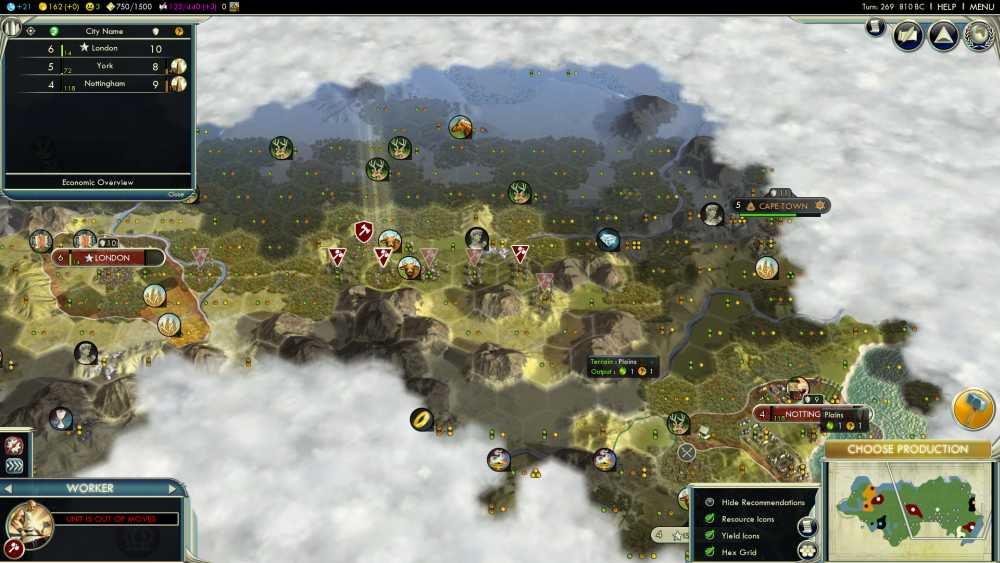
At its heart, Civ 5 is about Cities. Everything else — units, buildings, diplomacy, war, resource gathering and expenditure — arises from that one constant. Once you establish a city, it will produce a variety of resources to be allocated as you direct. It will accumulate citizens, who harvest the land around them for gold, food, production capacity, strategic materials (like horses, so the Cavalry have something to ride), and luxuries (like spices, which tend to make people happier about the prospect of eating rotten onions and old shoes). Cities and citizens also produce culture and science, both of which Firaxis has quantified and made into currencies. As if that weren't enough, cities also slowly generate "Great" people, who have powerful one-time-use abilities, and citizens have a happiness rating, which strongly affects growth.
If that sounds like a lot of different resources, that's because it is — certainly, it gives you more to think about than a traditional gold-and-lumber resource system. But the real complexity comes from the way in which all the resources interact with each other. For example, say you want to get more scientific research out of your city. You can do so by spending a certain number of turns building a Library, which directly increases your research capabilities. However, another option is to build a Workshop, which will make it take less time to build a Library later, as well as other research-enhancing buildings like a Public School or a University, not to mention the dozens of buildings not relating to research. Another option is to strengthen your city's gold production, then use the gold to buy the Library outright. Similar indirect paths exist through virtually every other resource, and there's always the option of hitting your neighbor over the head and making off with his textbooks.
Your nation-building strategy arises out of the interaction between all of these smaller, simpler systems. On that scale, it works, and it's fun. Taken individually, some systems work better than others. Your cities produce Culture, which has two purposes: it makes your territory grow, and it allows you to adopt Social Policies. You can think of the Social Polices like a talent tree for your nation. After accumulating particular amounts of culture points, you spend it to slightly alter how your empire operates. While there are a lot of options to pick from, you actually make choices infrequently, and the policies themselves aren't particularly interesting. They certainly don't have enough of an effect to be discernible by an opponent. Similarly, your scientific research goes into a tech tree, and while there's a certain amount of room to pursue particular technologies before others, the penalty for doing so becomes excessive very quickly. On their own, these systems are not terribly interesting, but being part of a larger system does a lot to minimize their flaws.

Of course, all of these choices depend on having the right information, which in turn requires a UI capable of communicating everything you need to know without getting cluttered. Firaxis did a great job at this. Virtually everything you need is either a mouse-hover or a mouse-click away. Hovering over your resources explains their source and their purpose. Over land, it will show the resources the land offers. By clicking on a city you can see its buildings, choose what it produces, see what it produces and modify how it does so. Manipulating units is dead simple, with mouse-hovers detailing how long it takes them to do something, combat odds relative to an enemy unit, advantages and disadvantages from ranks and terrain, and more. You can zoom in and out on the primary map, and even pull back to a two-dimensional strategic view. A giant glowing button by the minimap is your go-to for making sure units have orders and cities are building something. Every turn, important events pop up as icons on the right side of your screen, and clicking on the icons takes you to wherever you need to look.
Unfortunately, the strength of the UI doesn't carry over to the other aspects of the game that aren't directly related to the gameplay. The menuing system is a bit clunky. Civ 5 is more demanding on hardware than you might expect for a strategy game. Tabbing out is more of a pain than it should be in 2010. And Firaxis, while your introductory cinematic is very pretty, I don't want to see it every time I start the game. Furthermore, I don't want it to take 30 seconds to stop playing after I hit Escape. There are also a few strange setting restrictions. Perhaps there's a good reason not to be able to change video settings in the middle of a game, but I can't think of any. Some of the gameplay settings need to be alterable as well — at least the cosmetic ones. Also, while their implementation of an autosave feature was excellent, manual saving during multiplayer games isn't ideal.

One of most heralded changes from previous Civ games is the switch from square tiles to hexagonal tiles. Having tried it out, I think it's definitely a fun and welcome choice, though its virtues may have been overstated. It gives units a more natural movement, and removes the awkwardness of corners. It also complements another notable change: the inability to stack multiple military units on a single tile. You can no longer pile up enormous armies in the same spot and, when the time is right, flood an enemy nation without a care for placement or attack order. It's definitely a coup for reintroducing tactics to wars between nations. Besieging an enemy city with equivalent forces becomes a delicate puzzle, where each unit needs to be positioned in the right spot to fight the proper opponent or be in range to lob projectiles at them. It also creates situations where troops or terrain can create bottlenecks, which can make a stronger army hesitant to advance on a weaker but well-placed army. Sun-tzu would be pleased. On top of that, cities actually have teeth this time around — they can shoot attackers from a couple tiles away, which adds another element to planning battles.
The other major change is the introduction of City-states. These are essentially miniature empires that never expand. You can have limited diplomatic interactions with them, gaining favor by providing luxury resources or killing somebody for them, or simply by bribing them with gold. Or you can invade their tiny territories and conquer them. I was on the fence about these to start — they take a fair investment of time and resources to befriend or conquer, and they're often in spots to which you would like to expand. But they add another level of complexity to diplomacy, and when you can run an errand for them, they'll supply you with troops and resources, and even interact on other levels, like helping you attack or defend. I think the default settings put too many city-states in the game, but once that number is lowered a bit by modifying settings, they're a lot more fun.

Civ 5's AI is good at some things, and it struggles at others. It does a decent job during battles, maneuvering troops and deciding when to attack in ways that are reasonably close to what a player would do. Diplomacy is hit-and-miss. You'll often have multiple opposing AIs perform the exact same action at the same time. Sometimes it's offers for cooperation or trade agreements. Sometimes it's threats and war. Occasionally it seems like the AI massively overestimates your military capacity, and tries to buy peace from you for much, much more than you would accept. Conversely, proposing a trade is often futile, as they tend to make much higher demands than are reasonable. In a game with several strong opponents, these events can balance out, but other times it will make the game impossible to win or impossible to lose. Oh, and Montezuma's still a jerk.
One of the nice characteristics of the Civilization franchise is that it's easy to see major improvements from one game to the next. Combat tactics, the UI, and diplomatic relations all got a much-needed overhaul, and dozens of little things make for much more streamlined gameplay, allowing you to focus on decision-making without getting bogged down in minutiae. That, combined with their tried-and-true blend of staggered, long-term goals interwoven with short-term objectives makes Civ 5 a great time-waster. I'll bet that most people who play it will fall into the "just one more turn" trap as though the game were hammering away at their dopamine receptors directly.
... I'd love to see somebody get the license from Paramount to release an updated version of Birth of the Federation. It was basically Civ2 for the Star Trek TNG universe. I absolutely loved that game.
I want peace on earth and goodwill toward man.
We are the United States Government! We don't do that sort of thing.
It's a shame they removed the religion aspect of Civ 4. While it was at times clunky and had a confusing implementation (forcing a great deal of irritating micromanagement), the effect religion has had on societies historically has perhaps been greater than any other factor. Even today religious extremism plays a huge role in politics and world affairs. I was hoping they'd refine the mechanism to make it more sensible and enjoyable, but it seems they were scared of being politically incorrect and avoided controversy by removing it altogether.
its bad, real bad. Turns take too long to process, which is really bad when many people don't have anything to do but click next turn but one or two do have something. It can take minutes after everyone has clicked. Don't crash while in MP, sometimes its easy to get back in other times... Multi player also has animations hard coded to be off.
As for the intro movie, pressing ENTER skips it, once it bothers to read the keyboard. Otherwise edit the user config file found under documents section of Windows. There are some other settings in the ini files that cannot be adjusted anywhere else, as in, not even the game UI provides access.
I have it up and running on my iMac through boot camp, while I can start off max resolution and features it does chug as you fill in the map. Apparently they animate what is off screen too!
Outside of the multi player my real hangup is the mini map, looks like MS Paint was used. Many of us thought it was obvious place holder, but alas it is still here! Minor nits include not being able to adjust any video settings while playing the game. It takes like four clicks to start a game, as in just to get to the CIV game itself. Seems Steam wants to step in the way every chance it can, even offline. Some nation specials are pretty whack, if played right you can just roll over anything. City States while nice are a great source of workers early on, usually safe to steal one per, the squash which ever City State has an annoying personality. Best hint, leave space for barbarians near them so you get free rep for occasionally bopping the barbarians.
You do not need Steam to play the game nor do you need the DVD. You do need Steam to install it. I don't even let it start anymore, I do not need "buy this game spam" every time I exit to the desktop. I do not need the cheesy achievements and my play uploaded. Which btw, if you load a mod your ineligible for achievements, so don't even go for that clock mod.
Most common issues, can't install the game past Steam, can't run in DX9 more or maybe not in DX11 mode (its much better in DX9), various animation or graphics artifacts, CTDs, and other typical from new releases. The manual is electronic only.
* Winners compare their achievements to their goals, losers compare theirs to that of others.
It can, but you'll be best served playing with people you know. Civilization IV LANs provided some of my most memorable gaming moments (not the most memorable, but a few that rank fairly high)
If you know anyone else that plays it, you should definitely get into it with them. Multiplayer Civ + friends = unforgettable weekend.
Living With a Nerd
Taking a screenshot, scaling it down, saving it as a JPEG and then converting the result to PNG results in terrible image quality. Please don't think this reflects the actual visuals of the game.
-molo
Aside from bandwidth, a low resolution image from a game used in a review can protect you if the company that made the game doesn't like your review and tries to hit you with a DMCA violation for using their copyrighted images. Whenever you submit non-free content to Wikimedia Commons, there are many guidelines designed to keep you and wikimedia inside fair use and safe harbor suggested boundaries.
For example, when I uploaded a fair use clip of Life on Mars by David Bowie, I had to set the sound quality at the absolute lowest possible value and add this rationale to the very long list of requirements to turn a snippet of a copyrighted song into non-free fair use:
It is of a lower quality than the original recording.
I believe that a low res distorted image may protect you from being a target by a game publisher if you wish to reserve your right to pan a game, give it a score zero and still present screen shots to add in your criticism. While it's a good idea to mention these are not game quality resolution screen shots, there may be another purpose to their degradation. The 'this is kinda what it looks like' is exactly what protects you from someone claiming ownership of that imagery accusing you of unlicensed distribution of that imagery.
Just a thought from the world of jacked up copyright insanity. I submitted a story a short while ago that demonstrated how out of hand this exact topic can get.
My work here is dung.
I was under the impression that the conversion from JPEG to PNG would maintain the same image quality as the original JPEG. PNG is lossless, isn't it?
The PNG probably has a larger filesize though.
So work around it. Buy it, but install the cracked version and play to your hearts content. It's a bit of a catch-22, though. Still supporting the company that DRM's things using a third party, but getting to play an awesome game... Good luck figuring that out.
ASCII tastes bad dude.
Binary it is then.
While I love the new combat system, the AI is simply incapable of playing it well. It would seem that even in this day and age, the idea of forming a front-line to protect your ranged units is something a computer can't grasp. I don't think we'll need to worry about Skynet anytime soon.
Turn-based strategy is an underrepresented genre of video games. Perhaps it's because they aren't as flashy, or aren't as embedded in the public consciousness as the more popular types of games. Or maybe because it's so damn hard to build them right.
I was so set to love freeciv when I heard about it, then I found out the hard way that it wasn't turn based. People attacked me on _my_ turns. WTF? Apparently the concept of turn-based games was too hard for freeciv devs.
On;y 4-5 hours?
How long does a full game take? I remember getting hooked into Civ2 for ridiculous amounts of time. I can't rmemeber how much precisely, but the figure of 18 hours springs to mind.
I seriously hope to god you're not grading papers at an educational institution. If grades were based on all past and all future possibilities, no one would ever get an A, let alone an A+.
Fact is, your understanding of the meaning of a grading scale is impossible to implement and not very useful to boot. Grades are subjective... when you're comparing to an infinite space (ie, all future games), you're attenuating your scale and making the edge number meaningless. Like the opposite of "turning it up to 11", you never even dial it to 10, why have it?
Make sure everyone's vote counts: Verified Voting
You know, after Starcraft II I actually forgot that most games didn't release on the Mac until months later. I've noticed that the third suggestion on Google for "civ 5" is "civ 5 mac", beating out even "civ 5 torrent". Just sayin'.
I have seen the future, and it is inconvenient.
WTF??? ... thats ... all ....crap. All that stuff you just said. That shit makes ZERO sense.
Rituals from Social Studies? Religion from English class? I dont know if you realize this (apparently not), but you were most likely raised in a cult and schooled by its members, cause I dont think the vast majority of us recieved that brand of education.
Now quit yer bitchin and go prepare for the purification, the time is at hand.
I'm in the same boat. Sure, I can purchase the game, connect to the internet, and register it, then never connect again. However, I still have to deal with the bloat that Steam adds (which may be small, but is still bloat). Also, there is the issue of reinstalls and resales. I still play the original 1993 Colonization for a few weeks each year. Steam adds another level of complexity to the whole issue. I also refuse to "license" a game unless it's an MMO. This is a single-player game with a multi-player component. Therefore, I refuse to purchase this game (or license it, however you choose to label it).
Something changed with Civ IV that drastically increased technology progression. It was a fairly jarring experience when, after I had just upgraded all my city defenders to pikemen, it was already time to hand out the muskets. With Civ II and III, you could spend a few day's worth of play time in each major period of the game.
In fact I remember a patch being released for Civ IV that enabled an "extra long" game mode, which slowed technology development, and it was still far too fast compared to the previous games. I guess these faster games are more conducive to multiplay, but they killed off the epic month-long empire building slog of the previous games.
It's unoriginal, unpolished, and unfinished. Next question?
There was never a need for naval transport units. Even from ancient times, troops moved using boats they made themselves, even constructing a bridge across the sea when they had to.
What I WOULD like to see is army units that can do certain types of terrain modification. It would be nice to be able to, say, burn down a forest that has enemy units in it, or build roads or fortresses (Roman Legions could do this in Civ 3), or even build cities when fortified in one area for a long enough time period. One thing that always bothered me about sending out units to he far corners of the globe in the ancient era was that they could sit in a given square for THOUSANDS of years, and never build a city. What are these guys, immortals? They have to get married and have kids at some point, and there is no way for them to do that when they are isolated from your territory by a hostile enemy. There are plenty of instances where cities formed around military encampments. That's how half the West was settled.