 Slashdot Mirror
Review: Civilization V
- Title: Civilization V
- Developer: Firaxis Games
- Publisher: 2K Games
- System: Windows
- Reviewer: Soulskill
- Score: 8/10

If you're new to the Civ series (or even if you just haven't played one in a while), be prepared for a serious information dump. Civ 5 tries to start you out small and easy, but such things are relative for games this complex. Even setting up a game can seem daunting, though default options and settings go a long way toward making sure your first game is a good one. There's also a tutorial that will walk you through basic situations, AI advisers that explain things and suggest goals, and even a search-able "Civilopedia" with detailed descriptions of abilities, characteristics, and historical significance.
But even with those resources, Civ 5 demands that you spend some time learning about the game before you can really enjoy it. You can get by on the AI recommendations for what you should build, but after a while it feels like you're just facilitating a game of bots vs bots. Once you get past the learning curve, a wealth of options open up before you. Understanding the "how" takes a little time, but lets you start working on "how best," which is a much broader and more difficult question, and the one from which arises the game's extreme depth. Explaining the decision-making process is almost as difficult as the process itself. What Firaxis did really well was make certain that your long-term goals are affected in some way by all of your short-term choices — your task is to solve the equivalent of the Fermi equation for getting the most out of your resources while not neglecting relations with the other empires.
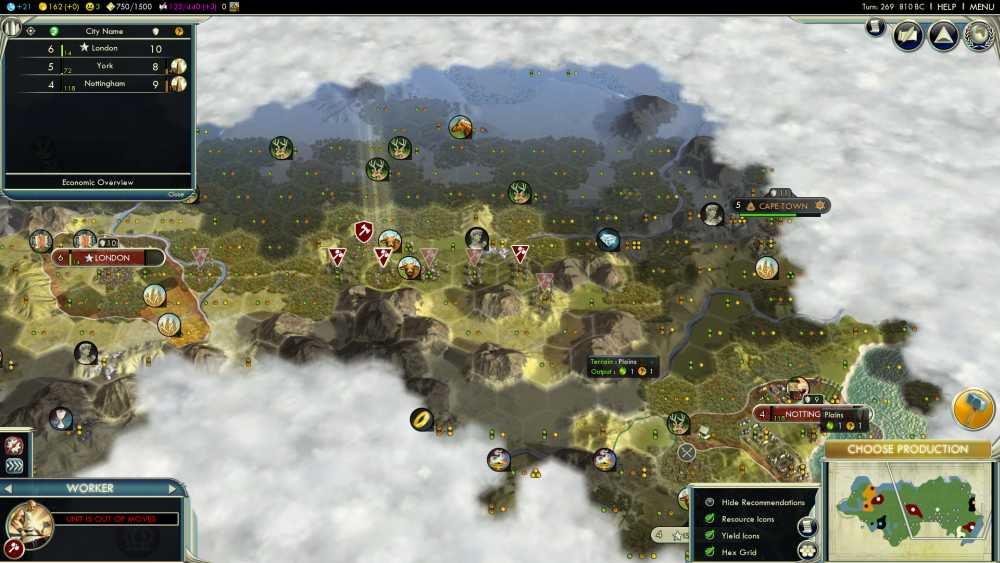
At its heart, Civ 5 is about Cities. Everything else — units, buildings, diplomacy, war, resource gathering and expenditure — arises from that one constant. Once you establish a city, it will produce a variety of resources to be allocated as you direct. It will accumulate citizens, who harvest the land around them for gold, food, production capacity, strategic materials (like horses, so the Cavalry have something to ride), and luxuries (like spices, which tend to make people happier about the prospect of eating rotten onions and old shoes). Cities and citizens also produce culture and science, both of which Firaxis has quantified and made into currencies. As if that weren't enough, cities also slowly generate "Great" people, who have powerful one-time-use abilities, and citizens have a happiness rating, which strongly affects growth.
If that sounds like a lot of different resources, that's because it is — certainly, it gives you more to think about than a traditional gold-and-lumber resource system. But the real complexity comes from the way in which all the resources interact with each other. For example, say you want to get more scientific research out of your city. You can do so by spending a certain number of turns building a Library, which directly increases your research capabilities. However, another option is to build a Workshop, which will make it take less time to build a Library later, as well as other research-enhancing buildings like a Public School or a University, not to mention the dozens of buildings not relating to research. Another option is to strengthen your city's gold production, then use the gold to buy the Library outright. Similar indirect paths exist through virtually every other resource, and there's always the option of hitting your neighbor over the head and making off with his textbooks.
Your nation-building strategy arises out of the interaction between all of these smaller, simpler systems. On that scale, it works, and it's fun. Taken individually, some systems work better than others. Your cities produce Culture, which has two purposes: it makes your territory grow, and it allows you to adopt Social Policies. You can think of the Social Polices like a talent tree for your nation. After accumulating particular amounts of culture points, you spend it to slightly alter how your empire operates. While there are a lot of options to pick from, you actually make choices infrequently, and the policies themselves aren't particularly interesting. They certainly don't have enough of an effect to be discernible by an opponent. Similarly, your scientific research goes into a tech tree, and while there's a certain amount of room to pursue particular technologies before others, the penalty for doing so becomes excessive very quickly. On their own, these systems are not terribly interesting, but being part of a larger system does a lot to minimize their flaws.

Of course, all of these choices depend on having the right information, which in turn requires a UI capable of communicating everything you need to know without getting cluttered. Firaxis did a great job at this. Virtually everything you need is either a mouse-hover or a mouse-click away. Hovering over your resources explains their source and their purpose. Over land, it will show the resources the land offers. By clicking on a city you can see its buildings, choose what it produces, see what it produces and modify how it does so. Manipulating units is dead simple, with mouse-hovers detailing how long it takes them to do something, combat odds relative to an enemy unit, advantages and disadvantages from ranks and terrain, and more. You can zoom in and out on the primary map, and even pull back to a two-dimensional strategic view. A giant glowing button by the minimap is your go-to for making sure units have orders and cities are building something. Every turn, important events pop up as icons on the right side of your screen, and clicking on the icons takes you to wherever you need to look.
Unfortunately, the strength of the UI doesn't carry over to the other aspects of the game that aren't directly related to the gameplay. The menuing system is a bit clunky. Civ 5 is more demanding on hardware than you might expect for a strategy game. Tabbing out is more of a pain than it should be in 2010. And Firaxis, while your introductory cinematic is very pretty, I don't want to see it every time I start the game. Furthermore, I don't want it to take 30 seconds to stop playing after I hit Escape. There are also a few strange setting restrictions. Perhaps there's a good reason not to be able to change video settings in the middle of a game, but I can't think of any. Some of the gameplay settings need to be alterable as well — at least the cosmetic ones. Also, while their implementation of an autosave feature was excellent, manual saving during multiplayer games isn't ideal.

One of most heralded changes from previous Civ games is the switch from square tiles to hexagonal tiles. Having tried it out, I think it's definitely a fun and welcome choice, though its virtues may have been overstated. It gives units a more natural movement, and removes the awkwardness of corners. It also complements another notable change: the inability to stack multiple military units on a single tile. You can no longer pile up enormous armies in the same spot and, when the time is right, flood an enemy nation without a care for placement or attack order. It's definitely a coup for reintroducing tactics to wars between nations. Besieging an enemy city with equivalent forces becomes a delicate puzzle, where each unit needs to be positioned in the right spot to fight the proper opponent or be in range to lob projectiles at them. It also creates situations where troops or terrain can create bottlenecks, which can make a stronger army hesitant to advance on a weaker but well-placed army. Sun-tzu would be pleased. On top of that, cities actually have teeth this time around — they can shoot attackers from a couple tiles away, which adds another element to planning battles.
The other major change is the introduction of City-states. These are essentially miniature empires that never expand. You can have limited diplomatic interactions with them, gaining favor by providing luxury resources or killing somebody for them, or simply by bribing them with gold. Or you can invade their tiny territories and conquer them. I was on the fence about these to start — they take a fair investment of time and resources to befriend or conquer, and they're often in spots to which you would like to expand. But they add another level of complexity to diplomacy, and when you can run an errand for them, they'll supply you with troops and resources, and even interact on other levels, like helping you attack or defend. I think the default settings put too many city-states in the game, but once that number is lowered a bit by modifying settings, they're a lot more fun.

Civ 5's AI is good at some things, and it struggles at others. It does a decent job during battles, maneuvering troops and deciding when to attack in ways that are reasonably close to what a player would do. Diplomacy is hit-and-miss. You'll often have multiple opposing AIs perform the exact same action at the same time. Sometimes it's offers for cooperation or trade agreements. Sometimes it's threats and war. Occasionally it seems like the AI massively overestimates your military capacity, and tries to buy peace from you for much, much more than you would accept. Conversely, proposing a trade is often futile, as they tend to make much higher demands than are reasonable. In a game with several strong opponents, these events can balance out, but other times it will make the game impossible to win or impossible to lose. Oh, and Montezuma's still a jerk.
One of the nice characteristics of the Civilization franchise is that it's easy to see major improvements from one game to the next. Combat tactics, the UI, and diplomatic relations all got a much-needed overhaul, and dozens of little things make for much more streamlined gameplay, allowing you to focus on decision-making without getting bogged down in minutiae. That, combined with their tried-and-true blend of staggered, long-term goals interwoven with short-term objectives makes Civ 5 a great time-waster. I'll bet that most people who play it will fall into the "just one more turn" trap as though the game were hammering away at their dopamine receptors directly.
It's a shame they removed the religion aspect of Civ 4. While it was at times clunky and had a confusing implementation (forcing a great deal of irritating micromanagement), the effect religion has had on societies historically has perhaps been greater than any other factor. Even today religious extremism plays a huge role in politics and world affairs. I was hoping they'd refine the mechanism to make it more sensible and enjoyable, but it seems they were scared of being politically incorrect and avoided controversy by removing it altogether.
I hope you made the right choice and you're playing an Englishman.
Perhaps since he isn't getting paid to write the review and likely has neither infinite time nor money like most customers he's probably capable of discerning what is crap before he spends his time and money on it and therefore doesn't? If he was a gaming magazine that was responsible for reviewing ALL games then your parroting the ancient concerns over the media's game reviews would be on target, but since he's only responsible for reviewing the games he wants to play AND review anyways, it's no surprise the games usually register in the upper end of his scale.
That would be true if he reviewed every game that comes out.
It appears he only reviews games that he thinks will be good, so the reviews will tend towards the higher end of the scale.
"If you make people think they're thinking, they'll love you; But if you really make them think, they'll hate you." - DM
I think it's been a while since I read so much rubbish modded informative.
PNG can be lossless, if you choose 0 for compression level - then the image is basically a bitmap when it comes to file-size (except png inherently supports Alpha-channel transparency).
Err... no. PNG is always lossless. PNG is also always zlib-compressed, so is almost always smaller than the equivalent .BMP file. I've also never seen an implementation of PNG that supports numeric setting of compression level: the choices are normally between different strategies, although most modern implementations simply autodetect the best strategy for each line of the image.
Similiar to Video - every time you change format you will almost-always introduce artifacts.
Depends on the format of course; there are few lossless video formats out there, but there are some (HuffYUV being the most common, but there are others)
Also, JPG image quality can be greatly improved by choosing the option to disable color subsampling.
This depends heavily on the image. Chroma subsampling is very useful in many situations, but it cannot represent very small areas of colour in a reasonable way. It does reduce the amount of data that needs to be compressed by half (6 values per 2x2 block rather than 12) and results in images that usually are indistinguishable from the source without enlargement, which really means that you can use a higher quality level for the rest of the process, which in many cases results in a better overall image quality. If you're targetting very high quality and don't much care about file size, then disabling it is an obvious win, otherwise you may want to try both ways.
JPG's tend to be smaller than PNG when you start with a BMP, but not always -- depends on the content of the image.
Yes, some images compress particularly well with PNG (e.g. line art, uniform fills, smooth gradient fills) but not very well at all with JPG. JPG is suitable only for photographic or similar images.
BMP->JPG: Smallish File size.
BMP->PNG: Smallish File size, may be smaller than previous JPG.
YET...Take that JPG and save as a level 6 compression PNG and it will be bigger than it's parent JPG and bigger than the BMP->PNG.
Yes, because JPG is lossy and PNG isn't. JPG compression artifacts are very hard for PNG to encode as they appear essentially as random noise to PNG's compressor. Therefore smooth BMP -> noisy JPG -> PNG will result in a larger file than direct BMP->PNG conversion. This is pretty much guaranteed to happen in any case where the resulting PNG is smaller than the JPG. There's probably an information-theoretic way to explain this, but off the top of my head I can't think of it.