 Slashdot Mirror
A Custom Objectionable Word List Ate My Homework
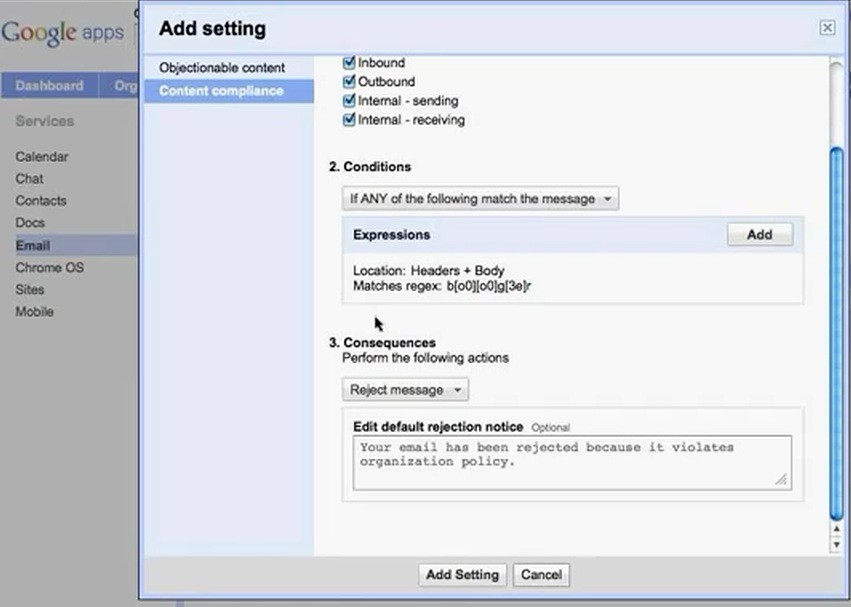
theodp writes "Among the first three schools using Chromebooks for Education is the Merton Community School District, which decided to go Chromebook after the Wisconsin Dept. of Public Instruction (WDPI) issued a news release (created using PDFMaker for Word) announcing that all Wisconsin schools can have access to Google Apps for Education by simply downloading a Google Consent Form (Microsoft Word format, oddly) from the WDPI website, completing & signing it, and submitting it to Google. And to help get the schools going, a separate Wisconsin Google Apps for Education website aims to jumpstart things with weekly webinars, the first of which — Getting started with the Google Apps for Education Control Panel — shows school officials how they can sandbox 'Naughty Students' and filter objectionable content. While Google illustrates how a list of 'custom objectionable words' can be used to flag and/or block students' e-mail with some cute examples — different spellings of 'booger' and a regex to block variants like 'b00g3r' — things get considerably nastier in the real world, as this NSFW custom objectionable word list used by the North Canton City Schools shows."


Can someone cut the extraneous crap and useless hyperlinks of this story and also re-edit so this is actually readable? I have no idea what the story is here.
Any high school student who uses these words in a piece of schoolwork is either committed a mistake
Oh yeah? How about an essay that contains something like this:
Although it is less relevant in the modern world, the Bible does contain a prohibition on beastiality (sic, the list doesn't spell this word correctly), which indicates that such practices were known among ancient near-east cultures...
Yeah, it is really a stretch to think that a student would use one of the words on the list in their schoolwork. Many of the words on that list could easily be used in an academic context even at the high school level. A student might be talking about dog breeding and use the word "bitch" appropriately, or might write a report about the history of the gay rights movement which contains various slang words.
The actions the school takes matter. But the list itself, as a trigger for action, seems pretty sensible.
It is sensible if your goal is to condition students to believe that censorship is normal and that if you are going to discuss certain topics it must be under the supervision of an authority figure. What do you think reaches students at a deeper level: a class about the US government which happens to cover the bill of rights, or a censorship system that the students must submit to every day? How much respect for freedom of speech do you think these students will have, after spending years dealing with this sort of censorship?
On the one hand, we criticize the Chinese for doing these sorts of things, we criticize Cisco for providing the necessary equipment, and we encourage people to run proxies and Tor exits. On the other hand, we engage in exactly the same behavior when it comes to our schools and students, we use the same equipment, the same sort of policies, and we discourage students from circumventing the censorship apparatus. What are teachers supposed to say when they teach about current events?
Palm trees and 8
you would be amazed at what was on the original lists
I am amazed at what remained on your list. What were you thinking? Not only did you block large numbers of works used in a typical biology textbook, you even managed to block words that would be relevant to bible discussions.
However as a school providing email to children, the consensus of our community to to provide some level of filtering.
So you are training your children to accept censorship and to run to authority figures whenever they need to discuss certain topics? If your school district were in a country like China or Myanmar, this policy might make sense.
Palm trees and 8
If that's what you're worried about, then you would be far better off having some method by which students can report e-mails that they receive as being threatening or harassing.
Your current system is, in itself, threatening and/or harassing, without providing any benefit at all. The bullies will quickly figure out which words are on your concern list, and stop using those words - while the students who are merely talking to each other about personal issues will have their conversations snooped on by the school administration.
I mean, who do you really think is going to be caught by this concern filter? Albert, a perfectly normal gay student who is just sending his best friend an e-mail about being afraid of telling his parents that he's gay, or Billy the bully, whose goal is to not come to the attention of the school administration, and thus probably has some sort of knowledge about the concern filter and will use words like "ghey" or "ponce" or some school slang you've never even heard in his email?
And that doesn't even consider the fact that there's a plethora of free e-mail providers out there! After a couple of run-ins with the law, Billy the bully's not even going to be sending his evil e-mails from his school account; he'll be logged in to a free Hotmail or Gmail account he set up at the local library. Sure, your system might report these incoming concerning e-mails, but what are you going to do about it? They're pretty much untraceable without a court order.
Basically, your school is wasting their time and money for what amounts to a false sense of security.