 Slashdot Mirror
Amazon Patents Annotating Books, Digital Works
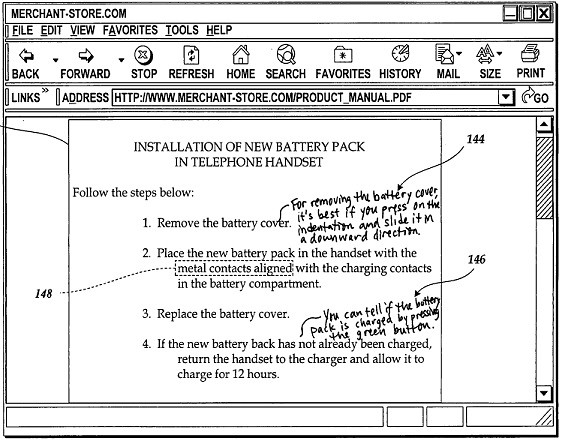
theodp writes "On Tuesday, the USPTO granted Amazon a patent on its Method and System for Providing Annotations of a Digital Work, which covers 'receiving an annotation of the digital work, storing the annotation, and providing the annotation to a user.' This includes annotations received in a graphical or handwriting format, as well as highlighting of text."
I think I smell at least one example of prior art.
Doesn't matter. We're a first-to-file country now, and there's no such thing as "obvious".
<xml><I><am><so><damn>Web 2.0</damn></so></am></I></xml>
With the recent change to U.S. patent law (i.e. first to file now, vs. first to invent previously), is there still such a concept as prior art? If "first to file" rules, then doesn't that mean that one could patent an invention which had been around for decades, in common use, but for which nobody ever thought to file a patent?
The obviousness standard in place should be replaced with this:
Press Release: USPO announces that Amazon has filed for a patent on annotating digital books. This patent will be considered obvious if somebody else can provide a working model of this within the next two months.
By definition, your proposed standard relies on hindsight, since you're showing something is obvious only after looking at it. Any engineer these days can sketch out a simple internal combustion engine on the back of a napkin. Does that mean that in the 1800s, internal combustion engines were obvious? No. Hindsight has no place in patents.