Slashdot Mirror


Amazon Patents Annotating Books, Digital Works

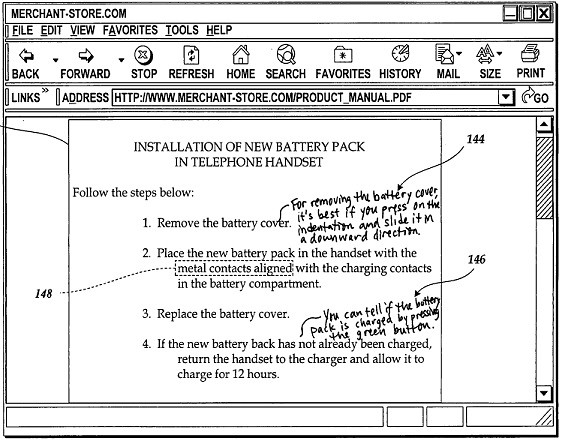
theodp writes "On Tuesday, the USPTO granted Amazon a patent on its Method and System for Providing Annotations of a Digital Work, which covers 'receiving an annotation of the digital work, storing the annotation, and providing the annotation to a user.' This includes annotations received in a graphical or handwriting format, as well as highlighting of text." I think I smell at least one example of prior art.
31 of 125 comments (clear)

  1. Okular Is Not the Best Example by eldavojohn · · Score: 4, Informative

    I think I smell at least one example of prior art.

    Ughhhh, Unknown Lamer, you're making defend an Amazon patent. The earliest timestamp I can find for Okular is August 27th, 2006 while the patent in question was filed a year and a half earlier on January 19th, 2005. I'm not saying that there is no prior art, I'm just saying I couldn't find any hard evidence of Okular being conceived prior to Amazon's patent. Now I have to go take a shower ...

    --
    My work here is dung.
    1. Re:Okular Is Not the Best Example by GameboyRMH · · Score: 4, Informative

      Yeah I would have mentioned the annotation features in Word, Excel and Adobe Reader.

      --
      "When information is power, privacy is freedom" - Jah-Wren Ryel
    2. Re:Okular Is Not the Best Example by elrous0 · · Score: 3, Interesting

      Hell even the Newton could even do that, just not very well.

      --
      SJW: Someone who has run out of real oppression, and has to fake it.
    3. Re:Okular Is Not the Best Example by 19thNervousBreakdown · · Score: 2, Insightful

      Doesn't matter. We're a first-to-file country now, and there's no such thing as "obvious".

      --
      <xml><I><am><so><damn>Web 2.0</damn></so></am></I></xml>
    4. Re:Okular Is Not the Best Example by Theaetetus · · Score: 2

      Hell even the Newton could even do that, just not very well.

      From the first claim:

      --receiving multiple annotations from different authors for particular content in a digital work; --storing the annotations in association with the digital work; --providing a list of abbreviated versions of the annotations to a user desiring to access one or more of the annotations, wherein the list presents the annotations in an order determined by reference to a criterion; --receiving an authorization credential from a user desiring to access one or more of the annotations; and if the authorization credential is valid, --providing a full version of one or more of the annotations of the digital work to the user in context with regard to the digital work

      I had a Newton, and I don't remember it doing any of those.

    5. Re:Okular Is Not the Best Example by forkfail · · Score: 3, Funny

      Obviously.

      --
      Check your premises.
    6. Re:Okular Is Not the Best Example by arth1 · · Score: 3, Informative

      Barnes & Noble should be able to squash this one.
      Their Reader, formerly Fictionwise ereader, formerly Palm Reader, formerly PeanutPress has annotation with highlighting (on both DRM'ed and non-DRM'ed content).

      I used it to annotate stuff back in the late 90s, and I still use it.

    7. Re:Okular Is Not the Best Example by Epimer · · Score: 2

      The change from first to invent to first to file doesn't have anything to do with the consideration of prior art.

    8. Re:Okular Is Not the Best Example by Raenex · · Score: 2

      +3 Insightful for that? First-to-file has nothing to do with whether a patent is obvious or if there is prior art. Either one can still shoot down a patent. The problem is the patent office isn't very good at doing this, regardless of first-to-file or first-to-invent.

  2. Bogus summary by dtmos · · Score: 5, Informative

    . . . which covers 'receiving an annotation of the digital work, storing the annotation, and providing the annotation to a user.'

    No, it does not. It covers A PARTICULAR METHOD of 'receiving an annotation of the digital work, storing the annotation, and providing the annotation to a user.' Specifically,

    A computer-implemented method for providing an annotation of a digital work, comprising:
    --under control of instructions that are executed by one or more computing devices:
              --receiving multiple annotations from different authors for particular content in a digital work;
              --storing the annotations in association with the digital work;
              --providing a list of abbreviated versions of the annotations to a user desiring to access one or more of the annotations, wherein the list presents the annotations in an order determined by reference to a criterion;
              --receiving an authorization credential from a user desiring to access one or more of the annotations; and if the authorization credential is valid,
              --providing a full version of one or more of the annotations of the digital work to the user in context with regard to the digital work.

    The patent covers a method that includes all five of the listed elements (receiving, storing, providing, etc.). Your favorite method must include all five of these elements, and be published before the filing date (19 January 2005) to be classified as disqualifying prior art. Not include one (or more) of these elements? Then it's not disqualifying prior art. (I'm speaking in generalities here, and ignoring other independent claims, apparatus claims, and lots of special cases. See your attorney if it matters to you.)

    The Okular annotation method, while no doubt earlier and better in every way, seems not to include many of these elements, and so would not be disqualifying prior art.

    Can we become better educated on patents -- maybe just a little -- so that we can not panic every time somebody patents something? By that I mean, can we start quoting Claim 1 in the summary, instead of the abstract?

    I note in passing that the Patent Examiner reviewed (approximately; I counted by hand) 184 US patents and patent applications, 6 foreign patent documents, and 80 other references, looking for art, and that the examination process took more than seven years to complete. Whatever else one may say about this patent, it wasn't rubber-stamped.

    1. Re:Bogus summary by jabuzz · · Score: 4, Informative

      Sure but it should have failed the "obvious to someone skilled in the art" test.

    2. Re:Bogus summary by betterunixthanunix · · Score: 3, Informative

      Can we become better educated on patents -- maybe just a little

      OK, let's start here:

      http://www.uspto.gov/web/offices/pac/mpep/documents/2100_2106_02.htm

      Then here:

      https://en.wikipedia.org/wiki/In_re_Bilski

      Then here:

      https://en.wikipedia.org/wiki/Church-turing_thesis

      Then, if we are all still paying attention, we can ask how any software patent is valid.

      --
      Palm trees and 8
    3. Re:Bogus summary by pruss · · Score: 3, Interesting

      Something I've wondered about, as a non-lawyer, is how exactly the obviousness test works. Some solutions are obvious once you formulate the problem with sufficient specificity. Here the problem is something like: "How to make dynamic annotations by multiple authors, with different preferences about the distribution range for their annotations, usefully available to the user of an electronic work?" Given this formulation of the problem, the solution in this patent is pretty obvious.

      But the problem itself isn't obvious. And there is an art to formulating a problem in such a way as makes a solution obvious. One could, after all, formulate the problem in a way that doesn't make this solution obvious: "How to do something really useful with an electronic work?" or even more specifically: "How to make an annotation system more sophisticated?"

      And I know that when I implemented initial annotation support in the Plucker e-text reader for PalmOS in March, 2004, nothing as sophisticated as this patent occurred to me.

      So, is the obviousness test a test of the obviousness of a solution or of the problem or both?

    4. Re:Bogus summary by fuzzyfuzzyfungus · · Score: 3, Informative

      It strikes me that the available prior art might hinge on whether you think that the distinction between the 'annotations' and the 'work' is terribly relevant(from the perspective of the patent, obviously the distinction between text and margin notes is relevant to the user).

      If it is relevant, the only real possibilities are the document markup features in some of the PDF/publishing related stuff, or Office and similar.

      If the distinction isn't materially relevant, practically any revision control system going back to the dark ages provides a superset of the features described:

      Support for multiple users and multiple devices, with authentication and permissions? Check.

      Stores 'annotations' in association with the digital work? Storing revision information in relation to the digital work being revised is only the entire point of revision control systems...(the revision control use case assumes that most changes checked in will be changes rather than comments; but, architecturally, comments and annotations are a proper subset of the sorts of revisions one can check in, and programmers certainly do check in code comments as well as changes to the 'work'

      Provides abbreviated versions? Any of the 'friendly-display' mechanisms for a revision controlled repository will provide for some sort of 'here be diff by user Foo. click to expand?' function.

      Access control? Yup, revision control systems do that as well, some only to file level of granularity, some more.

      Provide full version of one or more annotations? Check out SVN checkout...

      For my information(since I'm honestly not too much up on patents), does the expected use case of a tool count as a suitably weighty factor in determining validity? In this case, it is certainly fair to say that the expected use cases of Amazon's "digital margin notes" patent places it firmly in the same camp as other text annotation systems from Adobe, MS, and some more specialty vendors. Architecturally, though, the 'invention' is essentially 'partial re-implementation of a revision control system under the assumption that the base file(s) will always be treated as canonical, and the diffs as merely incidental'. Their implementation is likely to be a better fit than a straight revision control mechanism if you are, in fact, highlighting your way around an etext; but the underlying architecture will be equivalent to, or a mere subset of, revision control...

    5. Re:Bogus summary by Theaetetus · · Score: 4, Interesting

      Sure but it should have failed the "obvious to someone skilled in the art" test.

      That's not the test, that's the conclusion. The test - whether something is obvious - is whether one or more prior art documents, publications, or products, alone or in combination, teach or suggest each and every element of the claimed invention. So, for example, if the claim recites "A+B+C+D" and you have one piece of prior art that teaches A+B, another that teaches C, and another that teaches D, then in combination, they teach everything in the claim, so the claim is obvious. If, on the other hand, no piece of prior art teaches D, then the claim is not obvious.

      This is necessary because it creates an objective test, limited to what was known to those of skill in the art at the time the patent application was filed, which is required for due process. A purely subjective test of an Examiner saying, "without any evidence, I have a gut feeling this is obvious" would be almost certainly be improperly based on hindsight.

    6. Re:Bogus summary by forkfail · · Score: 2

      The problem, as I see it is that if A+B+C exists, you are still allowed to patent A+B+C', where C' is an extremely small incremental advancement over C.

      Pretty much everything we do is built on the shoulders of previous works at this point. And some ideas are definitely innovative and novel. The problem is actually qualifying what the difference between C and C' needs to be for it to be a non-obvious solution and non-trivial advancement.

      --
      Check your premises.
    7. Re:Bogus summary by Theaetetus · · Score: 2

      Yeah, its like adding the words "on the internet" to something people have done for decades makes something a new invention.

      No - go back and read my earlier comment. If [something people have done for decades] is known and [the internet] is known, then the combination of [something people have done for decades] + [on the internet] is, by definition, obvious. And no patent has ever been granted on such a claim. People may describe a patent as "X, but on the internet," but you have to go to the claims, not the title, the abstract, the summary, or a Slashdot article about it. Only the claims have any legal weight.

    8. Re:Bogus summary by Theaetetus · · Score: 3, Insightful

      The obviousness standard in place should be replaced with this:

      Press Release: USPO announces that Amazon has filed for a patent on annotating digital books. This patent will be considered obvious if somebody else can provide a working model of this within the next two months.

      By definition, your proposed standard relies on hindsight, since you're showing something is obvious only after looking at it. Any engineer these days can sketch out a simple internal combustion engine on the back of a napkin. Does that mean that in the 1800s, internal combustion engines were obvious? No. Hindsight has no place in patents.

    9. Re:Bogus summary by Epimer · · Score: 3, Informative

      I have to start with a disclaimer: it depends from jurisdiction to jurisdiction, and I'm much more familiar with European and UK standards of obviousness.

      The brief answer is that there has been precedent to suggest that identifying a technical problem to solved can itself be inventive. Put very broadly, something like "I want to make product X be better" isn't an objective technical problem to be solved, it's a desired outcome. But identifying a way in which to make product X better, followed by a means to implement it, may be non-obvious. The larger contribution in that case might well have been the identification of the problem, but that itself could have been inventive ("inventive" and "non-obvious" are used more or less interchangeably).

      My favourite example is the Anywayup Cup (Google it - also a great example of how patents can be enormously beneficial to the little guy). Anyone who's had a child (I'm told!) knows that kids spilling juice is a problem. The Anywayup Cup is a sippy-cup which, essentially, has a valve flush with the sipping portion. If you framed that problem as "I want a way to stop liquid from leaking out of the apperture in a sippy-cup" then that's an obvious solution. But that wasn't the objective technical problem to be solved; the problem to be solved was "I want a way to stop kids making a mess when drinking juice", and identifying the technical means to do so was the lion's part of the inventive step there.

      (there was more to this particular case than that - for example, there's the "long-felt want" argument here, because kids making an unholy mess with juice isn't exactly a new problem, so why hadn't a solution been presented before? This is not enough to demonstrate inventiveness, but it may contribute depending on the circumstances.)

      Both the UK and the European Patent Offices have pseudo-objective tests for assessing obviousness - the Pozzoli/Windsurfing test and the Problem and Solution approach, respectively. Common to both is ensuring that the problem to be solved is identified, the relevant skilled person is identified, and - arguably most importantly of all - the avoidance of hindsight. Nearly everything's obvious in hindsight.

    10. Re:Bogus summary by Fishbulb · · Score: 2

      Go watch Connections (the original 10 episode series) with James Burke. Free on YouTube:

      Connections Ep01: The Trigger Effect

  3. Digital Handwriting? by nurb432 · · Score: 3, Informative

    My newton did this decades ago.

    If you want a more current example of handwritten annotation on existing PDF documents, look at the now defunct 'entourage' tablet products.

    --
    ---- Booth was a patriot ----
    1. Re:Digital Handwriting? by flyingfsck · · Score: 2

      Xournal is probably the best one for annotating PDF files.

      --
      Excuse me, but please get off my Pennisetum Clandestinum, eh!
    2. Re:Digital Handwriting? by geekoid · · Score: 2

      No it did not.
      Unless there was some centralized global distribution system for annotation on a newton that I was unaware of.

      --
      The Kruger Dunning explains most post on /. http://en.wikipedia.org/wiki/Dunning%E2%80%93Kruger_effect
  4. This Patent is About Receiving and Serving by eldavojohn · · Score: 4, Informative

    Yeah I would have mentioned the annotation features in Word, Excel and Adobe Reader.

    Hmmm, I wasn't aware that these products allowed you to connect to a centralized server for storing/receiving annotations as far back as 2005. Are you sure you're not confusing the functionality to store them on the documents themselves? The first line of the patent summary reads:

    Methods and systems for receiving and distributing annotations of a digital work include receiving an annotation of the digital work, storing the annotation, and providing the annotation to a user.

    Emphasis mine. I remember being able to save notes and annotations on documents in Word but if those are changed or updated or added to, they wouldn't get these changes until they got my new version of the document.

    --
    My work here is dung.
    1. Re:This Patent is About Receiving and Serving by Anonymous Coward · · Score: 2, Funny

      You're doing it wrong. When there's a story about a patent filing, you're supposed to post about anything you can think of vaguely related to the patent in question's field, regardless of how it relates to the actual patent that you obviously didn't read, and scream PRIOR ART!!!!!! You get bonus points for every year after the patent filling that your "prior art" was released. 2X modifier if you manage to mix up trademarks and patents, 3X if you refer to the trademark as a copyright while doing so.

    2. Re:This Patent is About Receiving and Serving by JobyOne · · Score: 4, Interesting

      So sending and receiving a digital file (after all, that's what the annotations are, at the end of the day) from a server is non-obvious? You can't say "well, nobody ever sent and received *this particular type* of file before, so I'm inventing!"

      Fuck that. A file is a file, and syncing it with a server is syncing it with a server, regardless of the content of that file.

      I think Wikipedia could count as prior art. After all, it's nothing but a system for storing/receiving annotations to a digital work, and then distributing them to users depending on various criteria. Annotating text is annotating text, whether that text is hypertext or an ebook...FFS most ebook formats ARE hypertext in a stupid wrapper.

      --
      Porquoi?
  5. So - You had a Newton? by Cheech+Wizard · · Score: 3, Interesting

    So you're saying you had a Newton and were displeased with it? Or are you saying you read what some people wrote and are going with repeating their opinion(s)? I had (and still have and it still works) a Newton. It worked (and still works) fine. I really like my old Newton. Lots of people complained about the Newton but their expectations considering the technology of the day were a bit much. I wasn't as pleased with a "small toy" until I got an iPhone 4 (which is, in essence, derived from the Newton).

    1. Re:So - You had a Newton? by Anonymous Coward · · Score: 5, Funny

      Now, see, this, ladies and gentlemen, is a textbook, museum-exhibit-quality example of a Standard-Issue Classic Model Apple Fanboy. Note the stark contrast between his call to consider the technology of the time when the Newton was released with his primitive, volcano-god-worshiping fervor with which he rushes to defend what he perceives to be a slight against his master. Observe the immediate, hostile defensive stance taken by the poster, a reaction typically reserved for personal verbal attacks, generally not for negative remarks, no matter how factual or innocuous, against shiny, overpriced gadgetry. And, as is frequently the case with this sort of person, the attempt to dismiss any further criticism (including evidence to the initial claim, in this case including the fact that nobody bought the Newton) by likening this device to something popular today, hoping to change the subject before things get less-than-perfect for the history of the Cupertino company.. Simply marvelous.

      Next up on our tour, an Amiga Persecution Complex sufferer and the closely-related N900 User...

  6. Does Prior Art Still Matter? by flatulus · · Score: 3, Insightful

    With the recent change to U.S. patent law (i.e. first to file now, vs. first to invent previously), is there still such a concept as prior art? If "first to file" rules, then doesn't that mean that one could patent an invention which had been around for decades, in common use, but for which nobody ever thought to file a patent?

    1. Re:Does Prior Art Still Matter? by Epimer · · Score: 3, Informative

      NO!

      This is another of those hugely common misconceptions on Slashdot around how patents work (right up there with what the term "prior art" actually means).

      The only difference between a "first to file" and "first to invent" system is what happens when two (or more) parties come up with the same invention (near-)simultaneously. Under "first to invent", you would enter into costly interference proceedings and the rights would be awarded to the person who demonstrated that they were the first to conceive of an invention and reduce it to practice. This is not straightforward to do, and can be complicated by issues of due dilligence in reducing the idea to conception.

      Under "first to file", you ignore that question and simply refer to who was the first person to file an application. Interference proceedings are gone.

      It has ABSOLUTELY NO EFFECT on prior art; an invention must be new, involve an inventive step, not be excluded subject matter (although this is narrow in the US) and be capable of industrial applicability (very low threshold test, but mentioned for completeness' sake) to be patentable.

  7. It's more about controlled access by wireloose · · Score: 3, Interesting
    The patent's main features, from what I can see, are that it allows for authentication controls to limit access to the annotations, and for compensation methods as well. Most of the abstract describes these features.

    Methods and systems for receiving and distributing annotations of a digital work include receiving an annotation of the digital work, storing the annotation, and providing the annotation to a user. The user may be required to submit a valid authorization credential for the annotation. Annotations may be textual or graphical, and may be associated with particular content in a digital work. Indicators may be displayed to identify content in the digital work for which annotations are available. A user may exchange compensation or perform a specified action for access to an annotation. Some or all of the compensation received for an annotation may be distributed to the author of the annotation. Multiple annotations may be listed in an order based a criterion, such as ranking, price, or date of receipt. Users that purchase a digital work may automatically receive an authorization credential to receive annotations of the digital work.

    Also, annotations for MS Office documents are stored in the documents themselves, not kept seperately. Authentication in MS Office documents is limited to encryption passwords, if you have the password to the document, you also have access to the annotations.

    The focus here is on e-commerce related to the annotations. I can see it being used for educational e-texts. Certainly, an engine could also be sold to businesses of all kinds for sensitive document development and review.

    I can also see it being used to patent troll against Microsoft and anyone else that has annotation and comment abilities in their applications.