 Slashdot Mirror
Amazon Patents Annotating Books, Digital Works
theodp writes "On Tuesday, the USPTO granted Amazon a patent on its Method and System for Providing Annotations of a Digital Work, which covers 'receiving an annotation of the digital work, storing the annotation, and providing the annotation to a user.' This includes annotations received in a graphical or handwriting format, as well as highlighting of text."
I think I smell at least one example of prior art.
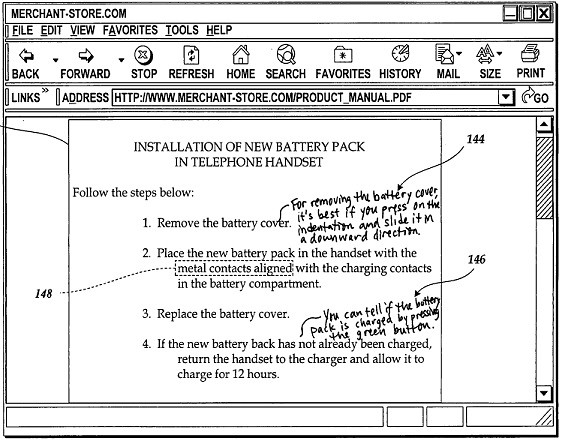
. . . which covers 'receiving an annotation of the digital work, storing the annotation, and providing the annotation to a user.'
No, it does not. It covers A PARTICULAR METHOD of 'receiving an annotation of the digital work, storing the annotation, and providing the annotation to a user.' Specifically,
A computer-implemented method for providing an annotation of a digital work, comprising:
--under control of instructions that are executed by one or more computing devices:
--receiving multiple annotations from different authors for particular content in a digital work;
--storing the annotations in association with the digital work;
--providing a list of abbreviated versions of the annotations to a user desiring to access one or more of the annotations, wherein the list presents the annotations in an order determined by reference to a criterion;
--receiving an authorization credential from a user desiring to access one or more of the annotations; and if the authorization credential is valid,
--providing a full version of one or more of the annotations of the digital work to the user in context with regard to the digital work.
The patent covers a method that includes all five of the listed elements (receiving, storing, providing, etc.). Your favorite method must include all five of these elements, and be published before the filing date (19 January 2005) to be classified as disqualifying prior art. Not include one (or more) of these elements? Then it's not disqualifying prior art. (I'm speaking in generalities here, and ignoring other independent claims, apparatus claims, and lots of special cases. See your attorney if it matters to you.)
The Okular annotation method, while no doubt earlier and better in every way, seems not to include many of these elements, and so would not be disqualifying prior art.
Can we become better educated on patents -- maybe just a little -- so that we can not panic every time somebody patents something? By that I mean, can we start quoting Claim 1 in the summary, instead of the abstract?
I note in passing that the Patent Examiner reviewed (approximately; I counted by hand) 184 US patents and patent applications, 6 foreign patent documents, and 80 other references, looking for art, and that the examination process took more than seven years to complete. Whatever else one may say about this patent, it wasn't rubber-stamped.
Now, see, this, ladies and gentlemen, is a textbook, museum-exhibit-quality example of a Standard-Issue Classic Model Apple Fanboy. Note the stark contrast between his call to consider the technology of the time when the Newton was released with his primitive, volcano-god-worshiping fervor with which he rushes to defend what he perceives to be a slight against his master. Observe the immediate, hostile defensive stance taken by the poster, a reaction typically reserved for personal verbal attacks, generally not for negative remarks, no matter how factual or innocuous, against shiny, overpriced gadgetry. And, as is frequently the case with this sort of person, the attempt to dismiss any further criticism (including evidence to the initial claim, in this case including the fact that nobody bought the Newton) by likening this device to something popular today, hoping to change the subject before things get less-than-perfect for the history of the Cupertino company.. Simply marvelous.
Next up on our tour, an Amiga Persecution Complex sufferer and the closely-related N900 User...