Slashdot Mirror


Committee Offers Scenarios for Japan's Energy Future

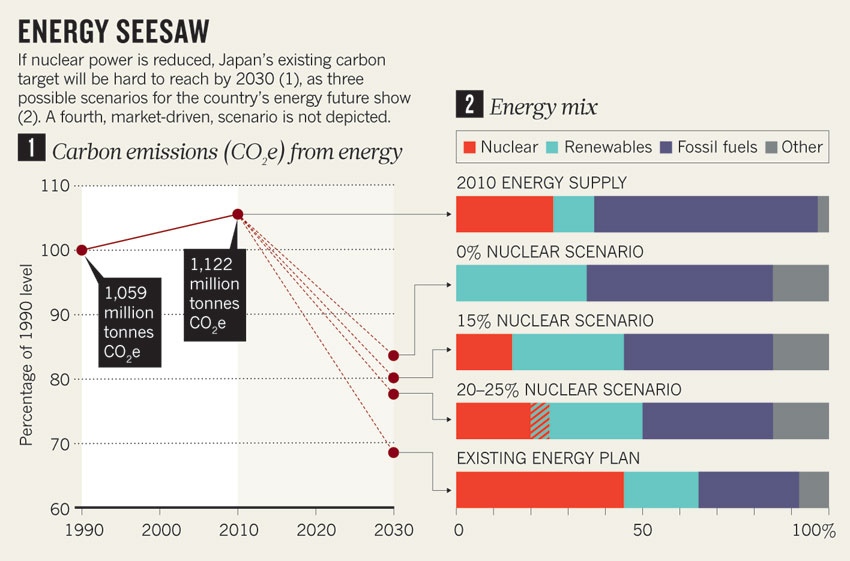
ananyo writes with a story about more concrete plans for a reduced or nuclear-free energy future for Japan. From the article: "It's official: nuclear power will have a much smaller role in Japan's energy future than was once thought. Since the meltdowns and gas explosions at the Fukushima Daiichi nuclear power station in March 2011, all of Japan's remaining reactors have been shut down for inspections and maintenance. The government offered a glimpse of their future, and that of the country's nuclear power in general, when it published an outline of four ways to satisfy Japan's future energy demands. One scenario recommends using a market mechanism to determine the nuclear contribution. Under the other three, nuclear power would supply at most one-quarter of Japan's energy by 2030 — and in one case, none at all. The scenarios come from a 25-person advisory committee to the industry ministry. The sharp reductions in the nuclear power part of the country's energy mix mean that Japan will struggle to reach the 31% reduction in carbon dioxide emissions that it had planned by 2030 (PDF)."
6 of 131 comments (clear)

  1. Pick one by crazyjj · · Score: 4, Insightful

    1) Reduced nuclear
    2) Reduced coal, oil, and natural gas

    Any third option for the foreseeable future is a hippie pipe dream (unless you count regular, sustained blackouts as an option). And if anyone thinks that solar panels and wind turbines are going to supply Tokyo with even a fraction of its power needs, you've obviously never been there.

    --
    What political party do you join when you don't like Bible-thumpers *or* hippies?
    1. Re:Pick one by Ironhandx · · Score: 4, Informative

      This is entirely accurate for Japans current situation. Even in areas like the US where land per capita is relatively abundant they can't possibly supply all of the countries power needs on wind, hydro, and solar alone. At least not any time soon, and by soon I mean within the next 30-40 years, which is our immediate concern.

      Only a very few countries in the world have enough land to supply completely sustainable energy. Canada is one, Australia is another. There are maybe 3-4 other countries that could at least mostly get onto these energy sources.

      Since as you can see this is a very small club to be in, Nuclear is unfortunately the way forward for the foreseeable future.

    2. Re:Pick one by pellik · · Score: 4, Interesting

      Nuclear power will only do serious damage to the environment if mistakes are made. Fossil fuels will damage the environment no matter what. I wonder if there is any logic behind Japan's decision or if this is just some politicians cashing in on public fear.

    3. Re:Pick one by AbrasiveCat · · Score: 4, Informative

      Yep, nuclear, coal, oil and natural gas are the only 4 cost-effective methods of large-scale power generation, especially in a crowded region such as Japan. Solar panels are not yet cheap enough and wind requires such a large area (so do solar panels but they could be mounted on roofs).

      Those of us who live in the northwest of the United States, or western Canada, might argue that hydro belongs on your list. There aren't many big hydro opportunities left to develop around here, but hydro plants we have seem be cost efficient.

    4. Re:Pick one by Urban+Garlic · · Score: 4, Insightful

      One thing we have learned is that, in nuclear power, "not making mistakes" can cost a lot of money and take a lot of time. One of the mistakes we heard about when the Fukushima Daiichi event happened was continuing to operate these poorly-designed older-generation reactors for so long.

      From the sounds of it, this new report has come out strongly in favor of not repeating that mistake, which sounds pretty logical to me.

      --
      2*3*3*3*3*11*251
  2. Sea wind by ShanghaiBill · · Score: 4, Informative

    wind requires such a large area

    No land is needed for wind power. Japan is an island nation at a latitude that has plenty of trade winds. Wind turbines can be located at sea, where the wind is steadier and twice as strong as on land.