Slashdot Mirror


Committee Offers Scenarios for Japan's Energy Future

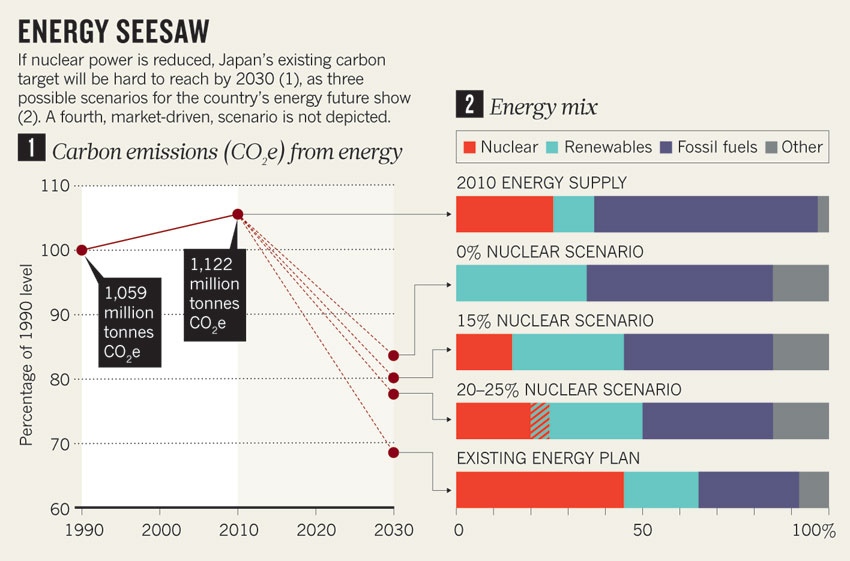
ananyo writes with a story about more concrete plans for a reduced or nuclear-free energy future for Japan. From the article: "It's official: nuclear power will have a much smaller role in Japan's energy future than was once thought. Since the meltdowns and gas explosions at the Fukushima Daiichi nuclear power station in March 2011, all of Japan's remaining reactors have been shut down for inspections and maintenance. The government offered a glimpse of their future, and that of the country's nuclear power in general, when it published an outline of four ways to satisfy Japan's future energy demands. One scenario recommends using a market mechanism to determine the nuclear contribution. Under the other three, nuclear power would supply at most one-quarter of Japan's energy by 2030 — and in one case, none at all. The scenarios come from a 25-person advisory committee to the industry ministry. The sharp reductions in the nuclear power part of the country's energy mix mean that Japan will struggle to reach the 31% reduction in carbon dioxide emissions that it had planned by 2030 (PDF)."
31 of 131 comments (clear)

  1. Pick one by crazyjj · · Score: 4, Insightful

    1) Reduced nuclear
    2) Reduced coal, oil, and natural gas

    Any third option for the foreseeable future is a hippie pipe dream (unless you count regular, sustained blackouts as an option). And if anyone thinks that solar panels and wind turbines are going to supply Tokyo with even a fraction of its power needs, you've obviously never been there.

    --
    What political party do you join when you don't like Bible-thumpers *or* hippies?
    1. Re:Pick one by Darkness404 · · Score: 2

      Yep, nuclear, coal, oil and natural gas are the only 4 cost-effective methods of large-scale power generation, especially in a crowded region such as Japan. Solar panels are not yet cheap enough and wind requires such a large area (so do solar panels but they could be mounted on roofs).

      --
      Taxation is legalized theft, no more, no less.
    2. Re:Pick one by Ironhandx · · Score: 4, Informative

      This is entirely accurate for Japans current situation. Even in areas like the US where land per capita is relatively abundant they can't possibly supply all of the countries power needs on wind, hydro, and solar alone. At least not any time soon, and by soon I mean within the next 30-40 years, which is our immediate concern.

      Only a very few countries in the world have enough land to supply completely sustainable energy. Canada is one, Australia is another. There are maybe 3-4 other countries that could at least mostly get onto these energy sources.

      Since as you can see this is a very small club to be in, Nuclear is unfortunately the way forward for the foreseeable future.

    3. Re:Pick one by pellik · · Score: 4, Interesting

      Nuclear power will only do serious damage to the environment if mistakes are made. Fossil fuels will damage the environment no matter what. I wonder if there is any logic behind Japan's decision or if this is just some politicians cashing in on public fear.

    4. Re:Pick one by Trepidity · · Score: 2

      Both the United States and Japan actually have considerable unexploited hydroelectric capacity, but construction of major new dams has been effectively discontinued for several decades now, because of a mixture of local opposition and environmental worries. It's renewable, but not sure it's really "green", since it requires a massive, permanent change to a river basin. Nuclear is probably greener, despite not being renewable.

    5. Re:Pick one by AbrasiveCat · · Score: 4, Informative

      Yep, nuclear, coal, oil and natural gas are the only 4 cost-effective methods of large-scale power generation, especially in a crowded region such as Japan. Solar panels are not yet cheap enough and wind requires such a large area (so do solar panels but they could be mounted on roofs).

      Those of us who live in the northwest of the United States, or western Canada, might argue that hydro belongs on your list. There aren't many big hydro opportunities left to develop around here, but hydro plants we have seem be cost efficient.

    6. Re:Pick one by Urban+Garlic · · Score: 4, Insightful

      One thing we have learned is that, in nuclear power, "not making mistakes" can cost a lot of money and take a lot of time. One of the mistakes we heard about when the Fukushima Daiichi event happened was continuing to operate these poorly-designed older-generation reactors for so long.

      From the sounds of it, this new report has come out strongly in favor of not repeating that mistake, which sounds pretty logical to me.

      --
      2*3*3*3*3*11*251
    7. Re:Pick one by Kokuyo · · Score: 2

      So the problem is operating old tech for too long? Well, not using that tech at all is one thing they could do... or they could upgrade in security conscious intervals. They could try other products. I mean, the iPhone isn't the only smartphone out there and neither are reactors like Daiichi the only types available.

      The only problem with this discussion is that a viable alternative is not considered due to fear and bad publicity.

    8. Re:Pick one by Luckyo · · Score: 3, Insightful

      This is the devastating irony of modern nuclear power. The more we invest in it, the safer it becomes. Yet investments in nuclear power are often viewed as something that increases risk of accidents due to "more power plants".

      It's a self-fulfilling prophecy as a result of it we're still running many plants built in sixties when nuclear energy generation was not even a decade old.

    9. Re:Pick one by ch-chuck · · Score: 2

      I'm beginning to think that, realistically, just like we put up with (US) 50,000 highway deaths per year because we like our cars, or an airline crash every so often because we like flying, we are going to have to sacrifice a 3 Mile Island or Chernobyl every once in a while for our love of electrical power. It's not a perfect world and never will be, stuff happens, and all you can do is be able to respond to contain and minimize the damage when it does. Like the town in PA that was moved due to an underground fire, towns near nukes that failed will just be closed off and make no man's land for a few hundred million years.

      --
      try { do() || do_not(); } catch (JediException err) { yoda(err); }
    10. Re:Pick one by AmiMoJo · · Score: 2, Insightful

      Japan has vast amounts of geothermal and plenty of off-shore wind. The former is cheaper than nuclear and coal, not sure about gas. The latter... Well, post Fukushima it is cheaper than nuclear, and possibly coal if you count the environmental and health costs of burning it.

      There is another option too: reduce energy consumption by becoming more efficient.

      --
      const int one = 65536; (Silvermoon, Texture.cs)
      SJW, n: "Someone I don't like, and by the way I'm a fuckwit" - AC
    11. Re:Pick one by rmdingler · · Score: 2

      How many lives are lost due to not generating enough power? What is the cost in infrastructure loss? There is such a thing as acceptable loss in any rational equation.

      --
      Happiness in intelligent people is the rarest thing I know.

      Ernest Hemingway

    12. Re:Pick one by AmiMoJo · · Score: 2

      0.3% of the Sahara could supply all of western Europe. There is more than enough solar available in southern US states for the whole country. Try googling solar thermal collectors. They work 24/7, BTW.

      --
      const int one = 65536; (Silvermoon, Texture.cs)
      SJW, n: "Someone I don't like, and by the way I'm a fuckwit" - AC
    13. Re:Pick one by dj245 · · Score: 2

      Both the United States and Japan actually have considerable unexploited hydroelectric capacity, but construction of major new dams has been effectively discontinued for several decades now, because of a mixture of local opposition and environmental worries. It's renewable, but not sure it's really "green", since it requires a massive, permanent change to a river basin. Nuclear is probably greener, despite not being renewable.

      Not only that, but until last year, Japan had been decommissioning a lot of their hydro units since they were fish choppers. Some of them had to be brought out of mothball status because of the power crunch.

      Anyone who proposes hydro as a solution to Japan hasn't been there. Pretty much any piece of land which is even slightly flat has buildings or rice paddies on it. They don't have enough space as it is. in the US, we call them "not in my backyard" (NIMBY) people who just want to oppose anything. The local opposition in Japan to such large projects is more like "don't displace me, bro". I'll exclude nuclear from those people though, as the current nuclear opposition in Japan is about as fanatical and misinformed as the US antinuclear movement was in the 1970's.

      --
      Even those who arrange and design shrubberies are under considerable economic stress at this period in history.
    14. Re:Pick one by AmiMoJo · · Score: 2

      If we ignore countries with ridiculously large hydro dam resources (Norway, Sweden, Finland, etc) the only currently available economic way of storing sufficient amounts of energy is by storing methane, and the only currently available method of getting enough methane is by tapping natural gas out of the Earth.

      Or molten salt, or pumped hydro...

      --
      const int one = 65536; (Silvermoon, Texture.cs)
      SJW, n: "Someone I don't like, and by the way I'm a fuckwit" - AC
    15. Re:Pick one by Luckyo · · Score: 2

      Wrong. Resistivity of materials is not solved by switching to DC. It does have some advantages over AC but it most certainly does not eliminate the problem.

    16. Re:Pick one by ChatHuant · · Score: 2

      Resistivity of materials is not solved by switching to DC

      That's true; the solution is to also increase the voltage (losses are inversely proportional to the square of the voltage), which is easier to do with DC (and a line from Africa to Europe needs to use DC anyway, if you want to go underwater for any significant length).
       
      Look up Path 65, which connects the LA area to a converter station all the way north in Oregon, close to the WA border, that is more than 800 miles away. It uses +/- 500 kV DC and can carry up to 2 GW

  2. So in other words... by Darkness404 · · Score: 3, Insightful

    So in other words Japan will make nuclear power taboo so there will be little research/upkeep on the remaining reactors making another Fukishima more likely. Wonderful!

    --
    Taxation is legalized theft, no more, no less.
  3. The choice was made well over a decade ago by dbIII · · Score: 3, Insightful

    They haven't built a new reactor in a very long time. This announcement is not much different to the German government one - letting the existing plants run down and not putting in a huge amount of capital to revive an almost abandoned reactor construction industry to build new ones. Everyone involved in building the previous ones has long moved on and spare expertise outside of their country is scarce.

    1. Re:The choice was made well over a decade ago by tp1024 · · Score: 3, Informative

      In fact reactor #6, while shut down at the time of the tsunami, was the only reactor that still had a functioning power supply after the tsunami. It was the only BWR5 design (#1 was a BWR3, #2 to #5 were BWR4) - unlike the others, it had three separate subdivisions each capable of cooling the reactor in the event of a power outage. Redundancy works. Just as in the Tokai, Fukushima Daini and Onagawa nuclear power plants that were also hit by the tsunami.

      However, neither TEPCO nor the Japanese Government should be spared any criticism for failing to upgrade the power plants. Hydrogen explosions were a known problem in those plants and could be prevented for a very modest sum of a few million dollar per reactor. Filtered containment vents were also implemented all over europe, Japan was attending the Paris conference on filtered containment vents in June 1988 and the only nation not to issue any official statement at all about them or initiate any studies on the problem.

      Until 2011 I thought Japan was basically a modern country with decent safety standards - now I know better.

  4. I Don't Get It by eldavojohn · · Score: 2, Insightful

    Any third option for the foreseeable future is a hippie pipe dream

    I don't get it, all the free market preachers are promising that my energy problems will shortly be solved by the free market but your view is such a fatalistic-don't-even-try-jaded response that you seem to doubt the free market can provide.

    And if anyone thinks that solar panels and wind turbines are going to supply Tokyo with even a fraction of its power needs, you've obviously never been there.

    I haven't been there. But no one's asking those solutions to go from zero to powering Tokyo over night. Look how gradually it's taken wind power to start in the United States (current numbers here). Japan is comparable at our state level and is looking at connecting with Korea, China, Russia and Mongolia power grids to buy more renewable energy. So why call these hippie pipe dreams? If these are hippie pipe dreams, when will our innovation kick in and 'save us' from nuclear and coal?

    (unless you count regular, sustained blackouts as an option)

    Did you hear that Japan did actually make small adjustments following Fukushima and called the movement setsuden?

    I don't think the situation is as dire as you describe it and, frankly, dismissing all the alternative efforts really undermines what we should be working toward which are transitional phases until some breakthrough comes in fusion or an unforeseen source.

    --
    My work here is dung.
    1. Re:I Don't Get It by CrimsonAvenger · · Score: 3, Informative

      I don't get it, all the free market preachers are promising that my energy problems will shortly be solved by the free market but your view is such a fatalistic-don't-even-try-jaded response that you seem to doubt the free market can provide.

      No, the "free market preachers" aren't saying that. Because the "free market preachers" know perfectly well that energy production is one of the most heavily regulated industries in the world.

      And as long as NIMBY exists, there isn't really an answer to increasing energy production - the people want green, but they pretty much stop wanting that as soon as the price tag is mentioned (yes, going all solar and wind will increase energy costs).

      On a related note, saw in the news this AM that the windpower industry is really peeved that Congress hasn't gotten around to renewing their tax credits, and is expecting massive layoffs as a result.

      Which reminds me, I really need to get off my duff and get some solar panels on my roof before the tax rebates end - much better to buy while the neighbors are paying for it than to wait until I have to pay for it myself.

      --

      "I do not agree with what you say, but I will defend to the death your right to say it"
    2. Re:I Don't Get It by nojayuk · · Score: 2

      "The whole reason the nuclear power industry developed based on uranium instead of thorium was for military reasons."

      Crap. Uranium reactors are physically simple devices, steam kettles heated by spontaneously fissioning uranium. Thorium isn't fertile enough by itself to initiate and sustain fission in a simple reactor structure. India has been building and trying to sell thorium-fuelled reactors but they include quantities of medium-enriched (ca. 20%) uranium and plutonium in the fuel mix to provide enough sustained neutron flux to fission the thorium fuel.

      The LFTR designs being touted by assorted folks are monstrously more complex than the existing uranium-fuelled reactor designs already built and operating today, and would have required decades of development back in the 1950s to make them work. The simple fertile uranium fission power reactors were an easier path to take and every country which started builing research and power reactors in that time took that route.

  5. Struggle? by JWW · · Score: 2

    "struggle to meet their emissions targets."

    I think they misspelled the word struggle, it should be spelt FAIL.

  6. Nukes will come back when they are safe by cryfreedomlove · · Score: 3, Interesting

    We need nuclear power generator technology that can be safely run by corrupt liars. Most government and regulatory agencies are run by corrupt liars, as we saw in the handling of the Fukushima crisis.

    1. Re:Nukes will come back when they are safe by Delarth799 · · Score: 2

      Thorium based reactors are pretty safe and with some investment you can build a few trash burning plants which produce fairly clean and cheap energy. Of course this requires people to actually learn about this sort of technology which isn't convenient for most people to do.

  7. This is a mistake by WOOFYGOOFY · · Score: 2

    Look nuclear could lead to bad scenarios, but civilization destroying climate change is the Worst Possible Thing. Why not spend the money to build them better? They knew beforehand that their older gen nukes were vulnerable. It has to be at least one option. It's great that there are super incentivized to find sustainable alternatives but is incentive what is lacking on the part of researchers or is it now time we're running out of ?

    Systematically lower carbon emissions- at the point of gun if necessary. Full throttle research into green technology - using deficit spending if necessary. Conservation and maximum usage of current alternatives , by law if necessary. That's what's got to happen and it will the only question is will we do it in time?

  8. Solar power is worse than Fukushima by tp1024 · · Score: 2

    If you want to replace just Fukushima Daiichi with solar power, you'd have to blanket the whole evacuation zone with one huge solar power plant like that one. (Notice the incredible environmental friendliness of solar power in that place!). But in fact, you'll lose about half of that energy due to storage issues or inefficiency.

    In order to replace all Japanese nuclear power plants with solar power, you need ten of those power plants - if you ignore storage losses.

  9. Sea wind by ShanghaiBill · · Score: 4, Informative

    wind requires such a large area

    No land is needed for wind power. Japan is an island nation at a latitude that has plenty of trade winds. Wind turbines can be located at sea, where the wind is steadier and twice as strong as on land.

  10. Re:Hot hot Hot by ciderbrew · · Score: 2

    When I first went the country wasn't very disability conscious. Skip a few years later ..... every main sidewalks, rail and subway stations had bobbled track bright yellow of floor ties. Braille on hand rails - lifts and loads of other bits. Social conscience has drive there too. If you can make it cool people will want them. Tax breaks for the supply chain and many more false economy drivers can be put in place. The tax make work they use builds good infrastructural items. Use the trillion yen subsidy for power stations corruption money and hand out contracts to install panels.

  11. Re:Hot hot Hot by Solandri · · Score: 2

    Japan (and Korea and the coastal areas of SE and E Asia) are in a monsoon area. The heat is due to the humidity. The sun does not magically shine stronger there (if anything it shines less due to the pollution from China).

    Once you subtract out government subsidies, solar is currently almost an order of magnitude more expensive per kWh than fossil fuels. Wind is a much better choice, at a bit less than 2x the cost. Nuclear is the best scalable option, at roughly the same cost as fossil fuels, but is a political hot potato. Hydro and geothermal are the best choices (cheaper than fossil fuels). But hydro is tapped out in most modern countries, and geothermal is limited in where it's available.

    Why is cost so important? Because our modern standard of living is based on cheap energy. In medieval times, the average person had to work 12 hours a day, 7 days a week in the fields just to generate enough productivity not to starve. Our modern standard of living is achieved by using cheap energy as a productivity multiplier. Instead of using nearly all our productivity to feed ourselves so we can produce more food, we spend a fraction of our productivity (money) on cheap energy. The energy powers machines which we then use to provide the majority of our productivity. People directly or indirectly just "work" by controlling those machines, thus generating enough productivity (income) to feed themselves in about 1 hr a day. The rest of your productivity (money) is spent buying a house and car and various entertainment -- things that would be considered lavish luxuries by medieval standards.

    Take away cheap energy and you can't run those machines as much. The average productivity per person plummets, and a greater portion of their workday is needed to generate enough productivity to feed themselves. That means less income left over for a house, car, and entertainment. Our standard of living goes down.