 Slashdot Mirror
Towards a 50% Efficient Solar Cell
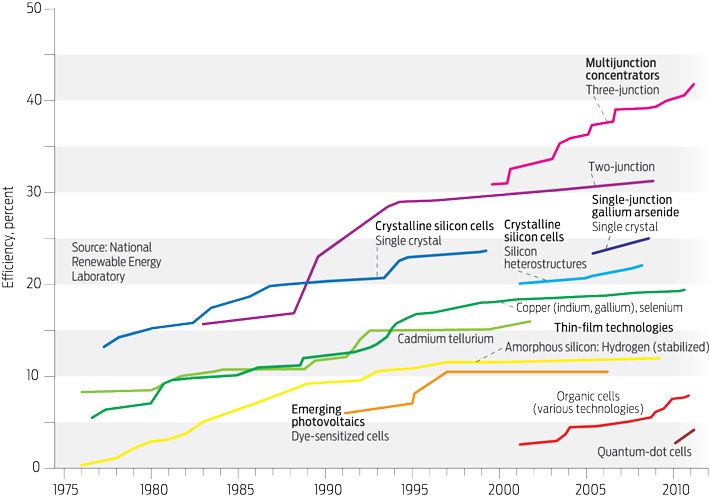
necro81 writes "IEEE Spectrum magazine has a feature article describing DARPA-funded work towards developing a solar cell that's 50% efficient, for a finished module that's 40% efficient — suitable for charging a soldier's gadgets in the field. Conventional silicon and thin-film PV tech can hit cell efficiencies of upwards of 20%, with finished modules hovering in the teens. Triple-junction cells can top 40%, but are expensive to produce and not practical in most applications. Current work by the Very High Efficiency Solar Cell program uses optics (dichroic films) to concentrate incoming sunlight by 20-200x, and split it into constituent spectra, which fall on many small solar cells of different chemistries, each tuned to maximize the conversion of different wavelengths."
Developments like this are awesome, because they open up the possibility of doing exactly what the summary describes -- using solar power to recharge things where size / weight / surface area is at a premium.
But those sorts of scenarios are few and far between. Most of the time, cost is the limiting factor, and these high-efficiency designs are always costly.
That's okay, though: PV panels are already plenty efficient for their desired function in most cases.
Cheers,
b&
All but God can prove this sentence true.
If that were true, this would only work if the sun were at a very specific angle. But that's not how it works. It concentrates light from the entire sky into a narrow beam which is then split into different wavelengths. It says that right in the summary.
No, he means forward-looking scientists working for government money (so, just like it should have been). So far the general public was the greatest beneficiary of DARPA projects. Computers, Internet, GPS to name the few...
I'm surprised that DARPA is getting all the credit here; the approach isn't new with DARPA.
That approach is known as the "spectrum splitting" approach. Some older work was the NASA "rainbow concentrator" array concept:
http://ntrs.nasa.gov/search.jsp?R=20110024141
http://www.techbriefs.com/index.php?option=com_staticxt&staticfile=/Briefs/June03/NPO21051.html
In general, spectral-splitting concepts do need to track the sun, and so they're envisioned more for concentrator systems than for flat-plate arrays.
http://www.geoffreylandis.com