 Slashdot Mirror
Towards a 50% Efficient Solar Cell
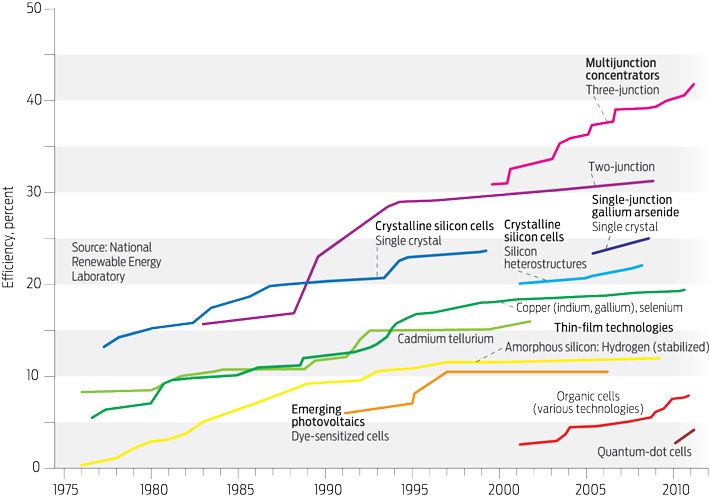
necro81 writes "IEEE Spectrum magazine has a feature article describing DARPA-funded work towards developing a solar cell that's 50% efficient, for a finished module that's 40% efficient — suitable for charging a soldier's gadgets in the field. Conventional silicon and thin-film PV tech can hit cell efficiencies of upwards of 20%, with finished modules hovering in the teens. Triple-junction cells can top 40%, but are expensive to produce and not practical in most applications. Current work by the Very High Efficiency Solar Cell program uses optics (dichroic films) to concentrate incoming sunlight by 20-200x, and split it into constituent spectra, which fall on many small solar cells of different chemistries, each tuned to maximize the conversion of different wavelengths."
Know your audience. As long as DARPA's research comes to the public eventually (we got the internet, after all) it's still beneficial. Quite possibly delayed and almost certainly more expensive than it should be, but slow and expensive progress is still progress.
How are sites slashdotted when nobody reads TFAs?
There's basically two ways to get power in space. One involves plutonium, the other high efficiency solar cells.
Since launch costs are related to weight, anything that increases panel efficiency, even if expensive, is great
for solar applications.
When the US starts paying what other countries pay for fossil fuel (as any European could say), then maybe solar power research will skyrocket. Until then, as it's not even currently appealing profit-wise, it's quite sad to say but only military applications and some rare initiatives (often subsidized) remain and that's just because soldiers can't be carrying their weight in oil to fuel the devices they use and batteries are still inconvenient. Let's give it a few more years, but recent events in the middle east should help a few make up their minds.
Any sufficiently advanced incompetence is indistinguishable from malice.
Governments do not "invest", Governments move money from one place to another... VERY inefficiently.
How are Obama's solar investments doing? Oh, that's right, they taxed you... took your money, then gave it to some businessmen that promptly filed bankruptcy and drove off in their BMWs. Congrats.
In this list of recipients of the DOE's 1705 Loan program, 5 of out 26 are listed as being in serious financial difficulty, the majority of the projects on the list are on-track.
Direct costs of the war in Iraq were $800B, by the time all direct and indirect costs are accounted for (interest, injured and wounded, veteran care and pay), it could hit $4T. The Loan Program cost $34B (and that's only if all $34B loans are defaulted on).
So, for somewhere between 5% and 0.8% of the cost of war that we shouldn't have started, the US Government can help to move us toward alternative energy sources, and off of foreign oil (I know we have domestic sources for much of the oil we use, but since it's a global commodity, any oil we consume means more that volatile middle eastern states will sell)
I'm not sure that the vetting process for all companies is fair and balanced, but I do think it's a useful program.
Developments like this are awesome, because they open up the possibility of doing exactly what the summary describes -- using solar power to recharge things where size / weight / surface area is at a premium.
But those sorts of scenarios are few and far between. Most of the time, cost is the limiting factor, and these high-efficiency designs are always costly.
That's okay, though: PV panels are already plenty efficient for their desired function in most cases.
Cheers,
b&
All but God can prove this sentence true.
If that were true, this would only work if the sun were at a very specific angle. But that's not how it works. It concentrates light from the entire sky into a narrow beam which is then split into different wavelengths. It says that right in the summary.
No, he means forward-looking scientists working for government money (so, just like it should have been). So far the general public was the greatest beneficiary of DARPA projects. Computers, Internet, GPS to name the few...
Is science just filled will bullshit these days? Here's an idea, instead dreaming of the 50% solar cellfor the year 2030, just focus on better manufacturing methods for the 20% cells? How about increasing the durability of the 20% cells?
Lets try the old car analogy... heck, it almost fits.
Instead of working hard toward developing more fuel efficient cars, we should have found better ways to manufacture the 60's vintage cars and continued to accept the 8mpg that was common then.
See how dumb that sounds?
What's wrong with research? It is after all what got solar from 5% efficiency to where it is today.
I'm not convinced its wise to build massive amounts of not-very-cost-effective solar installations when twice the capacity might be available in 5 years. (Finished and installed Solar is in the mid teens, not the laboratory figure of 20%).
Sig Battery depleted. Reverting to safe mode.
I'm surprised that DARPA is getting all the credit here; the approach isn't new with DARPA.
That approach is known as the "spectrum splitting" approach. Some older work was the NASA "rainbow concentrator" array concept:
http://ntrs.nasa.gov/search.jsp?R=20110024141
http://www.techbriefs.com/index.php?option=com_staticxt&staticfile=/Briefs/June03/NPO21051.html
In general, spectral-splitting concepts do need to track the sun, and so they're envisioned more for concentrator systems than for flat-plate arrays.
http://www.geoffreylandis.com
Are you suggesting that we shouldn't be looking into alternative energy sources?
Private industry hasn't exactly done a whole lot to do anything other than prolong our dependence on fossil fuels. The oil, and oil related, industries are bigger than ever, more money than ever is spent on refining more and more difficult sources of crude. Oil sources that 15 years ago were thought would never be cost effective are now major suppliers in the whole chain.
Solar power has made slight inroads, but only on a personal level. There's no significant widespread power generation through solar. We're NIMBYing wind turbines. Everyone is reluctant to invest in tidal power.
Everyone just keeps pouring more and more money into oil. Spending money thinking about how to stop doing that is sensible, even if 90% of it goes nowhere. Only spending money on things that are proven to work is what got us here, if private companies aren't willing to risk failing, then fucking A rights the government should help out.
Keep on knockin'
https://robbiecrash.me
It's not just solar, they are also very interested in wind, geothermal/ground source, and biofuels. But they think solar and wind have the most potential for their purposes (it's mostly only the Air Force interested in biofuels, for fueling their planes).
As for why, well, 80% of the convoys run in Iraq and Afghanistan are fuel convoys. On average, a soldier died or was wounded in one of every 46 of those convoys in 2010. And by the time you take into account the cost of the fuel and the expense of moving it, the military is paying something like 5-10 times the price you pay at the pump when you fill your gas tank.
What is this fuel used for? Some of it is used to power vehicles, of course, but the vast majority of it is used to provide electricity at remote and forward bases. They dump it in a generator, burn it, and wait for another convoy. On the other hand, the sun and the wind come to many of their locations without the need for a convoy.
The upshot of all of this is that with sufficient energy densities, the military could spend a whole lot more on solar panels and wind turbines that would seem justifiable to the average homeowner and still have it be economical -- I mean, just think of the money and lives that could be saved if a base could reduce the number of convoys it needs by 80%.
For all of that, you probably don't need cells with 50% efficiency, and I guess that's why TFA focuses on soldiers' gear instead of base power.
Your concern about a soldier contending with solar panels hanging off his back is a bit misplaced, I think. TFA says that at 50% efficiency, a 10-cm square panel is all that would be needed. That is already smaller than a single standard silicon cell in production today (standard is 15-cm square). And if you're worried about bad weather, sandstorms, and distractions then I would think that the last thing you want is a mechanical device with moving parts like foot pedals.