Slashdot Mirror


Internet-Deprived Kids Turning To 'McLibraries'

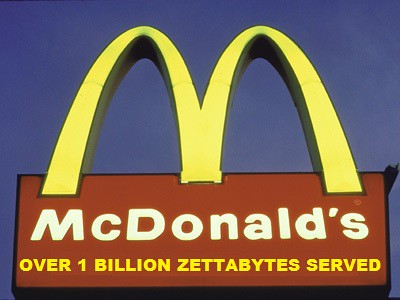
theodp writes "After the school computer lab and public library close for the night in many communities, the local McDonald's is often the only place to turn for students without internet access at home. 'Cheap smartphones and tablets have put Web-ready technology into more hands than ever,' reports the WSJ's Anton Troianovski. 'But the price of Internet connectivity hasn't come down nearly as quickly. And in many rural areas, high-speed Internet through traditional phone lines simply isn't available at any price. The result is a divide between families that have broadband constantly available on their home computers and phones, and those that have to plan their days around visits to free sources of Internet access.' The FCC says it can make broadband available to all Americans by spending $45 billion over 10 years, but until then the U.S. will have to rely on Mickey D's, Starbucks, and others to help address its digital divide. Time to update that iconic McDonald's sign?"
12 of 331 comments (clear)

  1. Title translation by c0lo · · Score: 4, Insightful

    Deprivation of Internet - a common cause of picking bad eating habits at low ages for Homo sapiens.

    --
    Questions raise, answers kill. Raise questions to stay alive.
  2. Wow by Jmc23 · · Score: 4, Insightful

    I rtfa and am quite suprised by what passes for 'poor'. Seems more like people who don't know how to budget and set priorities. Judging by the amount of debt the US has, sounds like par for the course.

    --
    Don't complain about syntax, grammar, or spelling. There is no.hell like input on android.
    1. Re:Wow by Anonymous Coward · · Score: 5, Insightful

      I have seen a fair bit of homeless people that have a decent($500 or less) laptop. Could they afford the $800 a month for an apartment no. I don't think you understand how becoming poor works.

    2. Re:Wow by sqrt(2) · · Score: 5, Insightful

      You might want to reassess your definition of poverty then. Cooking food yourself doesn't just involve purchasing ingredients. There is a substantial upfront cost of buying the equipment and infrastructure to turn ingredients into food. At the very least you'll need to heat water and have a surface that can be sterilized and used to cook on. You'll need utensils and pots/pans. The energy required will be either gas or electric which costs money. I suppose you could burn wood but that isn't free either and is illegal/impractical most places.

      So that $1 burger costs quite a bit more to cook yourself. If you have no equipment and no access to infrastructure then it's actually cheaper to buy fast food. The "total cost of ownership" of the food you make yourself is deceptive because much of the cost isn't directly related to the superficially cheaper ingredients.

      We haven't even touched on the subject of cheap food being almost universally less healthy--even if it provides enough caloric content. Then there are food deserts where healthy food isn't even an option.

      And for the "web enabled device" disqualifying you as poor remark; things really have changed that much. It happened so quickly that the older generation who can remember a time before the internet, or before computers, or before cell phones, thinks that owning or accessing those devices is a marker for the middle class and up. It's not anymore. Even the poorest citizens routinely use cellphones. Moreover, they NEED access to those devices/services just to be productive and make any money at all. Access to the internet or at least POTS is so vital that our government (rightly so) has partnered with industry players to make sure free cell phones are available to those who need them.

      If you don't have access to a phone, and now the internet, you are effectively barred from participating in the economy. We can't survive that. We can't function if those people are completely dependent on government services to survive. It actually works out better, is less costly, to give away cellphones and internet access so those people can provide for themselves at least more than they were before. The alternative to not providing those things is paying for someone's entire existence, or if you refuse that, paying to lock them up when they inevitably turn to crime just to remain alive.

      --
      If you build it, nerds will come. Soylentnews.org
    3. Re:Wow by sqrt(2) · · Score: 5, Insightful

      You also have to pay for a place to store those things (flat, house, or something), and pay to have energy delivered to that dwelling to run those appliances. You'll also need transportation to and from a grocery store which could be substantially farther away than McDonald's. You're in grinding poverty, remember, so no car. It'll also take you much longer to shop that way, even before you get to start making food. Upfront costs instantly make the "cheaper" solution a non-starter for many people trapped in poverty.

      I can leave you with the same idea expressed more colorfully by Terry Pratchett, from Men at Arms,

      The reason that the rich were so rich, Vimes reasoned, was because they managed to spend less money.

      Take boots, for example. He earned thirty-eight dollars a month plus allowances. A really good pair of leather boots cost fifty dollars. But an affordable pair of boots, which were sort of OK for a season or two and then leaked like hell when the cardboard gave out, cost about ten dollars. Those were the kind of boots Vimes always bought, and wore until the soles were so thin that he could tell where he was in Ankh-Morpork on a foggy night by the feel of the cobbles.

      But the thing was that good boots lasted for years and years. A man who could afford fifty dollars had a pair of boots that'd still be keeping his feet dry in ten years' time, while a poor man who could only afford cheap boots would have spent a hundred dollars on boots in the same time and would still have wet feet.

      This was the Captain Samuel Vimes 'Boots' theory of socio-economic unfairness.

      --
      If you build it, nerds will come. Soylentnews.org
    4. Re:Wow by Baloo+Uriza · · Score: 5, Insightful

      Thank you for explaining why McDonald's is not only popular, but thriving, in the American midwest. I was surprised to discover that, unless you live in a big city like McAlester, Claremore or Lawton, indoor plumbing is still a "maybe." Want basic landline phone service? That's a very real maybe. Want electricity? That's almost definitely a solar panels on your roof thing. Want indoor plumbing? Then you're stuck on a water cistern or a well, both of which depend on electricity. Whether you go well or cistern largely depends on whether or not fracking has destroyed the water table yet. And if you're on a cistern in rural Oklahoma two years into a drought, well, a shower is a five gallon bucket of water heated with a bucket heater, once a week, and you're happy to have the luxury of water to spare for bathing at all. (No, your coworkers and clients don't complain, they're in the same boat).

      --
      Furries make the internet go.
    5. Re:Wow by Anonymous Coward · · Score: 5, Interesting

      This is spot-on.

      When I was 16, I ran away from home. Because the people I lived with were incompetent, abusive people. For a time I ended up in some youth homes for girls, but later on I was on my own.

      Affording the infrastructure to cook food really is the hard part, when you don't start out with a stable living place, or with pots and pans someone gave you, or with a steady job that lets you pay for electricity or gas to cook the food with. The price of a 12 dollar pan can feed you three times or more, depending on what you buy and how much food you need to live. If you only need to eat once a day, that could be 3 or 4 days. The pan is just metal if you don't have money above what it takes to buy the pan, or a fire and food to cook with it. I would have been more likely to visit McDonalds and get something from the dollar menu than stare at an inedible pan. It wasn't until I was making much more money I could afford the luxury of investing in infrastructure that would pay off long-term.

      In 2000, when I ran away from home, you could still find a lot of jobs in paper job fliers. The trouble back then was figuring out how to wait for a phone call when you didn't have a phone. I ended up in a lot of jobs where I could walk in and be hired on the spot (retail), because better jobs required a real phone to get them. I spent a LOT of time in libraries teaching myself about computers and the web, and because things like the job sites and free email and craigslist gave me a huge wealth of information and ways to communicate nothing else could give me. Having access to a computer at a library in my early 20s is THE sole reason I make 38k a year now, just hitting 30. And 38k a year is a lot, to me, even after paying Chicago area rents. (I know to many of you it isn't. I have a friend who I know makes 100k as a software tester, and I can't imagine what it is to live with that much money.) Making 38k, I'm actually getting fat because I can eat whatever I want, whenever I want. I can just buy food on the shelves without debating what is both the cheapest and what I have the capabilities of cooking. I can just buy random things at the grocery store without checking the price. I have random QUARTERS sitting around that I don't need to use for food. I am so incredibly lucky. Of course, the hard part now is learning how to save when nothing in my childhood or early adulthood nurtured such skills, and I thought I wouldn't see 30 ever.

      Anyway, without libraries giving me free internet, and without prepaid phones coming so far down in price, I would be MUCH poorer than I am now. If you have the internet, and a phone, you can get a job, and everything from there is up. I've looked at the job listings I looked at when I was younger--there's pretty much nothing in them now, 13 years later. All jobs are found online. You HAVE to have a phone and some form of internet to get a decent job. It is NOT a luxury, it is NOT a sign that you are middle class. And you need a bit of money so you can print out your resume at the library or a office store. (Although, in the past, I have gone into interviews without having a copy of my own resume. Because I couldn't afford the paper or ink it would be printed on, as it usually wasn't free like the internet at the library was. I remember making up excuses to myself in case anyone asked me about it.)

  3. Re:Libraries by ndogg · · Score: 5, Insightful

    Sorry, liberals don't like it when the churches do things like "donating free space" to help people. They throw hissy fits, and start screaming about a separation of church and state. Well at least they do in the US, never mind that in Canada that churches and synagogues have been doing this up here for the better part of a decade already and it's open to the public.

    We only care when government money is used to maintain such services, or are the only places for those public services to be available.

    How comfortable would you be if the only place in your town that had free internet was a mosque?

    --
    // file: mice.h
    #include "frickin_lasers.h"
  4. Actually pretty useful as a backup by puregen1us · · Score: 4, Interesting

    Given that the McDs connections are pretty fast, and pretty reliable, it's actually handy to use as a backup.

    Couple of years ago the connection at home was being flaky and finally gave out. Problem was, it was a major DR test day at work, and I needed to be online from home for 12 or so hours.

    I just grabbed the laptop, blackberry, and powercord, and went 5 mins down the road to the 24hour McDs. Sat there for hours til my ass was numb, happily on my work BB using hands-free, and worked away for hours.

    I wasn't disturbed, had unlimited food and drinks available. Really, not the worst place to work at all. I had more space there than I get at my desk job, and better food and drinks too. Work don't have iced tea on tap.

    The McDs connection was enough to remote desktop into my XP desktop at work, without lag or dropping. I was impressed how stable it was. Most places can't handle basic browsing that well given the number of people sharing, but that was totally solid.

  5. Re:Libraries by Gordonjcp · · Score: 5, Funny

    How comfortable would you be if the only place in your town that had free internet was a mosque?

    More comfortable than if the only place with free internet was McDonalds. In the mosque there's be less proselytising and the food is better.

  6. Re:Internet is need, not a want. by zAPPzAPP · · Score: 4, Insightful

    No, you will not.
    Not as an active part of society at least. As involuntarily and essential services like paying your taxes, registering business, all kinds of insurances move to online only, you just can not participate in the economy anymore without internet access.

    Sure, go live in the forrests dependant on no one else. There you won't need internet. But these rights are not made for hermits, they are made for citizens.

  7. Liberals and Libraries by rocket+rancher · · Score: 4, Interesting

    Sorry, liberals don't like it when the churches do things like "donating free space" to help people. They throw hissy fits, and start screaming about a separation of church and state. Well at least they do in the US, never mind that in Canada that churches and synagogues have been doing this up here for the better part of a decade already and it's open to the public.

    We only care when government money is used to maintain such services, or are the only places for those public services to be available.

    How comfortable would you be if the only place in your town that had free internet was a mosque?

    Hmmm. Don't think you are a troll, so I'm going to toss you a peanut or two to munch on. Haven't you heard of the Office of Faith-Based and Community Initiatives, created by Bush II more than a decade ago? True, Bush used it as a sly way to fund get-out-the-vote programs targeted at GOP constituencies and faced some serious blowback when his first director of the office, John Dilulio, resigned in protest over the political agenda that permeated an ostensibly apolitical office. The office was expanded and renamed the Office of Faith-Based and Neighborhood Partnerships by that arch-liberal, Obama. The OFBNP has funneled billions of dollars of tax money into exactly the kind of social services that you are referring to, via competitive contracts awarded and monitored by a council of secular and religious leaders from around the country.

    I don't think liberals care much at all about *who* is helping redistribute the nation's wealth, as long as it gets redistributed in a way that benefits all, and not just a few. It's a great idea, really, letting churches help. Conservatives who don't like to redistribute wealth in any direction but upwards would look pretty silly if they tried to block money doing God's work, wouldn't you agree?