 Slashdot Mirror
Moore's Law and the Origin of Life
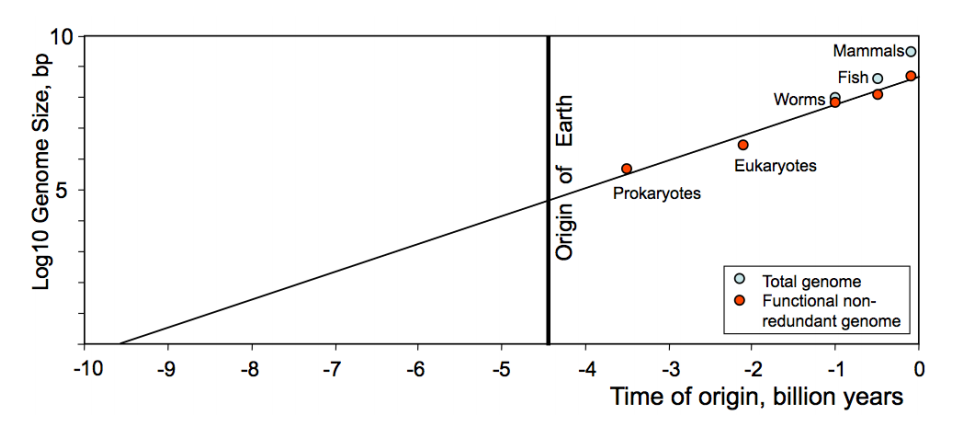
DoctorBit writes "MIT Technology Review is running a story about an arXiv paper in which geneticists Alexei A. Sharov and Richard Gordon propose that life as we know it originated 9.7 billion years ago. The researchers estimated the genetic complexity of phyla in the paleontological record by counting the number of non-redundant functional nucleotides in typical genomes of modern day descendants of each phylum. When plotting genetic complexity against time, the researchers found that genetic complexity increases exponentially, just as with Moore's law, but with a doubling rate of about once every 376 million years. Extrapolating backwards, the researchers estimate that life began about 4 billion years after the universe formed and evolved the first bacteria just before the Earth was formed. One might image that the supernova debris that formed the early solar system could have included bacteria-bearing chunks of rock from doomed planets circling supernova progenitor stars. If true, this retro-prediction has some interesting consequences in partly resolving the Fermi Paradox. Another interesting consequence for those attempting to recreate life's origins in a lab: bacteria may have evolved under conditions very different from those on earth."
A single base pair is not alive, not even in a primitive way. The extrapolation is invalid. A more interesting statement would be the minimum complexity of the first living things 3.5-4.0 billion years ago.
This is a fine example of how not to use arXiv as a news source. This old yarn has been trotted out before, and it is based on bad assumptions about complexity and offers a handy False Dilemma Fallacy.
Either
1+1=6 or
1+1=8.
1+1=6 is disproved, so 1+1 =8!
Or your math is wrong.
Complexity != genome size.
See c-value enigma.
This is dealing with evolution, not origin of life. While it fits even less with a strictly literal interpretation of the Bible than life originating on Earth, it weighs neither positively nor negatively on whether life arose on its own or was created by a deity.
http://xkcd.com/605/
All of this assumes that the complexity of life, as he defines it, increases at a relatively constant rate. There is no reason that this has to be true. Environmental effects on organisms increases selective pressure and causes evolution to progress at a faster rate. Cataclysmic events happen every now and then and causes extinctions and hardship on surviving organisms. Seems pretty uneven to me...
"Here Lies Philip J. Fry, named for his uncle, to carry on his spirit"
The problem with the kind of creationism some people are advertising is that they insist that it happened around 6000 years ago. A lot of scientists would be ok with the idea of creationism -- if you allow it to happen billions of years ago as the spark that created life, but then let life evolve independently. But of course then humanity is not special -- unless the creator helped things happen this way for the purpose to create intelligent life.
So creationism/intelligent design is OK, and a higher being managing/guiding the universe is OK; it just doesn't make sense for it to have happened 6000 years ago.
This is just talking about exponential growth rates and using that to estimate the start of life. Apparently, the editors of /. can't understand exponential growth without thinking of Moore's law.
You're welcome.
~ Whence do you come, slayer of men, or where are you going, conqueror of space?
becasue when you say it happened at X time, you need to show evidence, and all the evidence show, very clearly, that it is older then 6000 years. So going the Catholic route, God help evolution in ways we can't see' make no prediction, so there is no argument.
The Kruger Dunning explains most post on
"SARS and the Origin of Life"
"Horny Rabbits and the Origin of Life"
"Rice on a chess board and the Origin of Life"
PROTIP: Just because there is exponential growth doesn't mean a subject has anything to do with Moore's "Law".
It does, however, use a metric pretty much meaningless to biology and comes with an answer that will get it some attention from the tragically retarded known as scientific journalism (and by extension, Slashdot editors).
The world's burning. Moped Jesus spotted on I50. Details at 11.
Uhmmm.... "life as we know it" happens to be limited to life that originated on Earth. Earth isn't 9.7 billion years old. I trust you can see the problem with this notion.
Certainly the possibility exists that life on earth actually originated elsewhere and happened to land here after the earth was formed, this is far from an actual testable scientific theory until at least we find any evidence of life outside of this planet that we can verifiable say did not come from here.
File under 'M' for 'Manic ranting'
"unless the creator helped things happen this way for the purpose to create intelligent life."
Assuming that humanity is evidence of intelligent life is a very big assumption.
The assumptions in the article are especially suspect, given the large number of quite well documented "explosions" of genetic diversity in Earth's history (see, e.g., the Cambrian Explosion for the biggest example, though there are plenty of lesser events), where gigantic leaps in genetic diversity appeared over (geologically) short timescales. An extrapolation assuming a generally smooth growth rate is simply untenable.
The problem with the kind of creationism some people are advertising is that they insist that it happened around 6000 years ago. A lot of scientists would be ok with the idea of creationism -- if you allow it to happen billions of years ago as the spark that created life, but then let life evolve independently. But of course then humanity is not special -- unless the creator helped things happen this way for the purpose to create intelligent life.
So creationism/intelligent design is OK, and a higher being managing/guiding the universe is OK; it just doesn't make sense for it to have happened 6000 years ago.
No the problem with creationism is that it's a crappy scientific theory. It doesn't add any predictive power, doesn't resolve the actual question of how life was created, and it fails Occam's Razor. It's exactly as useful as "a wizard did it".
As anyone who is familiar with interpolation knows, extrapolation is a very risky business that provides little statistical confidence and error bounds in the prediction.
Of course, that doesn't prevents some from trying to use it to win the lottery anyway. Sure you get a prediction, but there is virtually no way to assign useful error bounds to the prediction.
what could possibly go wrong, particularly when you extrapolate twice as far as you actually have data for.
... Cataclysmic events happen every now and then and causes extinctions and hardship on surviving organisms
Indeed, it appears that periodic cataclysmic events are required in order to keep evolution going.
We've seen several eras in Earth's history where life appears to "stagnate" at some level, proceeding with little-or-no change for long periods. The last of which was the "age of dinosaurs", which lasted 170 million years or so, depending on how you define the starting point. It ended with the Chicxulub impact.
We also see numerous examples of species which are largely unevolved; for example, ants have been around for 120 million years and one species of prehistoric ant is apparently still living in the Amazon. Coelacanths have been around in their present form for about 400 million years.
The overall impression is that life tends to "stagnate": once life evolves into an efficient survival mechanism, there's no pressure to evolve further. Evolution aims at being a better "fit" for the unchanging environment, but more complexity is simply not needed.
This is why I believe the Drake equation is overly optimistic. I think it omits the factor "fraction of star systems that experience occasional planetary meteor strikes". If we ever travel to another star, we're likely to find it teeming with life, but stagnated at some level.
This may be one factor (of possibly several) that explains the Fermi paradox.
The "doubling rate" identified in the article may be an artifact of Earth, and that's only if Genome complexity is even a reasonable measure to make. Lilies have 30x the genome size of humans - another explanation might be that genome complexity is related to genome size, which does not have much selection pressure. It's not a peer-reviewed paper.
This is clearly a solid comparison since I found a related correlation between Moore's law and humanity. Having met humanity, I can definitively say that the software doesn't take full advantage of the hardware's advances.
The idea that life here began out there is not new (see panspermia or Battlestar Galactica). We just never really thought about where life may have started if it didn't begin on Earth. Given that the Earth is only about as third as old as the Universe in general, and that stars from the earlier Universe tended to have shorter lifespans, means that a planet with life could have evolved over a few billion years, then the sun could have exploded and some trace of that life may have made it to Earth where it was reawakened in the presence of heat and other elements. The fact that we have to worry about contaminating Mars and the various other bodies we share this sun with means that it could have very well happened the other way too.
Not true. Histones, the proteins that keep DNA ordered, are some of the earliest proteins. They provide an extremely accurate clock for when species diverged.
While on a short term, a few million years, you are right when you say the rate of genetic drift is not predictable. However, over a longer period of time the rate SEEMS to be fairly consistent. That is the point of the article.
You seem to be confusing genetic diversity with Phylogenetic diversity. Phylogenetic diversity describes how genes change physical differences while genetic diversity talks about the complexity of the genes themselves.
You can have genetic diversification without the physical structure of the organism changing, especially if there are environmental restrictions.
But this idea also seems to have some improbable time scales. The summary says "just before" the earth formed, but in fact they are claiming that life is more than twice as old as the earth. And that would be an earth that was pretty inhospitable to life until another billion years or so.
I find the idea quite incredible:
And yet they claim this finding with scant evidence that there is life anywhere else. Maybe there was some ancient life on Mars, but nothing more complex than bacteria, and even in this theory there could be nothing more complex than bacteria (that can survive in space rocks), and some version of that is floating around all over the place and somehow we're isolated from anything that could have evolved to our level of complexity after having more than twice the time to do so.
Not buying it at all.
"Somebody has to do something. It's just incredibly pathetic it has to be us."
--- Jerry Garcia
Since the supernatural is completely imaginary
It depends on how you delimit natural. Math and logic laws aren't natural, at least in the sense that they're causal results from some physical/material/energetic/whatever process. In fact it can be argued it's the other way around, and nature as a whole "follows" the principle of non-contradiction, arithmetic, generalized geometry. That's pretty supernatural for me, in the strict sense of "beyond nature".
Still no literal "bearded man in the sky"-style deity though.
Conservatism: (n.) love of the existing evils. Liberalism: (n.) desire to substitute new evils for the existing ones.
The critical "plot" in the article from which the age estimate is derived has 6 data points: "prokaryotes," "eukaryotes," "worms," "fish," and "mammals." Nowhere in the article is the selection criteria for these 6 particular categories explained. In other words, out of the hundreds of major categories of life which the authors might have chosen to plot, they arbitrarily pick 6 that vaguely fall on a log-linear line (with a bit of fudging for "functional, non-redundant genome"). Give me a big scattery cloud of hundreds of potential data points, and I can reach whatever conclusion you want with the proper selection of a half dozen.
It automatically assumes that FTL drives are not only possible
No it doesn't. Von Neumann probes traveling at sub lightspeed and replicating exponentially could have traversed the galaxy in less time than it takes life to evolve on a bare rock.
Give me Classic Slashdot or give me death!
I guess Moores Law proves Intelligent Design! :) Oh wait... Intel... I mean Intel Design... :)
http://www.beanleafpress.com
The article really is not convincing, for several reasons:
Their graph, the one that supports the whole enchilada, has five data points. Color me unimpressed that they were able to fit a function to five data points. Furthermore, the specificity of classification even within the graph varies a lot- prokaryotes are a much broader classification than worms, fish, or mammals. Is there variance in the amount of functional base pairs within the prokaryotes? I don't know- I'm not a biologist. Their paper doesn't clarify this point at all. How do I know that they are not cherry-picking their organisms to fit an exponential curve?
They're extrapolating backwards without good justification. Even if the growth is exponential, what affects the time constant? Some organisms reproduce slower than others, which surely affects the exponential rate of growth. If bacteria existed on space-bound pieces of rock, would they be able to reproduce at the same rate as a bacterium in a pond? Surely the microbiology of the "first organism" would be very different than that of organisms many billions of years following? Would mutations occur more rapidly in space, increasing the rate at which function base pairs would grow?
They assume the origin of life had one base pair. I'm not a microbiologist- does it make sense for the DNA of the first organism to have one base pair? If the organism instead had 10 base pairs, their estimate for the origin of life is knocked forward by a billion years or so. Even without that, the error bars on their analysis are +/- 2.5 billion years, just due to statistical uncertainty.
They reference a "Another complexity measure yielded an estimate for the origin of life date about 5 to 6 billion years ago." Why are the results so different? What were the error bars on their data? They claim that those results are incompatible with an origin on Earth, but if the error bars are similar to those on their claims, then that statement doesn't hold water.
A transistor isn't much of a computer, but it is a switch, and three of them is a logic gate. 3 nucleotides is not a genome of a living thing. There's no point in extrapolating the length of a genome below the minimum length of a viable genome if the question you're trying to ask is "when was the first genome?" The graph shows billions of years of very short genomes starting at 9 BCE.I don't know what the minimum genome is, but I'm sure it's not 1 pair, or 3 pairs. A good guess would be the 4 BCE mark on the graph, though.
But if you think like Wolfram, it's all an algorithm, and this reductionist algorithm is the basis in the post.
I think these kinds of discussion suffer from lack of philosophical literacy. Creationists are clearly wrong in whatever they think about the mechanisms of speciation. They don't pop out of nowhere "just because", and replacing "just because" with "because god so wished" doesn't improve the notion a bit. On the other hand evolutionists rarely notice that a process of natural selection doesn't create something "new", it only causes a (mathematically preexisting) potential arrangement of atoms, one of an infinite set, to actually appear. The set of all possible carbon-based DNAs hasn't changed since the Big Bang, or even before it. Natural selection only makes some of them appear as actual combinations of carbon atoms, it neither adds nor subtracts from the full set.
Conservatism: (n.) love of the existing evils. Liberalism: (n.) desire to substitute new evils for the existing ones.
Dude, that's really ignorant. Life is WAY to complex to be reduced to what you are describing. The process involved in just DNA replication (not counting the transcription and translation processes involved in protein synthesis) in even the simplest prokaryotic cells involves more than 30 specialized proteins that perform the tasks of accurately copying the genetic material. They include DNA polymerases, primases, helicases, topoisomerases, DNA binding proteins, DNA ligases, and editing enzymes. And these are just for simple prokaryotes, not eukaryotes. All these protein mechanisms MUST be present for just this one process in this one simple form of life. but there's a major chicken and the egg problem here: the information on how to build the proteins necessary to do DNA duplication is encoded on the DNA. So you have to have the cellular machinery to use the DNA information, but you can't build the machinery until you have the information from DNA. Having just DNA is like having an x86 executable program that knows how to manufacture both a brand new computer and the machines necessary to build that computer... It's not going to get far if you have only that program and no existing machines for it to make use of. And having just amino acids or proteins is no better than just having the machinery... It's going to just sit there unless you have a program to run it. This new theory (and all theories along this line) are totally bizarre because they fail at a fundamental level to account for what life is. Having an Amino acid or even a random chain of them gets you no closer to life than having base elements swirling around. You need the entire system: both the information as stored on DNA and molecular equipment that can process that information. You can't just have an amino acid chain form over here and have another form over there and somehow get life from that. A self replicating machine with encoded information about how to build itself is clearly more than a random assemblage of chemicals on an asteroid, or even in an ocean. For any origin theory to succeed it must provide an explanation of these things: 1. It must explain the origin of the system for storing and encoding digital information in the cell. 2. It must explain the origin of the information itself that is stored in DNA 3. It must explain the origin of the integrated complexity, or functional interdependence, of the cell's information processing system. This is why, like it or not, there is no plausible naturalistic origin theory at this time. It is why Intelligent Design can't be gotten rid of... It is the only theory that currently offers an explanation that accounts for these three points. You may not like the explanation, but the only cause we know of that leads to the effect of having information or information processing systems is intelligence. There is no known chemical process or law of nature that would lead to an integrated, information processing system that contains the information necessary to replicate itself. High school textbooks often get this next point wrong: Natural Selection is not a possible theory, because it presupposes the existence of life that it can act upon. Getting the first life requires a different origin theory, and as yet there aren't any other than intelligent design that can account for all the evidence. This is the very reason famous Athiest Antony Flew became a diest. Sorry to get on my soapbox, but these ignorant theories that come out every day about life magically happening on an asteroid, or life magically arising because a world happens to have water are really starting to irritate me. It's only a plausible theory if it can account for everything we currently know. I'm interested in hearing all theories that can do this, naturalistic or otherwise, but if it can't even explain the basic facts that must be explained, the don't call it an origin theory, don't pretend it's legitimate, and don't waste the electrons sending it to me.
Beware of bugs in the above code; I have only proved it correct, not tried it.
On the other hand evolutionists rarely notice that a process of natural selection doesn't create something "new", it only causes a (mathematically preexisting) potential arrangement of atoms, one of an infinite set, to actually appear
The problem with "philosophical literacy" is that it makes you say things like "mathematically pre-existing" as if it meant something other than "non-existent".
You seem to want to reify the mathematical language we use to describe reality, as if the tool we use to describe the world and which we have invented and adapted to describe the world ever more deeply, somehow "predates" the world that language was invented to describe.
I see no reason to privilege math over English in this regard. Both are just languages we use to describe, understand and communicate our understanding. Neither has any ontology apart from us, the beings who invented them, and to impute otherwise is both unwarranted and uninteresting. There is no explanatory need to do so, nor any operational test we can apply to test the validity of the hypothesis (although it would be damned interesting if you could come up with one.)
There are certainly many cases where our mathematical description has to be "fixed up" by hand to actually describe the world, the most obvious one being the excess of solutions to almost all the basic differential equations we use in physics, particularly the things like the backward-in-time solutions to any given wave equation. (That the time-reversed solutions of the Dirac equation can be given meaning does not change this, it merely emphasizes what a poor tool mathematics is for describing the universe in all the other cases where the advanced wave has no apparent physical meaning.)
Given what a lousy tool math is to describe the world, it would be very, very weird if the world were somehow "following" math. The hypothesis that we invented math to describe the world in much the same way we invented to stone ax for changing the world looks a lot more plausible.
Blasphemy is a human right. Blasphemophobia kills.
Personally, I don't think it matters what a person believes in that regard. The universe looks to be 14 billion years old, so you might as well say that it is so, even if it chronologically has only been around for 6 thousand or so.
To posit that God made a universe with a perfect apparent history of 14 billion years only 6000 years ago according to God's wristwatch would create deep quandaries to any theist is thinks non-superficially. If God creates apparent facts, why are those facts not true? Why does God need to create a universe of lies?
So are Kilby and Noyce the two competing gods in the Zorastrian religious system?
I see no reason to privilege math over English in this regard.
But you certainly see much reason to privilege reason, i.e., logic and all it implies.
There's no running around the fact that if you refuse the framework you're left with no knowledge at all. Either you accept some kind of basic realism or you give up and go with the methodological anarchism of a Feyerabend, who sees no difference at all between modern Physics and Astrology, or some kind of skepticism, be it classical skepticism, which affirms no possibility of knowledge of anything at all, or the Kantian alternative, which says science can be at best a very precise knowledge of our sensory input, but incapable of saying anything at all about this maybe existing thing that maybe multiple humans (supposing there are more than one) perceive as "the external world".
I tend to switch between realism and kantism, but I concede the later is more rigorous. Too bad it causes everything we say about anything to necessarily become surrounded by double quotes.
Conservatism: (n.) love of the existing evils. Liberalism: (n.) desire to substitute new evils for the existing ones.
"unless the creator helped things happen this way for the purpose to create intelligent life."
Assuming that humanity is evidence of intelligent life is a very big assumption.
Well, let's do science to it: Back problems due to poor adaptation to walking vertically. Nerves that run under your feet. Your retinas are upside down and thus have a hole / blindspot where the blood vessels go through. Hooves exist, so do better spines like giraffe's necks, and cephalopod's eyes are right side out with no blind spot required (blood in the back, receptors in the front) so it's not like "god" didn't do it right elsewhere. I just can't believe a benevolent deity created man. If so, we were made to suffer and be laughed at.
Then you look at yourself and think, Oh, look, I don't have fur like other mammals do! Then you look about at other mammals that don't have fur... They are aquatic or have aquatic ancestors: Whales, Elephants, Manatee, Walrus, Hippopotamus. A small portion like the naked mole rat simply live underground -- They're all in contact with stuff more dense than air. What about those aquatic creatures though? Don't they all get layers of blubber -- fat concentrated towards the outside rather than distributed in the core. A dog, horse or even cow will die from fat clogging its heart long before it can reach the level of percentage of body fat that a human can reach -- That's because our fat isn't concentrated in our core, it's blubber. We have superior breath control than Apes & Chimps do -- They'll never learn to talk like we can. We can hold our breath, hell, you can pressurize your mouth and your soft palette will close off your sinus, making an air/water tight seal. The chimps and apes don't stand upright -- but they do when they're crossing or wading in water... They don't have our dexterous opposable thumbs and dexterous digits because they don't catch prey. Our hands would be pretty good for catching fish.
So, when we look at things rationally, and compare the evidence, it seems unless there's a prevailing scientific theory that we came from aquatic apes, then both religion and science are fucking morons. YOU ARE NAKED. YOUR ANCESTORS WERE MERFOLK OR MOLE PEOPLE!
I'll ignore lots, and say there are two or four strings of proteins. They're added and subtracted with various goo as things bind to them from external influence, or survive external influence.
There are strands, and some stands have affinities for various proteins to bind to them. Others will be rejected. Steven Jay Gould's _Hen's Teeth and Horse's Toes_ explains hows and whys very well.
I start the considered domain life as we know it, which can be devolved backwards a considerable distance, as referenced in the post. Seen going forward, you have four sets, A1, a1, B1, and b1, then the proteins, then delta T living inside of influencing domains comprised of ambient circumstances, so as to eradicate the impossible, up to the point of causing small-case bindings.
Eventually, you get to humanity, which considers such things, as opposed to dogs, who are interested in licking things, sleeping, and so forth.
We aren't the pinnacle of life, but we're completely involved in a sentient examination of how we got here. My algorithm is only slightly more complex than the one you state. We live long enough to mate, and we then communicate the next expression, and live only a short time after that, except where it helps the next generation mate, and so forth.
There is the history of the gene pool, time, pressure on affinity expressions and ones that can be communicated into a future generation. The next generation lives to spread the communication, or it's lost to the gene pool unless it is strong enough to be communicated again, by someone else.
There are many that can live, but cannot re-express. XYY combos are a good example.
---- Teach Peace. It's Cheaper Than War.
Look again - I said a million years to cross *the entire galaxy*. There's no reason they'd have to do it all at once. Colonize a nearby star, wait a hundred or a thousand years to build up, then repeat, possibly from both stars. BOOM, you've got exponential growth and plenty of time to colonize the entire galaxy by now. Hence the paradox. We have around sixty stars within 16 light-years of Earth, and we live in a relatively podunk outskirt neighborhood (a factor that *may* have facilitated life's emergence, but that's pure speculation at this point). That's sixty stars within 160 years at 10% lightspeed, and at less than 16 years at relativistic speeds. And IIRC current estimates are that at least a double-digit percentage of all stars in our galaxy have rocky planets. Let's call it 10 stars with rocky worlds within16LY. And the number of stars increases with volume, i.e. the cube of distance, so that's 80 rocky systems within 32 LY, and over 2,000 within 100LY. Pretty good odds for finding a colonizable world, especially considering our own system has two other planets that may also have supported life at some point and would likely be terraformable even with 21st century technology if we had the patience for a millenia-long project.
There's also the fact that once a species wins free of its home planet and has individuals living their life in artificial habitats the difference between interplanetary and interstellar distances is actually fairly minor - you have more resources and energy available around a star, but high-efficiency resource recycling will likely develop quickly just for convenience's sake, and compared to the energy required to get a world-ship up to 10% of lightspeed, the energy required to maintain the closed ecosystem for a few centuries is probably not that great. Also factor in that there's a good chance that a species attempting serious interstellar travel has likely discovered gravitational lensing, which would let them see pretty exactly what to expect at their desitnation - I believe the estimates are that a Hubble-grade telescope at ~700AU from our sun (minimum distance for using it as a gravitational lens for visible light) would be able to get google-earth grade photographs of planets within at least a couple hundred LY (sure the FOV is extremely limited, but if you're talking prep-work for interstellar travel shoving a telescope around the Oort cloud is cheap and easy). Include high-grade spectral analysis and you could get an *incredibly* detailed picture of neighboring star systems that way, probably even pick out ideal colony sights within a few miles and get a pretty good idea of local wildlife properties if it's a living world.
Finally there's built-in incentive for any long-lived species around a sunlike star to leave - eventually their star will die, I'm not certain, but I suspect some second-gen stars have already begun to do so. Unless *everyone* decides to die along with it you'll get world-ships fleeing to at least the outer system (assuming it goes Red-giant like ours is expected to), and again, once you're living in multi-generational artificial environments interstellar travel is mostly just a matter of energy, and atomic energy is pretty energy-dense.
--- Most topics have many sides worth arguing, allow me to take one opposite you.
First, "even the simplest prokaryotic cells" are hard-core veterans of the evolutionary process. The first living things almost certainly used slower and less efficient, but simpler, systems for absolutely everything. For example, DNA can be copied with only a polymerase and temperature cycling, so the fact that living things use a more complex system now doesn't mean that a stripped-down version is impossible. Also, early life didn't necessarily use DNA or proteins - RNA (and many xNAs) can both store information like DNA and react like proteins, so it's quite possible that life started off with a single molecule (or a single molecule and some "free helpers", like spontaneously forming lipids or minerals) and later added proteins (tougher and more flexible) and DNA (long-term storage).
1. Many xNAs form chains spontaneously and replicate when thermocycled. ...and can later add more parts via natural selection.
2. Some of those chains will have useful info that makes replication more likely or protects itself better...
3.
Partly true: ID is only supported by argument from ignorance - that's why it's so absurd.
Read first. Then tell me what's wrong with all of those ideas.
Well, some parts are true by definition (like pure mathematics) and the rest are chosen to fit the real world like scientific theory (applied math and most of the rest). We shouldn't be any more surprised that math and logic work than science works, because we alter them or choose what to apply where in order to make it work. When you want to paint a house and you measure it, does nature specifically "make" the house and paint fit a "multiply to get the area" rule and an "add up the sides" rule? Or do you choose to multiply some numbers and add others because following that model gets you a useful answer, even though nature doesn't 'know' what "house", "paint", "add", or "area" means?
No, your statement is a perfectly valid description of a situation. I'm saying that nature doesn't conform to the sentence, you thought up that sentence to conform to a (possible) state of nature - i.e. the category "apple" only exists in you head.
I don't agree with Platonic realism and related philosophical positions, that's all. I see no connection to atheism, etc.
You're asking me to rewrite something without using one of the basic concepts people use to think about things. Are words human inventions? Can you rewrite your post without them?
4000 transistors per IC in 1975, 2000 in 1973...
The integrated circuit was invented in 1951.
I'm sure this is scientifically sound.
My first thought was have these guys even heard of the "Cambrian Explosion"?
Build a Man a Fire, and He'll Be Warm for a Day. Set a Man on Fire, and He'll Be Warm for the Rest of His Life.
And to be fair, as a computer programmer, it's much less tedious to write a program to solve a particular goal than to write a system that incorporates genetic algorithms, and wait for it to evolve and to that goal on its own.
Whatever some slashdotters might think, computer programmers are not omnipotent, omniscient supernatural beings.
You have just written the worst analogy in slashdot history. Good work.
To have a right to do a thing is not at all the same as to be right in doing it
Colonize a nearby star, wait a hundred or a thousand years to build up, then repeat
That sounds vaguely plausible if every star has an habitable Earth-style planet and you can send a pretty large number of people there to develop the infrastructure.
Otherwise, unless you're talking about terra-forming fantasies, you're just going to have a lot of people travelling for a very, very long time and ending up on places like Mars, where no one sane would want to spend their lives.
To have a right to do a thing is not at all the same as to be right in doing it
That, and even if they did have a good metric, I suspect the first few million to billion years, would have more rapid development.
SImply put, from an evolutionary perspective - the more precisely a genetic material copies itself, the more it will propigate. Until you run into a wall of needing to adapt to changing conditions in the environment.
Assuming that exact replication is not trivial, you can conclude that for the initial period of life, mutations would be more frequent than they are now, and therefore , any calculation covering the change rate would have a negative second derivative with respect to time. Possibly something like (T+Log(T)). If T+Log(T) were the growth rate of the complexity, the complexity vs. time would look exponential, and the Log(T) factor could easily be overlooked if you aren't towards the beginning of the process.
Self proclaimed typo king, and inventor of the bear destroying coffee table (patent not pending).
One can say that it is true only while there is someone who somehow perceives the concepts of "triangle" and even "property". So unless you can say that all Psyche is supernatural, properties of a triangle is not a supernatural entity, it's just a psychical object - as natural as any physical object, just of the other nature (pun not intended).
If this were the case 3-body orbital mechanics wouldn't work before there were human beings around to think of them. Not to mention nothing with a trigonometric nature in whatever quantum-something went around in the Big Bang. And other universes, potentially or even actually existing, would be utterly devoid of them.
Conservatism: (n.) love of the existing evils. Liberalism: (n.) desire to substitute new evils for the existing ones.
Can you show any evidence that those things existed before humans perceived them?