 Slashdot Mirror
Moore's Law and the Origin of Life
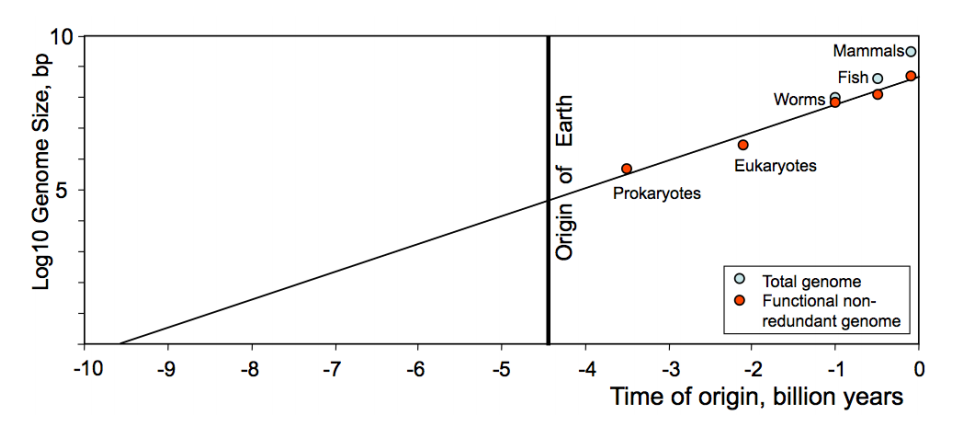
DoctorBit writes "MIT Technology Review is running a story about an arXiv paper in which geneticists Alexei A. Sharov and Richard Gordon propose that life as we know it originated 9.7 billion years ago. The researchers estimated the genetic complexity of phyla in the paleontological record by counting the number of non-redundant functional nucleotides in typical genomes of modern day descendants of each phylum. When plotting genetic complexity against time, the researchers found that genetic complexity increases exponentially, just as with Moore's law, but with a doubling rate of about once every 376 million years. Extrapolating backwards, the researchers estimate that life began about 4 billion years after the universe formed and evolved the first bacteria just before the Earth was formed. One might image that the supernova debris that formed the early solar system could have included bacteria-bearing chunks of rock from doomed planets circling supernova progenitor stars. If true, this retro-prediction has some interesting consequences in partly resolving the Fermi Paradox. Another interesting consequence for those attempting to recreate life's origins in a lab: bacteria may have evolved under conditions very different from those on earth."
This is a fine example of how not to use arXiv as a news source. This old yarn has been trotted out before, and it is based on bad assumptions about complexity and offers a handy False Dilemma Fallacy.
Either
1+1=6 or
1+1=8.
1+1=6 is disproved, so 1+1 =8!
Or your math is wrong.
Complexity != genome size.
See c-value enigma.
This is dealing with evolution, not origin of life. While it fits even less with a strictly literal interpretation of the Bible than life originating on Earth, it weighs neither positively nor negatively on whether life arose on its own or was created by a deity.
http://xkcd.com/605/
All of this assumes that the complexity of life, as he defines it, increases at a relatively constant rate. There is no reason that this has to be true. Environmental effects on organisms increases selective pressure and causes evolution to progress at a faster rate. Cataclysmic events happen every now and then and causes extinctions and hardship on surviving organisms. Seems pretty uneven to me...
"Here Lies Philip J. Fry, named for his uncle, to carry on his spirit"
This is just talking about exponential growth rates and using that to estimate the start of life. Apparently, the editors of /. can't understand exponential growth without thinking of Moore's law.
"SARS and the Origin of Life"
"Horny Rabbits and the Origin of Life"
"Rice on a chess board and the Origin of Life"
PROTIP: Just because there is exponential growth doesn't mean a subject has anything to do with Moore's "Law".
It does, however, use a metric pretty much meaningless to biology and comes with an answer that will get it some attention from the tragically retarded known as scientific journalism (and by extension, Slashdot editors).
The world's burning. Moped Jesus spotted on I50. Details at 11.
"unless the creator helped things happen this way for the purpose to create intelligent life."
Assuming that humanity is evidence of intelligent life is a very big assumption.
The assumptions in the article are especially suspect, given the large number of quite well documented "explosions" of genetic diversity in Earth's history (see, e.g., the Cambrian Explosion for the biggest example, though there are plenty of lesser events), where gigantic leaps in genetic diversity appeared over (geologically) short timescales. An extrapolation assuming a generally smooth growth rate is simply untenable.
what could possibly go wrong, particularly when you extrapolate twice as far as you actually have data for.
... Cataclysmic events happen every now and then and causes extinctions and hardship on surviving organisms
Indeed, it appears that periodic cataclysmic events are required in order to keep evolution going.
We've seen several eras in Earth's history where life appears to "stagnate" at some level, proceeding with little-or-no change for long periods. The last of which was the "age of dinosaurs", which lasted 170 million years or so, depending on how you define the starting point. It ended with the Chicxulub impact.
We also see numerous examples of species which are largely unevolved; for example, ants have been around for 120 million years and one species of prehistoric ant is apparently still living in the Amazon. Coelacanths have been around in their present form for about 400 million years.
The overall impression is that life tends to "stagnate": once life evolves into an efficient survival mechanism, there's no pressure to evolve further. Evolution aims at being a better "fit" for the unchanging environment, but more complexity is simply not needed.
This is why I believe the Drake equation is overly optimistic. I think it omits the factor "fraction of star systems that experience occasional planetary meteor strikes". If we ever travel to another star, we're likely to find it teeming with life, but stagnated at some level.
This may be one factor (of possibly several) that explains the Fermi paradox.
The "doubling rate" identified in the article may be an artifact of Earth, and that's only if Genome complexity is even a reasonable measure to make. Lilies have 30x the genome size of humans - another explanation might be that genome complexity is related to genome size, which does not have much selection pressure. It's not a peer-reviewed paper.
Since the supernatural is completely imaginary
It depends on how you delimit natural. Math and logic laws aren't natural, at least in the sense that they're causal results from some physical/material/energetic/whatever process. In fact it can be argued it's the other way around, and nature as a whole "follows" the principle of non-contradiction, arithmetic, generalized geometry. That's pretty supernatural for me, in the strict sense of "beyond nature".
Still no literal "bearded man in the sky"-style deity though.
Conservatism: (n.) love of the existing evils. Liberalism: (n.) desire to substitute new evils for the existing ones.
I guess Moores Law proves Intelligent Design! :) Oh wait... Intel... I mean Intel Design... :)
http://www.beanleafpress.com
A transistor isn't much of a computer, but it is a switch, and three of them is a logic gate. 3 nucleotides is not a genome of a living thing. There's no point in extrapolating the length of a genome below the minimum length of a viable genome if the question you're trying to ask is "when was the first genome?" The graph shows billions of years of very short genomes starting at 9 BCE.I don't know what the minimum genome is, but I'm sure it's not 1 pair, or 3 pairs. A good guess would be the 4 BCE mark on the graph, though.
On the other hand evolutionists rarely notice that a process of natural selection doesn't create something "new", it only causes a (mathematically preexisting) potential arrangement of atoms, one of an infinite set, to actually appear
The problem with "philosophical literacy" is that it makes you say things like "mathematically pre-existing" as if it meant something other than "non-existent".
You seem to want to reify the mathematical language we use to describe reality, as if the tool we use to describe the world and which we have invented and adapted to describe the world ever more deeply, somehow "predates" the world that language was invented to describe.
I see no reason to privilege math over English in this regard. Both are just languages we use to describe, understand and communicate our understanding. Neither has any ontology apart from us, the beings who invented them, and to impute otherwise is both unwarranted and uninteresting. There is no explanatory need to do so, nor any operational test we can apply to test the validity of the hypothesis (although it would be damned interesting if you could come up with one.)
There are certainly many cases where our mathematical description has to be "fixed up" by hand to actually describe the world, the most obvious one being the excess of solutions to almost all the basic differential equations we use in physics, particularly the things like the backward-in-time solutions to any given wave equation. (That the time-reversed solutions of the Dirac equation can be given meaning does not change this, it merely emphasizes what a poor tool mathematics is for describing the universe in all the other cases where the advanced wave has no apparent physical meaning.)
Given what a lousy tool math is to describe the world, it would be very, very weird if the world were somehow "following" math. The hypothesis that we invented math to describe the world in much the same way we invented to stone ax for changing the world looks a lot more plausible.
Blasphemy is a human right. Blasphemophobia kills.