 Slashdot Mirror
Observed Atmospheric CO2 Hits 400 Parts Per Million
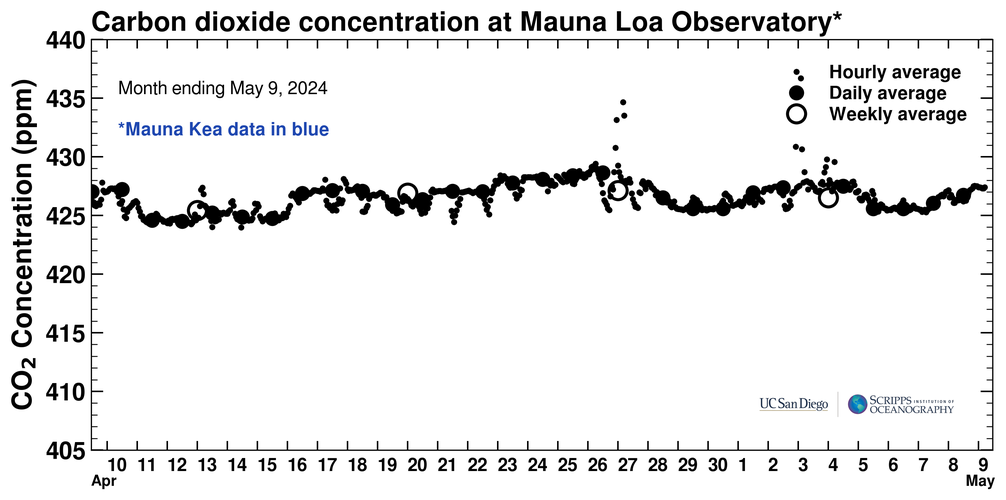
symbolset writes "Over the past month a number of individual observations of CO2 at the Mauna Loa Observatory have exceeded 400 parts per million. The daily average observation has crept above 399 ppm, and as annually the peak is typically in mid-May it seems likely the daily observation will break the 400 ppm milestone within a few days. This measure of potent greenhouse gas in the atmosphere should spark renewed discussion about the use of fossil fuels. For the past few decades the annual peak becomes the annual average two or three years later, and the annual minimum after two or three years more."
Might be better for warming argument if mean avg global temp hadn't been declining whilst CO2 concentrations increased.
Just one of many articles that a Google search turns up. See http://www.sciencedirect.com/science/article/pii/0012821X9500213V
> Atmospheric PCO2 as determined from the goethites in these four âoewell-behavedâ
> cases ranged from values indistinguishable from modern (within analytical
> uncertainty) to values up to approximately 16 time modern (modern
> atmospheric PCO2 was taken to be 10â'3.5 atm). One interpretation
> of the fifth, âoeanomalousâ, comparison is that atmospheric CO2 levels
> increased from about 3 times modern to about 18 times modern from the
> Triassic into the Early Jurassic. This inferred value for the PCO2 of the
> Early Jurassic atmosphere is not uniquely constrained by the existing data
> and needs to be substantiated. However, even considerably lower Early
> Jurassic atmospheric PCO2 values of 6 to 9 times modern (i.e., 1/3 to 1/2
> of the estimated value of 18 times modern) would still indicate significant
> differences between the global carbon cycles then and now. These
> results highlight the need for more research on the behavior of the
> atmosphere during and after the Triassic-Jurassic transition.
Guess what...
* planet earth didn't blow up
* it didn't turn into a Venusian hell
* planet earth had some of the lushest growth of flora and fauna in its entire history
I'm not repeating myself
I'm an X window user; I'm an ex-Windows user
That's not really quite right...there have been several predictions from the AGW crowd that have proven to be less than accurate. One of the more notable was for an "ice free Arctic by 2000" and recent prediction that it would be ice free by 2013 (to be fair there are a couple of months yet there). These perhaps prove your point that making predictions with human factors involved is chancy at best.
On the other hand, that's not particularly an answer to the question I asked. Groups like 350.org are asking for a dedicated, wholesale change to the entire economy of the planet in pursuit of what is (at best) an unproven goal. What is missing from their website is any estimate of how much this would cost, or how long it would take.
Nobody is saying once we hit the magic 350ppm we'd have to stop all these great things they want to do. I'm just asking how long they think it would take to get there if their agenda was widely adopted.
Ferret
From the High, Snowy Mountains of Colorado
Sic gorgiamus allos subjectatos nunc