 Slashdot Mirror
LXDE Previews Port From Gtk+ 2 to Qt
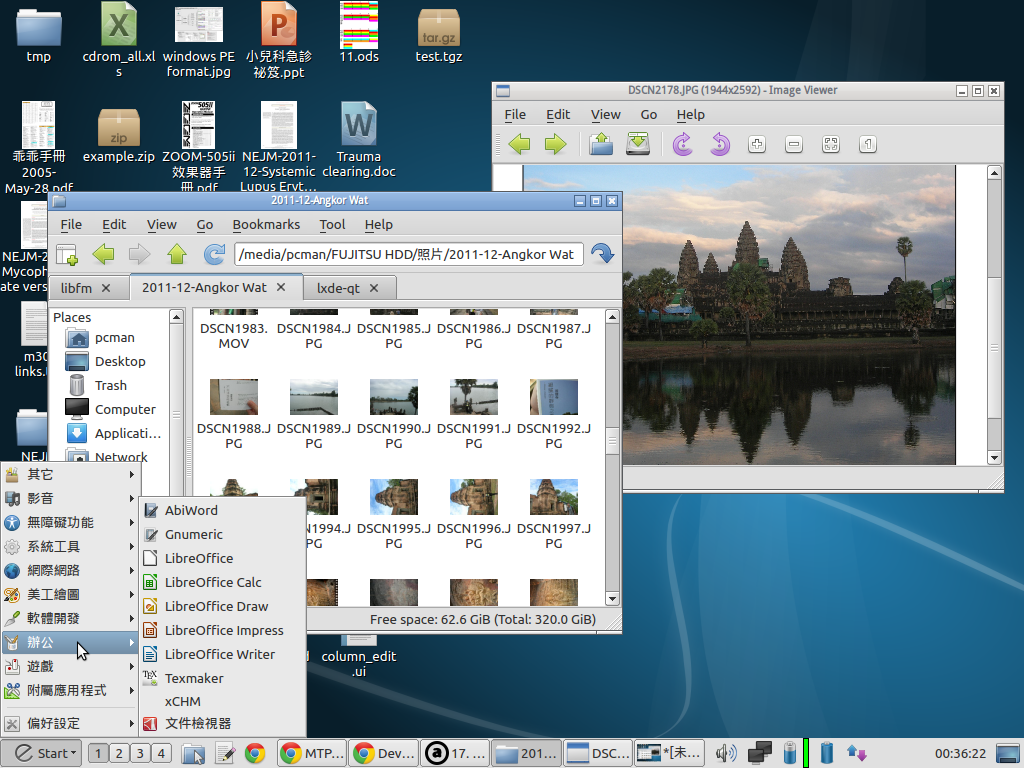
An anonymous reader writes "As the PCMan at the LXDE blog lets us know, the work on a port of LXDE to the Qt platform is showing promise. As the developers stand to face the deprecation of Gtk+ 2, migrating away from the popular toolkit will soon be necessary. The developers note that migration to Qt 'will cause mild elevation of memory usage compared to the old Gtk+ 2 version,' but clarify that a similar increase in resource usage is expected of a migration to Gtk+ 3. Yet, the port to Qt is ongoing, and clearly taking shape, as the screenshot shows. An official release might be a while, though. As an update to the post notes, the plan is to use the recently released Qt 5.1 in the future, which we might not see in distros for some time."
They are also cooperating with the Razor Qt desktop. From the weblog post: "...We subscribed razor-qt google groups and discussed about possible cooperation earlier. Currently, the ported LXDE components are designed with Razor-Qt in mind. For example, PCManFM-Qt and LxImage-Qt will reads razor-qt config file when running in razor-qt session. We’ll try to keep the interchangeability between the two DEs. Further integration is also possible. Actually, I personally am running a mixed desktop with LXDE-Qt + Razor-Qt components on my laptop. Components from the both DE blends well."
Serious question, I'm assuming that there was a specific reason for going with QT and not GTK3; anyone know why?
I'd like to see all Linux projects standardize on Qt as a their Gui toolkit. I understand why everyone has their own but the war is won and Qt won it.
Python: 'And then suddenly you have a language which says "we're all stuck with whatever the whiniest coder wants".'
Personally I hate the Qt APi. It has its uses. The cross platform capabilities are a lot better and it has a lot of functionality built-in that you can only get as separate external libraries with GTK+. But I disagree that it is better to program for. GObject may be verbose but to me the object model, class hierarchies, etc make a lot more sense.
Here's a good history by RMS: http://www.linuxtoday.com/developer/2000090500121OPLFKE. Note that since then, Qt is now under the GPL v2.1; however, because of the history, I think most developers fear tight integration with it. "Will they ever remove the GPL in a new version one day?" is the thought in some people's minds. A lot of F/OSS may sound ridiculous and like paranoia, but it's paranoia that keeps companies like Microsoft out of the OS that we geeks love so much. Having said all of this, my personal opinion is that Qt is fine now and that the paranoia is unwarranted, but it still exists.
The G
I'd like to see all Linux projects standardize on Qt as a their Gui toolkit. I understand why everyone has their own but the war is won and Qt won it.
War..Won!? All I see is healthy competition, and personally I run a whole host of Applications that I don't care what toolkit they are in. Having a look around there are some absolutely stellar QT applications http://calibre-ebook.com/, k3b http://www.k3b.org/ (although not in development for a while), MP3 Diags http://mp3diags.sourceforge.net/ and of course Clementine http://www.clementine-player.org/about. There are a few programs that can run either that I use Transmission http://www.transmissionbt.com/ and Avidemux http://fixounet.free.fr/avidemux/ . But the Bottom line is GTK+ seems as popular as ever, and still more popular than Qt.
What is most bizarre is this about this is LXDE is looking great, a Desktop we don't hear about often enough, and is looking like a desktop I would use...half this discussion is about lets be honest a license subtlety I don't care about.
Most importantly, the KDE community, way back when Nokia bought Trolltech, has managed to get in the contract a clause (still valid under Digia ownership) that says if Nokia/Digia doesn't release new versions of Qt under a free license (currently it is - to correct you a bit there - under the LGPLv2.1) for 12 months, then everything is automatically given to the community under a BSD license.
http://www.kde.org/community/whatiskde/kdefreeqtfoundation.php
To me, this is a good thing if it joins with and speeds up Razor-QT development. Many times I wished for a lightweight QT-based desktop (but realistically, I'm so content with XFCE+openbox I'll probably never switch)
How many times has firefox been ported to qt at this point? I remember at least two separate times that it almost got into a usable state but was then abandoned.
Everything will be taken away from you.
I'd like to see all Linux projects standardize on Qt as a their Gui toolkit. I understand why everyone has their own but the war is won and Qt won it.
Because it was a commercial library for a long long time and people went with alternatives, similar to LessTif vs Motif back in the day.
Understanding the scope of the problem is the first step on the path to true panic.
It is both LGPLv2 and GPLv3.
I don't have anything against Qt, but what makes you think that it "won"? Off the top of my head, I can't think of any major open source desktop applications that use Qt (other than those bundled with KDE). They all use GTK+: Firefox, LibreOffice, Chrome(ium), Gimp, Gnome, Eclipse and every Java app that uses SWT (and every Java app that uses Swing emulates GTK+ not Qt).
the paranoia is unwarranted, but it still exists.
It may well be there, but there's also a marginalization of Qt/KDE by some of the largest distros (perhaps with that canard). If you look at the companies backing them, you'll see many @bigco addresses on the GNOME-related software teams and many, many fewer working on KDE. So I think some of it is simply NIH, but perhaps with a business strategy aspect of, "Who is Digia and why should BigCo be dependent on them when we have an alternative we control, even if it's not as good?" That question may have even had more merit under Nokia, especially when it was taken over by Microsoft (oh, did I say that out loud?).
Even if it's a false dilemma, it probably keeps many people working on the projects they like inside their comfort zone. Big choices can be made on merit, but there are sometimes humans involved who apply criteria without pure impartiality. Sometimes these bigco's pick a technology horse, and boy do they stick with it until it needs to be brought out back and shot. Qt/KDE is definitely not alone in that regard!
My God, it's Full of Source!
OUTSIDE_IP=$(dig +short my.ip @outsideip.net)
I already have QT and such installed on my LXDE machine due to a couple of KDE apps I fell in love with. They work fine under Openbox/LXDE, so shouldn't be much of a problem to convert over to the new QT based DE.
The problem isn't running QT based apps under Openbox/LXDE. The problem is rewriting LXDE componets to use QT to draw to the screen instead of GTK2. They are basically rewriting the panels and all the other components to call QT libraries instead of GTK2 libraries.
Skype?
I think this dates back to the early Gnome 1 days. Compaq, Debian, Eazel, Free Software Foundation, Gnumatic, Helix Code, Henzai, Inc., IBM, Sun Microsystems, and VA Linux Systems were the guys behind Gnome 1. That's where the big company support started.
The big company Qt guys were SUSE (Novell), Turbolinux (Asian still big) Conectiva (now merged with MandrakeSoft to form Mandriva) and Caldera (SCO).
When Nokia owned Qt directly that certainly helped but Nokia was very parochial in its interests. Both Gnome and KDE are underfunded at this point.
I'm still on Motif you insensitive clod.
I was in the same boat but I finally adopted VLC as my media player and it depends on the basic Qt libraries. It is so much faster to start and uses the least memory of any video player, for GTK+ or Qt. It really proves to me that Qt code can run just as fast as GTK code, even on a primarily GTK machine.
Also bear in mind that LXDE has not yet announced any plans to drop GTK support, but GTK3 team has been openly dismissive of anyone not developing for Gnome in specific, so it may be inevitable.
From a user standpoint, I have a different question, or a variation of this one. Why would anyone who needs a Qt based environment prefer LXDE, which is just beginning now, over Razor-qt, which has been around a bit and has a considerable headstart? Although I'd welcome these 2 merging, if that's what happens.
I don't have anything against Qt, but what makes you think that it "won"? Off the top of my head, I can't think of any major open source desktop applications that use Qt (other than those bundled with KDE). They all use GTK+: Firefox, LibreOffice, Chrome(ium), Gimp, Gnome, Eclipse and every Java app that uses SWT (and every Java app that uses Swing emulates GTK+ not Qt).
VLC media player is qt-based
And this other is less known but even more impressive, Velneo: www.velneo.com It's a RAD tool, where the awesome productivity is cross platform.
Check a full-fledged ERP, running i Android http://www.youtube.com/watch?v=iXluV5jvmc0 The very exact set of advanced corporate features are available in Windows, MacOSX, Linux and Android. In the video, it is shown accessing a remote database in realtime. I tested it on my own, you develop once, and you don't have to know anything advanced about Windows, Android, MacOSX or Linux, to run the software you developed in such OS.
The power of Qt is noticeable in Velneo, and I talk after a decade and half of experience in software development, including using mainstream development tools.
Not if you want things like menus and buttons, which I've heard Firefox has.
I heard the next version will be removing the last of them, since they confuse users.
If they simply stated than GTK should be considered a gnome component versus gnome independent, that doesn't necessarily bother me as it is a game of semantics. However, the key sentiment that strikes me as counter-productive:
"You can't just write something for 3.0 (be it an application, a shell plugin or a GTK theme) and expect it stay working that way forever. Instead you need to constantly improve on your work."
Which is a huge 'screw you' to backwards compatibility. To say that reworking perfectly working code repeatedly due to platform fickleness is to 'improve on your work' is extraordinarily asinine.
As a developer supporting a platform, I understand the appeal of declaring I have a free hand, but I know that attitude would make my solution impractical to consume. That's the whole point of 'major' releases with naming conventions that allow coexistence with 'older' streams on s system, to assure continued value to those who consumed the library. This is a standard that gnome has already badly broken (see MATE being forced to rename libraries because gnome reused a number of names in an incompatible fashion).
XML is like violence. If it doesn't solve the problem, use more.