 Slashdot Mirror
A Math Test That's Rotten To the Common Core
theodp writes " The Common Core State Standards Initiative," explains the project's website, ""is a state-led effort that established a single set of clear educational standards for kindergarten through 12th grade in English language arts and mathematics that states voluntarily adopt." Who could argue with such an effort? Not Bill Gates, who ponied up $150 million to help git-r-done. But the devil's in the details, notes Washington Post education reporter Valerie Strauss, who offers up a ridiculous Common Core math test for first graders as Exhibit A, which also helps to explain why the initiative is facing waning support. Explaining her frustration with the intended-for-5-and-6-year-olds test from Gates Foundation partner Pearson Education, Principal Carol Burris explains, "Take a look at question No. 1, which shows students five pennies, under which it says 'part I know,' and then a full coffee cup labeled with a '6' and, under it, the word, 'Whole.' Students are asked to find 'the missing part' from a list of four numbers. My assistant principal for mathematics was not sure what the question was asking. How could pennies be a part of a cup?" The 6-year-old first-grader who took the test didn't get it either, and took home a 45% math grade to her parents. And so the I'm-bad-at-math game begins!"
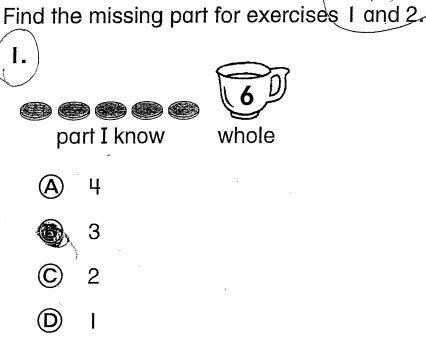
Yeah, why pennies, and why a cup? I'm guessing the answer is D, 1, based on the number on the side of the cup, but that's a guess.
And what about #12? What the heck is a "subtraction sentence"? Why are there no subtractions in the answers?
The question is clearly ridiculous. The problem lies there and solely there though, unlike as the article suggests. Expecting 5 or 6 year olds to be able to do basic addition and subtraction of small quantities of physical items is not a problem at all –that's exactly what I'd expect a 5 or 6 year old to be able to do. Writing crappy questions like pearson has is absolutely a problem though.
This is a test for 5 year olds just joining school FFS
I don't see the Common Core standards as the problem, this is just a poorly written test made by people who were not the authors of Common Core. Unless I misunderstand, Common Core simply defines what skills a student should be proficient at by the end of school years. It doesn't define these test questions, Pearson Education did.
Question 1: You see 5 pennies, the total in the cup is 6, so the missing part is 1 (penny). How hard can that possibly be?
If you see five, and there are six more in the cup, then the total is eleven. If only one is missing, then which one?
There do not appear to be any coins in the cup. It appears to be full of liquid with the internal liquid level line.
There is a number 6 under the cup, it does not say 6 coins. Why would there be coins in cap anyways? You put liquid in cup.
"Find the missing part?" is a bad question. If anything it should ask about coins, not parts.
There are no parts missing all the coins are whole so is the cup.
The whole thing is not clear and misleading.
You are assuming the question is asking about the sum of coins. That is not indicated by the question.
Having to make assumptions about a question is very very wrong when it is not a written test where one can explain the assumptions one has to add to a question.
Ridiculous. You have five out of six, so the remaining part is 1/6. That makes at least as much sense.
Take a look at some of the tests from a hundred years ago and try your luck at passing them, or read reports written by sixth graders in 1900. Impressive, huh?
Part of the reason for that apparent phenomenon is that the kids who weren't actually near the top of their class in 1900 didn't go to school. Most 12-year-olds were working, either in factories or on family farms. Illiteracy and innumeracy was much much higher than it is today: Many many people not only couldn't have passed those tests, many people couldn't even read the numbers or hope to add them together. The fact of the matter is that according to even cursory study of the issue demonstrates that on average Americans are better educated now than at any time previously in the entire history of the country. The idea that there was some kind of idyllic America with great educational systems some time in the distant past is just nonsense.
I am officially gone from
Then just ask "what is 6 minus 5". Why make the question ridiculous?
now we need to go OSS in diesel cars
Buy you're wrong. The answer is 1 penny plus 1 cup. That's why you always need to be explicit with units, to avoid making the mistake of thinking it's merely just one penny.
As copyright owner of this comment, I authorize everyone to defeat any technological measure which limits access to it.
It's easy to say "teachers who can't teach shoudl be fired" without looking at that fact that in many states the annual salary for a teacher is a paltry 35K / year or under. NO ONE wants to teach because they are paid horribly, are constantly lambasted by the public, and in many inner cities it is a dangerous job to boot. Teaching is not paid at the level it should be in the united states. You aren't going to get good teachers if you don't pay them a living wage.
Other than that? That was the entire problem. Look, we're adults and we can say "they probably meant to have this be a problem about subtracting 5 from 6, and the fact that the 5 was in pennies and the 6 wasn't was just some boneheaded test writer." A 6 year old may very well not figure that out even if he can subtract.
There's also a question of if a poorly written problem like this slips through, how shoddy the system of test reviewing is in the first place and so how many other problems are as bad.
$70k of student debt, $35k/year income, got 30 kids to watch during the day, and spend all night scoring their stuff. Fun times! Maybe they'll have their debt paid off by the time they retire.
Well, sure, you were able to take what has to be one of the most pathetic examples of muddiness I've ever seen, and by a rather sophisticated exercise of elimination of possibilities, construe what must have been the intent of its creator. That was a much more difficult problem than the arithmetic problem that it was intended to represent, and you are no 5-year-old.
Those who would give up essential liberty to purchase a little temporary safety, deserve neither liberty nor safety.
Well, according to the illustration, the cup is full of milk... which lends credence to your theory.
I am very small, utmostly microscopic.
Bob has 5 apples. Bob gives 3 of his apples with Alice. How many apples are there?
How many apples are there? There are five. Bob has two, and his idiot friend Alice has three.
Actually, since you didn't specify where we're looking, there's no way to even answer that.
Ignorance is a choice
The test is being given to 6 year olds with marginal reading abilities.
And that's part of the problem. By age six, reading abilities should not be marginal. At age three, yes. But if you haven't taught your kids to read reasonably well by the time they're six, either they are stupid or you are.
What strikes me about this test is the utter alienness of its language and symbology.
Okay, it's been half a century since I took a test intended for children entering elementary school. I recognize a few of the sentence forms. Somebody has a certain number of guitar picks and gives some away, no problem. But the bizarre pennies to coffee cup equivalence, what the fuck is up with that? Who thought it was a good idea to assume that young children would know that the sentence in "number sentence" means what the rest of the world generally calls an "equation", or that a "subtraction story" conversely means a word problem? What is a "related subtraction sentence" and how does it differ from an ordinary subtraction sentence? Why are you using passive voice to ask questions of a five-year-old? Why do you think we need cubes to solve a linear equation?
What's meant by the fragmentary term "part I know"? Dude, I have no idea what you know. Try speaking in full sentences, like we're taught in school. Oh, right.
In short, this seems substantially to be a test of cultural indoctrination whose arithmetic pales in comparison to the challenge of getting inside the parochial mind of whoever developed the test. I'd be proud if my child failed this test. It's beyond absurd; I find it positively bigoted. These people need to get out and see more of the world.
Parity: What to do when the weekend comes.
If you've listened to the instruction that goes along with the test, it would be clear what to do. My first grader has no problem with these problems. He's told me that the teacher has explained the technique and he recognizes it from the questions that are asked.... Without understanding the context in which things are taugh, you can't judge the tests that are used. This test is not ridiculous when you look at it in proper context.
Some people want to make political hay out of this, since they feel that they are losing local control. Or they are secretly against a good public education, so they oppose real attempts to raise the standards, think outside of the box and teach the concepts that will form the foundation of a lifetime...
While Bill Gates and others may talk about the declining state of education, there is a real movement by conservatives to use public money that funds education to enrich those who teach, by privatizing schools.
The Common Core is a strategy to standardize the curriculum across all the 50 states (which isn't a bad idea) but the people who write the standards and create the tests don't have our best interests at heart. By creating ludicrous tests, they are going to "prove" that the US students are failing terribly, especially those in public schools. Then there will be demands of reform, where they will promote pseudo public schools that use public funds ran in a for profit manner.
Once that happens, education which should not be a for profit enterprise, would be transformed into private enterprises that uses public funds to enrich companies like Pearson, Amplify, Thompson, etc.
What I want to know is why these people aren't hunted down and branded with a big "Useless, do not employ" on their foreheads?
No sig today...
Not just "friend and ally", but also a very wealthy country — whereas the text was implying, the hijackers came from an impoverished one...
In Soviet Washington the swamp drains you.
If you've listened to the instruction that goes along with the test, it would be clear what to do. My first grader has no problem with these problems. He's told me that the teacher has explained the technique and he recognizes it from the questions that are asked.... Without understanding the context in which things are taugh, you can't judge the tests that are used. This test is not ridiculous when you look at it in proper context.
when you ask a simple question in a simple way, you test a child's ability to understand concepts. When you ask a simple question in an overly convoluted and distorted way, you test a child'a ability to follow directions. The school district makes clear which kind of test this is supposed to be.
honestly people, a test for first graders that is hard to understand for many slashdot readers, including myself??? "you can't take it out of context, there are accompanying teaching segments, etc". I'm going to go out on a limb and say that you should be able to isolate a math question of "6 - 5 = ?" and be able to understand it outside of context.
Based on the language, another valid answer is 6 since there are still 6 guitar picks. Now if it had asked "How many picks does she have left?", then the answer would be 2, but it asks "How many are left?" Awful question. I ran into this a lot in 1980s elementary school. I would get frustrated and go up to teachers during the test and ask which way it was meant to be interpreted. Many would get frustrated with me, instead, thinking I was just causing trouble, but a few teachers were actually honorable enough to announce the proper interpretation to the class, or throw out the test and have us retake it, modified.
I don't know about that weird language, but I'd guess it's the result of too much ideological abstraction. When it comes to ideology, a lot of state organizations operate under some-is-good-therefore-more-is-better. This particular doctrine was probably started as a way to reduce fear of math in the student, and now it's been taken to ridiculous extremes. I don't even know what 'number sentence" (equation?) or "subtraction story" (?) mean.
While I agree with your overall point, I disagree with that. Whether the phrasing is easy to understand or not entirely depends upon whether you have been exposed to that phrasing before.
I agree with that. I would have no problem with a math test that exclusively featured problems in the patterns of:
6 - 5 = ?
6 - ? = 1
? - 5 = 1
Then, a DIFFERENT test with word problems. And if the school feels it necessary, a THIRD test with pictograms (or whatever).
I know adults who have no problems with basic math but who cannot figure out a word problem. Those seem to be two different mental processes. So combining then into one score and on one test isn't very helpful. And probably leads to a lot of wasted time due to stress when the student hits a word problem.
The questions should be obvious, clear, and unambiguous in written and verbal form, period, with no conflicts between the two. There's no reason the teacher should have to prop it up. If there's anything political in this, it has to do with the test writers spending too much time huffing ideological ivory tower vacuum over the fear-of-math 'problem.' The sad part is, they've abstracted so far, it actually makes many of these math problems more ambiguous to people having trouble with it than the traditional word problem would.
Thinking out of the box is fine. However, as a student who often thought out-of-box, looking at question 6, I see immediately, based on the language, that there are at least two answers: 2 and 6. The test writer only meant for one answer to be correct, so the question is badly worded. "Part I know" also sits wrong with me. It sounds like retard-speak. As a student, knowing you're being graded on this, which would you pick? I would guess 2 and hope for the best. Learning math should not be this way.
This demonstrates why problems should be tested by real kids before being released on the masses.
One, albeit simplistic, test is to determine if particular questions are more likely to be answered "incorrectly" by kids who did well on other questions than by kids who didn't do well on other questions. If the problem is supposed to be hard, smart/more mature kids should do better on it than other kids. If the problem has been made hard by unintended ambiguity, smarter/more mature kids are sometimes more likely to get it wrong as they try to make sense out of the chaos that they are more likely to detect.
Although it may be too complicated for first graders, the "test group" might also be asked to mark each question with "how sure are you that you got the right answer (certain, somewhat sure, quite unsure)" to detect when kids feel they had to assume facts not in evidence to try to answer the question.
Sort of like politics - simplistic people come up with simplistic answers because they often fail to see the underlying and more subtle issues.
Why is there an "insightful" mod and why isn't it "-1"? If I wanted insight, I wouldn't be reading
Point taken. Locals can fail utterly, and dismally. But, they can't fail on the same scale that federal government can fail!
Let us imagine that half of the school districts in the US prove to be utter failures. In that case, why on earth is it necessary for the federal government to spend untold billions to assist in their failure?
Oh, wait. I don't need an answer to that. It's obvious, really. Government meddling helps to insure that failure is uniform across the nation!!
"Windows is like the faint smell of piss in a subway: it's there, and there's nothing you can do about it." - Charlie Br