 Slashdot Mirror
A Math Test That's Rotten To the Common Core
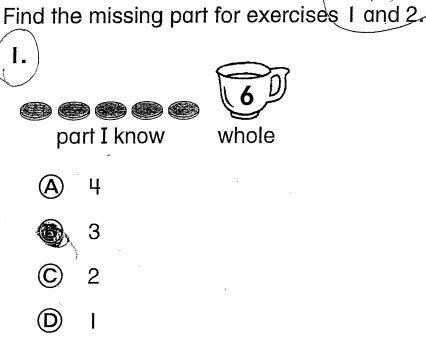
theodp writes " The Common Core State Standards Initiative," explains the project's website, ""is a state-led effort that established a single set of clear educational standards for kindergarten through 12th grade in English language arts and mathematics that states voluntarily adopt." Who could argue with such an effort? Not Bill Gates, who ponied up $150 million to help git-r-done. But the devil's in the details, notes Washington Post education reporter Valerie Strauss, who offers up a ridiculous Common Core math test for first graders as Exhibit A, which also helps to explain why the initiative is facing waning support. Explaining her frustration with the intended-for-5-and-6-year-olds test from Gates Foundation partner Pearson Education, Principal Carol Burris explains, "Take a look at question No. 1, which shows students five pennies, under which it says 'part I know,' and then a full coffee cup labeled with a '6' and, under it, the word, 'Whole.' Students are asked to find 'the missing part' from a list of four numbers. My assistant principal for mathematics was not sure what the question was asking. How could pennies be a part of a cup?" The 6-year-old first-grader who took the test didn't get it either, and took home a 45% math grade to her parents. And so the I'm-bad-at-math game begins!"
This is a comment that I hear frequently from my friends that are teachers; most standardized tests don't actually test the skill they're intending to evaluate.
or read reports written by sixth graders in 1900.
I'm calling bullshit on this. Part of my job a couple of years ago was handling university archives. I was exposed to a large number of essays written by college students from ~1890-1910. They were all on the level that I was expected to write freshman year of high school.
Someone at Pearson came up with a bad question.
They meant for that question to coincide with the standards which say subtraction should be taught. How the heck do you leap from "Pearson has some bad questions" to "curriculum standards are bad"? Common Core may be bad, it may be good, TFA gives no reason to believe either. They only show that Pearson's implementation has some errors.
We teach firefighting, construction safety, and other topics that have specific codes and standards students need to learn. When we realize we have a bad question we don't say "construction codes are bad and students shouldn't be expected to learn them", we say "this question is bad and we should rewrite it so it better gauges the student's understanding".
There are a couple of statistical calculations test makers can use to find and fix bad questions. It doesn't appear that Pearson used those (yet). If they run the calculation, they'll see which questions are bad and can fix or remove them.
Obviously if fewer than half of students get a question correct, it's probably a bad question. There are other calculations which are similar but more advanced. Look at a properly designed quiz covering the same subject, one with well vetted questions, and I bet it looks a lot better. Questions like "Imagine you had four cookies and gave one to your sister. How many would you have left?" also meet the common core standards, and that's probably a good question for a certain grade level.
It's hard because the people writing the test have no experience writing for an audience.
When you write for an audience, you quickly come to understand that things you think are obvious aren't obvious to everyone, and that any loose or fuzzy choice of words adds ambiguity. It's the problem of self anchoring and illusion of transparency.
Specifically in the case of the test:
Test modes are introduced with only a brief explanation and no worked examples for clarity.
"Find the missing part for exercises 1 and 2" is weak, non-specific, and ambiguous. "Part" has connotations of a physical piece that completes a whole (like a puzzle piece, or the broken handle of a cup), but is used to describe a grouping. The presentation uses two disparate representations of a group: 5 pennies, versus a cup labelled "6". The captions "part I know" and "whole" seem to have nothing to do with the pictures - the 5 pennies isn't a "part", and the cup is a "whole" object, but why is it labelled 6? The cup is non-sequitur to the question, and cups hold fungible materials while the pennies are enumerated. And to drive that last part home, the cup is shown "filled" with liquid. Or is it partially filled? And is the fact that it's partially filled somehow related to the question?
Here's a reworked example that's a little better. (Could be better - I didn't give spend a lot of time.)
For the next two questions, we will show you something on the left and something on the right. Choose the answer which, when added to the thing on the left, makes it the same as the thing on the right.
Example: [left: Square containing 3 circles] [right: Square containing 4 circles]
[list of answers, with circle marked correct].
Question 1:
Show 5 smaller cups (shot-glass sized) filled with a dark liquid. Show a measuring cup with lines labelled 1-7, and filled to level 6 with a dark liquid.
Question: How much more ink is needed on the left to make the amount of ink on the right?
Interestingly enough I was alive at the time of the events of 9/11/2001. And I remember that 17 of the 19 hijackers weren't Afghanis but Saudi Arabian. A full 89% were from our friend and ally in the middle east, Saudi Arabia.
You are correct, and the original article is incredibly misleading.
The Common Core State Standards are, dontchya know, standards. They do not define tests. The states who participate in them can test to the standards. How they choose to do that is not a reflection on the standards themselves.
If anyone cares to learn more about what the standards are, a web search turns up the actual standards pretty easily: http://www.corestandards.org/
Here's the sort of language about testing that actually appears on that site:
Common Core doesn't specify questions or tests - this is just a shitty test, that happens to meet (maybe?) Common Core.
There's a lot of misunderstanding (and hence vitriol) about CC out there; Common Core says your students need to have certain skills. How you develop them is up to you.
https://en.wikipedia.org/wiki/Common_Core_State_Standards_Initiative#Mathematics_Standards
Please help metamoderate.