 Slashdot Mirror
A Math Test That's Rotten To the Common Core
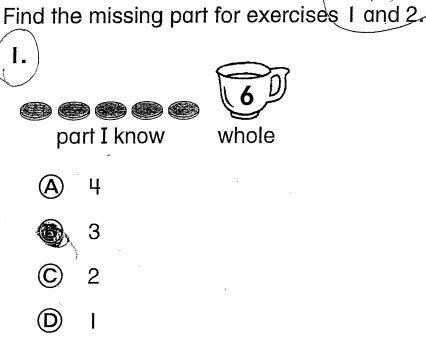
theodp writes " The Common Core State Standards Initiative," explains the project's website, ""is a state-led effort that established a single set of clear educational standards for kindergarten through 12th grade in English language arts and mathematics that states voluntarily adopt." Who could argue with such an effort? Not Bill Gates, who ponied up $150 million to help git-r-done. But the devil's in the details, notes Washington Post education reporter Valerie Strauss, who offers up a ridiculous Common Core math test for first graders as Exhibit A, which also helps to explain why the initiative is facing waning support. Explaining her frustration with the intended-for-5-and-6-year-olds test from Gates Foundation partner Pearson Education, Principal Carol Burris explains, "Take a look at question No. 1, which shows students five pennies, under which it says 'part I know,' and then a full coffee cup labeled with a '6' and, under it, the word, 'Whole.' Students are asked to find 'the missing part' from a list of four numbers. My assistant principal for mathematics was not sure what the question was asking. How could pennies be a part of a cup?" The 6-year-old first-grader who took the test didn't get it either, and took home a 45% math grade to her parents. And so the I'm-bad-at-math game begins!"
An earlier edition of the "Social Studies Extended Response" stated the following (emphasis mine):
In Soviet Washington the swamp drains you.
It's a system full of good intentions, but the people that come up with the questions appear to be gearing things toward a certain way of thinking. I'm all about the system, it is designed to show the children how they think, and how they work out problems naturally, in their mind's eye as it were.
One problem that I have had with it in the past is that the way the questions allow for assumptions. For instance, I'm from Alabama. In Alabama it's generally hot and humid. When we take our kids to the park, they generally are wearing sandals or flip-flops. Any time they're playing in the sand, they're going to be bare-footed, or at the most, sandals/flip-flops. They give the kids a story to read about a kid that goes to the park. The story is basically this:
Story title: 'A day at the park' Timmy goes to the park. He plays in the park. He plays in the sand. It starts to rain, so Timmy has to leave. Timmy goes home and puts on dry socks. Timmy then takes a nap. When Timmy wakes up, the sun is out. He goes back to the park. Timmy likes the sun. Timmy smiles.
Then the questions that they ask are something like this:
1) What's another good title for this story? a) The sun b) Timmy goes to the park c) Rain and sun d) Timmy takes a nap
2) Why did Timmy put on dry socks? a) Because Timmy was home b) Because his socks were wet c) Because he was sleepy d) Because Timmy wanted to go back to the park
So question #1 is asking for an opinion, and question #2 is asking about something that's not mentioned in the story. After my kid missed both questions, I asked the teacher why, and her answer was that the questions are introducing higher learning. Higher learning? An opinion is higher learning? Asking questions that are full of assumptions not mentioned in the story, is higher learning?
So in that way it needs to be improved upon. But for math, they allow the kids to express the algorithm in any way, and as long as they get the answer correct, and the algorithm that they use is logical, then they're credited with learning. And I think that's way better than, "Here is an algorithm, learn it, and use it." Because if you don't understand how that algorithm came to be, you will not be able to use it in real life. Whereas if you came up with the algorithm yourself, you cannot explain how or why you came up with it, but you understand how to use your brain in the real world.
Politics; n. : A religion whereby man is god.
Show 5 smaller cups (shot-glass sized) filled with a dark liquid. Show a measuring cup with lines labelled 1-7, and filled to level 6 with a dark liquid.
I mean this with no disrespect, because I largely agree with your bigger point. But you've illustrated part of the problem with the original test - People designing tests for kids who don't understand how those kids perceive the world.
Until at least age 7 or 8, and usually later, kids have a very poor grasp of conservation of volumes. They will tend to linearize the problem, seeing the "full" smaller glasses as having the same volume as the marker with the same height on the larger measuring cup.
Question 5 was my favorite WTF.
====
5. Find the missing part.
Write the numbers.
[9]
o o o o [ ]
___ ___ ...and got it wrong.
part I know missing part
====
(the o's are pennies, and the [ ] is a box)
(slashdot is messing up the formatting, or I'm not doing it right)
The student filled in:
_9_ _5_
Yeah, they *wanted* a different answer, but he's still right.
What part does he know? The big "9" in the box.
What part was missing? The 5, which he got right.
If this were for an older student, and if the style of questions was explained and examples provided, then I'd understand that they should listen and comprehend what is expected with certain types of questions, but this is a first grader. The expectations should be very obvious.
Before you write that off as something the student should have understood, take question 6, which is right next to it:
====
Complete the picture.
Write a subtraction sentence.
6. Jennifer has 6 guitar picks.
She gives 4 guitar picks to
her students. How many
guitar picks are left?
[6]
| o | |
| o | |
| o | |
| o | |
__ - __ = __ ... but the "6" is right under the part of the picture that has 4 dots in it (and yes, they're black circles, not triangles as a guitar pick would be... that's just one more stupid little detail that doesn't matter much, but shows the poor quality of the test).
====
The student got this one right:
_6_ - _4_ = _2_
So what is it? Do they write the number that represents the whole first, or the number that represents the dots above the answer line?
There's so much wrong with this test. Even the way it was marked by the teacher is, IMO, in bad form. Incorrect answers have their question number circled, and correct ones have a check mark in the middle of the question space. To see why that's wrong, just look at the students answer in question 8. It's a multiple choice question. He put an "X" through the three he thought were wrong, and circled the one he thought was right. "Circle" means right; "X" means wrong". They expect the child to circle correct answers, but they circle incorrect questions.
BTW, anyone know when they started referring to math problems as "number sentences" and "subtraction stories"? Mixing reading comprehension and math seems like another unnecessary complication for a first grade test.