 Slashdot Mirror
Zuckerberg To Teach 10 Million Kids 0-Based Counting
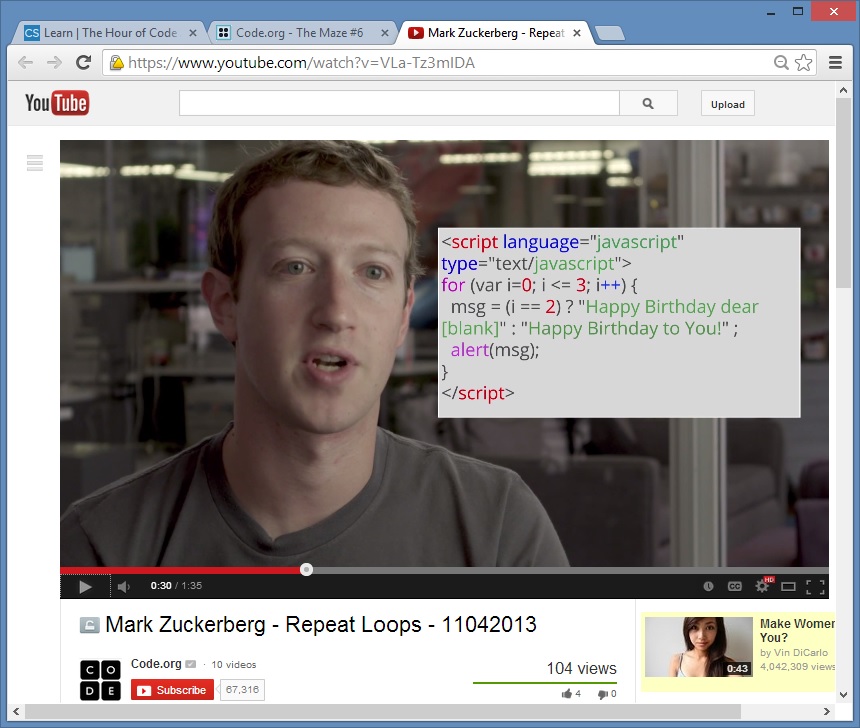
theodp writes "'Why do programmers start counting at zero?' wondered Mike Hoye, questioning the conventional programming wisdom. Code.org will soon introduce the practice to a hoped-for audience of 10 million schoolchildren as part of Computer Science Education Week's Hour of Code. In a tutorial created by engineers from Microsoft, Google, Twitter and Facebook that's intended to introduce programming to kids as young as six years old, an otherwise breezy lesson featuring look-ma-no-typing Blockly and characters out of Angry Birds and Plants vs. Zombies, a Mark Zuckerberg video introducing the concept of Repeat Loops includes an out-of-place JavaScript example that shows kids it's as easy as 0-1-2-3 to generate 4 lines of lyrics from Happy Birthday to You by using zero-based numbering with a For-loop and ternary If statement. Accompanying videos by Bill Gates on If Statements and basketball star Chris Bosh on Repeat Until Blocks show the Code.org tutorial is still a work-in-progress. That's no big deal, since CSEdWeek has pushed back the delivery date for final Hour of Code tutorials from its prior little-time-for-testing due date to Dec. 9th, the first day of a five-day period during which teachers are expected to deliver the lessons to 10 million students."
Iterating through offsets beginning with zero is simply not counting. The writer is confused.
Those who would give up essential liberty to purchase a little temporary safety, deserve neither liberty nor safety.
It is quite true though that the 0-based thing is entirely an artifact of C (and of course languages that cribbed its syntax).
Its not an "artifact of C" its an artifact of reality.
If you allocate 10 bytes at address X, then:
the first one is going to be at address X, the second one is address X+1, etc.
The x[y] syntax then reduces to address x + y
And so x[0] is the byte at x, x[1] is the byte at x+1, etc.
Now you could 1 base the indexes, where x[1] resolves to address of x, but the implementation of that is:
x + 1 - 1, and x[y] in general becomes x + y - 1
That's an extra subtraction instruction on every single array access.
For larger datatypes it becomes:
x + y*sizeof(type) for zero based and
x + (y-1)*sizeof(type) for one based arrays
That's going to be true for any language, and the question is posed to every language designer: either the programmer counts from zero, or every array access in the language has a subtraction added to it.
For C, which is designed to be a bare bones close to the hardware language the decision was a nobrainer, but even for higher level languages its always a choice between a performance hit, or using zero based indexing.
Another wrinkle is that if you use 1 based indexing, then x[0] is undefined.
Another wrinkle is that if you use 1 based indexing then the maximum length of an array was reduced by 1.
No. Ada begins iterating wherever you tell it to. You can index your arrays from -100 to 0 if you like.
I don't deny that it's useful, but Ada does that by effectively adjusting all the indexes to zero based behind the scenes.
"Thinking that's a feature of programming is a sure sign of a inexperienced programmer."
No, only an inexperienced programmer would not understand that zero based indexing is the 'natural' indexing, and that anything else requires extra processing.