 Slashdot Mirror
Non-Coders As the Face of the Learn-to-Code Movements
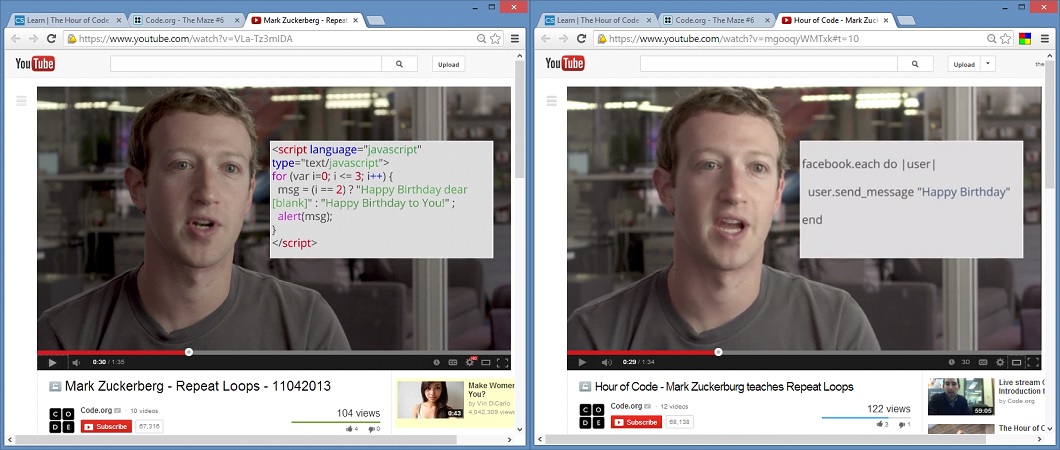
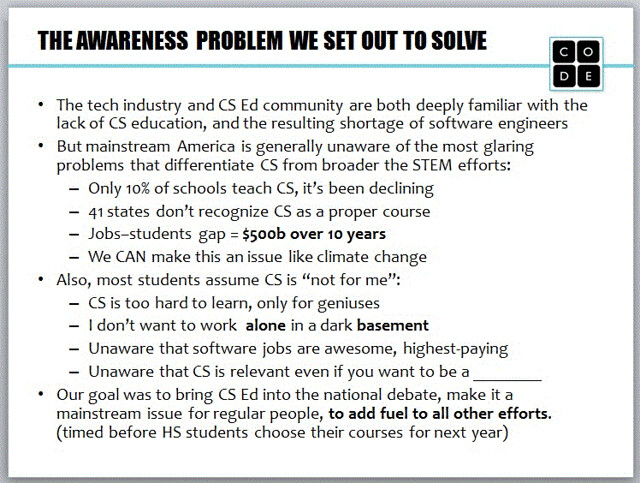
theodp writes "You wouldn't select Linus Torvalds to be the public face for the 'Year of Basketball.' So, why tap someone who doesn't code to be the face of 'The Year of Code'? Slate's Lily Hay Newman reports on the UK's Year of Code initiative to promote interest in programming and train teachers, which launched last week with a Director who freely admits that she doesn't know how to code. "I'm going to put my cards on the table," Lottie Dexter told Newsnight host Jeremy Paxman on national TV. I've committed this year to learning to code...so over this year I'm going to see exactly what I can achieve. So who knows, I might be the next Zuckerberg." "You can always dream," quipped the curmudgeonly Paxman, who was also unimpressed with Dexter's argument that the national initiative could teach people to make virtual birthday cards, an example straight out of Mark Zuckerberg's Hour of Code playbook (coming soon to the UK). Back in the States, YouTube chief and Hour of Code headliner Susan Wojcicki — one of many non-coder Code.org spokespersons — can be seen on YouTube fumbling for words to answer a little girl's straightforward question, "What is one way you apply Computer Science to your job at Google?". While it's understandable that companies and tech leaders probably couldn't make CS education "an issue like climate change" (for better or worse) without embracing politicians and celebrities, it'd be nice if they'd at least showcase a few more real-life coders in their campaigns."
Actually, yes I expect most of them to have nothing to do with the actual endeavor involved.
It's very rare for the President of the Hair Club for men to be in the advertising.
Writing, reading and arithmetic. Then how do you organize a task, a problem. Define what you have, define the goal, investigate what help you can get from tools/people & then define a plan which might get you to the goal. School doesn't tend to teach how to solve problems or tasks early on, but they can do that.
Of course I'm not.
But seriously, am I the only one who doesn't give a shit?
Look, don't code. Don't encourage your kids or students to code. It'll make those who do more valuable. Do mechanics worry about everyone on the planet knowing how to fix their car? Do carpenters spend countless hours navel-gazing about bringing carpentry to school children and girls and the average CEO? Do HVAC specialists?
Do whatever the hell you want to do. The fewer who want to code, the better for the negotiating power and leverage of coders and technologists going into the future.
It's like literacy or numeracy or basic understanding of science. You have a problem as a culture if it is culturally acceptable to say "I can't do math" or "I can't understand written language" or "I have no idea about the universe around me or how people go about understanding it" or "I can't read or write logical directions."
Do you expect everyone to be a best-selling novelist (or a writer that is enjoyed for all history?) No.
Do you expect everyone to be the next Ramanujan? No.
Do you expect everyone to be the next Knuth? No.
But it is expected that everyone have basic skills in these kinds of things. It's just necessary to understand the world. If you don't understand these kinds of things -- if you don't have basic skills in language or mathematics or logic -- then you are at a disadvantage in modern society.
I group computer science'logic here separate from Mathematics. Perhaps it shouldn't be. But having a population that doesn't understand things like this shuold be considered as problematic as a population that can not read and write.
-- Erich
Slashdot reader since 1997
What about a PHD for all with an no questions asked loans that just about the only income they can't get at is your in prison $0.13-$1.00 HR job.
Must be ego deflating for all the coding "gods".
If everyone could program bday cards the world's GDP would rise annually by an additional 5%!!!!
I would hate to live in the world that so many or /. readers seem to live, in which only people who know how to do something can do it, or where coding is a magic that must be protected from the masses. When I learned coding my parents did not know if it would good or bad because few people could do it, but in middle school I was sat down at a teletype machine for an hour a day to learn. I high school I sat down at a terminal and learned to code for real. This taught me problem solving, algebra, trigonometry, and a whole bunch of other stuff that I would haven't learned as well otherwise. Which is beside the point, as coding itself, like reading, writing, and maths has value
I must also mention that I was fortunate because I had teachers who actually knew programming as work skill, one from IBM, so I was not learning it as wrote, but as craft. There were no tests to pass, other than being able to create a product.
And really teaching to code is not that hard, at least if you are not worried about tests and objectives and things that generally ruin the educational environment. A few summers ago I taught a group of kids, 12-17 years old, how to make an online application in Python, using nothing but a terminal application and online account, creating one sub-domain for each student.
So I don't care how is encouraging kids to code. i don't care if they are going to fail every test that comes out. All I would want to do is expose every student to a method of problems solving, let them go through some activities that doesn't involving copying code snippets to make a robot move, and allowing them to have some success and build confidence in them selves. Not a test, not a competition, not a game, just good old fashion legitimate problem solving.
"She's a scientist and a lesbian. She's not going to let it slide." Orphan Black
Has never stopped him from being an opinionated (if misinformed) spokesman on subject. Google "Linus Torvalds" and "usability" for examples. So yes, I would expect Linus Torvalds to be a spokesman for NCAA basketball, basing his opinion on the strengths and weaknesses of the competing teams CS departments.
Even in its short period of existence, we've already seen several large projects come out of the year of code:
1. Affordable Care Act health exchange website
2. Target credit card security infrastructure
3. Slashdot Beta
This 'movement' is just patronizing what it sees as gullible dupes for the following reasons: profit and oh yes, profit. Professionals and SMES are an integral part of the food chain when bringing new blood into the mix. Leaving them out works to stagnate those fresh minds, not help them along.
This all has a familiar feel to it.... What the big companies really want right now is cheap programmers, not more programmers. They're clearly hoping that increasing supply will lower their labor costs, whether it's by pushing the "year of code" or by increasing HB-1 visas.
Have you read my blog lately?
With all due respect, if the folks who made Beta had learned to code, then maybe the world would be a better place. Simple fact is, computers are the machines that run the world today. Those who don't know basically how they work are going to be at a serious disadvantage.
Fuck Beta
Easy enough to learn it in a year.
At work I've got a bunch of non-coders that tell me what, when, how, for how long I have to code !
Next year we should commit to getting everyone to learn medicine.
After the "Year of Science" and the "Year of Engineering" everyone will be a genius and all the world's problems will be solved.
Someone looked up all the people who were on the committee of this Year of Code thing. Only three of 23 had a geeky coding background. The others were a bunch of entrepreneurs and startup-biz types.
Tom Morris blog
How many of them even know what 'github' is? Just a bunch of Nathan Barley types who got lucky. Although it doesn't mean the organisation would be any better if Nathan's programmer sidekick Pingu was on the committee.
See also
Adrian Short blog.
and see also all the episodes of Nathan Barley on YouTube if you've not seen it before.
inb4FuckBeta
Introducing non-coders to coding ... it feels good ... it just does.
-kgj
Learn to Code has nothing to do about coding or learning to code, its simply a response to the diminishing technical skills in the workforce.
By taking popular figures and adding their face to this programme it makes the coding seem "cool" even if those people have nothing to do with the programme (Like this hasn't been done before and failed before)
I think the real goal is to encourage more people to take up the technical arts but as usual they have bitten off more than they can chew, You can learn to code for your entire life and still never perfect it elegant coding is what we all aim for but few achieve, it would be like starting a programme to teach school children every language in the world.
The one BIG misunderstanding about coders that we are slave monkeys who only come out from under our rocks to air out. This comes from non-coders who DO NOT understand, not just coding but the science in general. Here's a question for those non-coders out there; who do you think taught US?! QA coder who must know how to talk to people. A coder who must know how to share that knowledge in a classroom context. No every coder is a natural born coder. But, there are those that have the ability to do it, and that can be taught. You know..it's so funny. Einstein was an eccentric, yet he was a superstar to the non-scientific community. Think about that....
The 5 Tenets of TKD Courtesy Integrity Perseverance Indomitable Spirit
Working in the medical field, coders can be VERY dangerous. Improperly coded shit kills people all the time... Do you want that IV machine's program coded by an idiot?
I'd pay these sorts of concerns more credence, if the problem were universal and a large number of societies weren't punishing employers. But it's not. Instead, the problem of "useless people" really is a problem of the first world and some dysfunctional societies in the poorest parts of the world. Everyone else is hiring like crazy. Similarly, all sorts of costs and regulations have been added to the cost of an employee again in the same sort of societies that IMHO have "useless people".
As I see it, if the cost of employing you is larger than the value you can deliver through your labor, then you just became useless to an employer.
What do we do with all the useless people?
Firing them from the Slashdot Redesign Team would be a good start.
... I'm afraid. Only certain personal traits (such as good looks and charisma - no pun intended) are socially celebrated, while science and engineering talent are quite frankly milked and abused.
The UK turned its back on science and engineering back in the 1950s and embraced the arts (nothing wrong with that) and the cult of management instead. That tide has not turned; if anything it is getting worse.
When I joined the IEE (now IET) back in 1990 there was an assumption that everyone with an engineering degree would be in management by age 30. That's only 10 years (and not the best years) of engineering usefulness.
Now I see India making the exact same mistakes. We have to deal with 22 year old rookies who don't have the experience (I work in firmware with a strong analog emphasis) to deliver production code.
The interview was hilariously bad, but here's something interesting. Lottie is what, late 20s/early 30s? UK schools have had computers since the 1980s (and before for some places) & many schools did 'Computer studies' which included basic programming. On top of that we've had affordable home PCs for the best part of twenty years, broadband Internet for a decade, a 1980s computer literacy campaign, a 1990s Internet campaign, any bookshop full of programming tomes and YET... this lady can't code and clearly knows next to nothing about computers!???
In fact the whole language of this debate is moronic - what do they mean by 'code'? Programming? Putting together web-sites? Knocking up 'apps' using pre-programmed bits? Honestly, its like if we had an English literature promotion campaign and the boss went on TV saying 'Is important to read words'... 'what sort of words?'... 'Am not sure. Get back to me in 2015'...
Because it's not really about anyone learning to code. Doesn't seem to be, anyway.
It's about looking (and perhaps feeling) like you care about the "right" things. No need for actual code knowledge for that.
Because being able to use logic to write instructions that are correct and unambiguous is a skill that everyone should learn.
Coding isn't the only avenue for logical skills. There are off of the top of my head; philosophy, mathematical proofs, writing essays, writing cooking recipes, learning to play chess, and everything in basic sciences..
There are other avenues for intelligent and creative people than coding and coding is a relatively easy skill to pick up. I am unconvinced that coding adds anymore to a kid's education than reading, writing, mathematics and science. And the way things are in the US, teaching basic science should be a MUCH higher priority than computer science; let alone coding. Maybe if we pushed more of the basic sciences, we'd have less ignorant asses like Ken Ham and less people falling for his "beliefs".
What about being able to string a coherent sentence together, you fucking thick oaf?
Confucius say, "Find worm in apple - bad. Find half a worm - worse."
call themselves coders, so I see no problem with
Linus presenting himself as a basketball player.
I've got a book here, Electronic Computers Made Simple 1968 edition (yeah, you read that right) by Henry Jacobowitz. It's brilliant, there's an 'Introduction to the analogue computer' featuring a bit of calculus, some material on op-amps & servomechanisms, a chapter on number systems, one on Boolean algebra, a clear overview of transistors, digital electronics & how they fit together in gates, a look at programming (which to be fair doesn't feature any actual code though does describe techniques such as branching) and finally an end chapter promising that 'micro-miniaturization' will be the next big thing. It ends with the words 'The computer era has hardly begun'.
The book was aimed at self-learners and could be picked up in any book shop for a hefty 10s or around £7 in today's money.
Hence before most of us were born, and before you could get access to a working computer publishers were printing perfectly good educational guides for the (then) new technology that any working-class kid could study with a bit of effort.
Now we've got airheads on telly & dopy ad campaigns. Grim.
Yea, it happens. Here in the US we elected a Chief Executive who had no background as an executive, and very little as a legislator. As least those in the UK can hope that the director of the Year of Code is a reasonably good manager.
Sadly it's all gender politics and nothing to do with programming.
The idea is to get women into programming, not just anyone that feels like it. That's why the public face is always an empowered middle-class woman and not someone like Richard Stallman or Linus Torvalds (more presentable but accused of being mysoganist). Not only people that can actually code but who have used their skills to make a difference.
Incompetent coders cost quite a lot of money. They take longer to get anything done (if they ever get it done), and the bugs they cause cost money for you and your clients, and harm your reputation among your clients, and they cost more money to fix, and so on. A team of incompetent coders will drive their employer right out of business.
So, I disagree that foisting coding skills on to people who aren't good at it will do them or anyone else any good.
As an aside, there are plenty of people who would be very competent food-growers, but who are unemployed, precisely because there is no market for food-growers. We produce so much food, in fact, that the government pays land owners to let their fields lie follow, actively blocking those who would happily work the fields for a wage. This is one example of a broad trend that produces the unemployment you are lamenting: the problem is not that most people can't do anything at all, the problem is that we simply don't need them to do anything.
You won't solve this problem by trying to impose a highly specialized and advanced skill set on to a population of people who have generally average abilities.
Feel free to try, though.
Excess coders are not something I worry about. Why? Same reason performing musicians don't worry about little Timmy tooting on a recorder in 2nd grade. Odds are Timmy will get frustrated just like I did when I tried to play that damned thing. Even if Timmy has "talent", odds are he won't be able to make money at it. Even if he makes money at it, odds are it won't hurt the other players.
I think coding is a lot like music in that regard. Fine, teach "coding appreciation" and have coding classes just like you have music appreciation and music classes. Most people will suck at it, only a few will make money, and of that subset only a few will be noteworthy.
For all intensive purposes, "whom" is no longer a word. That begs the question, "who cares"?
That is pricesely the reason why we shouldnt invite everyone to learn a litle bit of coding. We dont invite everyone to build a little bit of bridges, just because it s so much fun, do we now?!
Btw, here are the missing symbols, fillem in as desired: 't''' (typing comments on a Galaxy Nexus 10 is no fun on /.)
Indeed. Yet curiously with CS and IS jobs people much rather pay an exorbitant amount to a business major to market a crapy product than to hire a competent CS major to create proper product that anyone can sell. After all selling is just a numbers game, put in a hundred to get 2, put in a thousnad to get 20.... Cant do that with coding, where paying one properly typically yields better results than paying ten poorly.
You can fuck yourself to hell, Dice. See you next week.
I think they are trying to show people that want to learn. I do understand that it might be a good idea to show people that already know how to code, but we don't know what they look like anyway. I have heard of Linus Torvalds, but I don't what he looks like.
Sir - I salute you a very insightful summary.
And sad at the same time. She has the looks though, can't argue that.
But the mindset that lead to the poor code being produced in the first place will also be unable see that the solution is to bring in a professional to do it right.
Non coders only see the physical component of coding and can't see anything else; just as if I watch a carpenter work, I won't recognise the skills applied there. Applied to management, they don't know that they don't know, and therefore use the only criteria they understand, which is price.
Plan My Week for iPhone
Have a look at this from 1971...
http://www.pointlessmuseum.com/museum/howitworkscomputerindex.php
Ladybird books were popular in the UK with kids aged 5-11.
"I might be the next Zuckerberg."
*pauses* you wouldn't want to do that..
> So, I disagree that foisting coding skills on to people who aren't good at it will do them or anyone else any good.
You say this as if skills are something you don't pick up as you go. Programming is easy, programming well is hard. Nobody is born knowing this stuff. The only way to find out if you have the potential is to try it, and I'm all in favor of getting more people to try it. You never know where you'll find your next Mozart or Einstein if you don't teach them the basics.
This site used to be great. Even in it's latter days, it's been good. That is poised to change. Before long, it will be mediocre, and ordinary.
I didn't see a problem when Dice Holdings initially bought Slashdot. I figured there would be efforts to drive nerd traffic towards their job listings and such. That was fine. We all need jobs.
Things have changed now. Beyond the shifts in story choices, the slashvertisements, and so on, something fundamental has changed: Slashdot's owners do not appreciate it.
Their recent financials show that they have written its value as an asset down to zero. They have legally claimed it to be worthless. That is at the root of what is happening now. They want to fundamentally change the nature of this site in order to remake it into something with big growth potential.
Beta is just the latest symptom of this disease. It will not be the last. In striving to make it into a site that will bring them a growing user base and growing revenue per user, they have shown a willingness to dumb down the interface in the name of making it more accessible to newcomers, to cast aside essential elements of decade-spanning community culture, and to plow ahead with changes in the face of overwhelmingly negative user feedback.
This is not going to change. This will not go away. I will not support it.
I will be gone for this entire week, in protest. While away, I will work to create a new community where things can be run with quality user discussions as the paramount objective.
Be seeing you.
And yet there was still the Therac-25 case where bad software design and a race condition leading to lethal radiation doses.
The people who designed the system and wrote the code may not have been idiots, but clearly problems made it through the testing process and killed three people (as well as affecting others).
Joe, try reading back your own sentences. They are sometimes incredibly hard to read. :) Add some punctuation there or break them down otherwise.
The harder part are the SAT/ACT
Care to give an example of what you mean??
unless you have an itch to scratch. Even if you have decades of experience, it's still a mind-numbing drudgery of second-guessing every motherfucking line of code that's written. The only satisfaction you get is when you finally say, "I don't care how crappy it's written as long as it works, like bunny shit feeding the plants."
PR bunnies produce pellets. Facefook is a giant heap of pellets. The Z is a coder? Pu-leez. NSA writes the code and the Fuckerberg pimps it like Steve Jobs used to pimp the latest iCrapware. Bend over bitches. The Z is the CEO of jack-shit and jack already left town. I, for one, look forward to facefook being bought out by Acme Marketing Ltd and all their staff being made redundant, re myspace.com. I pray, daily, that Wile E. H4x0r will strap an Acme rocket to Z's ass and launch him into orbit before Branson gets there first.
code.org is nothing more than an intelligentsia registration mechanism for the next pogrom.
Good luck with that. You have been warned.
Teach the teenagers G-Code. Give them 3-D printers. Reap lots of creativity, most of it indictable.
I've been learning to code since May 2013. While I've been building computers since I was 8, I never bothered to learn to code. Primarily the reason for not learning to code until now, is because I didn't have a project I was passionate about. My only experience with coding was nearly failing a C class as an undergrad. (Pass/Fail, 61%, thanks to my homework assignments being finished by my roommates). Coding, like any other skill, is something you learn when you have a specific goal in mind. You don't learn to climb a mountain unless you have a mountain to climb.
Also, coding (queue the outrage) is not that hard. I'm sure my code looks like crap, but the learning curve isn't that sharp. Some other things that have happened since May to me: promotion to c-level at my company (50+m EUR in revenue, 130+ colleagues, growing at a 25% clip) and my wife having our first kid. The baby is by far the most work.
Yes I'm a proponent of learning to code, but only if you need it for your job (i.e. you do lost of repetitive shit on a computer, or you're actually a developer), or if you have a hobby that requires it - for example you want to build an app. And that leads to my rant.
At work we have a small app-building division. Every week we get requests is from individuals "I have this awesome idea, I need you to build it. Can't tell you want it is before you sign an NDA. Oh and I'm still looking for funding." Anyone who does this can take a long walk off a short pier. We politely answer "we will not sign NDAs, nor will we discuss your app until you have a budget"
So... if you have an idea for an app... LEARN TO CODE!. Its not that hard. Start with CoronaSDK and get a few tutorials.
Any kind of media initiative is going to get paid actors and celebrities to promote it, coding or not. You don't want real people representing coders or anyone else, because they'd be boring and unattractive. If you want to "sell" something, you need to package it. And especially with software development, which is usually done by people who are not media celebrities. I mean, anyone who could be a media celebrity wouldn't get into coding as a career.
Anyone think they want me to be a spokesman? Hi kids, I read Dover math books! Don't you want to grow up and be like me?
The military has done this for much longer than anyone else. They have TV ads of soldiers doing exciting things like rappelling and driving tanks. Most of your time in the Army is spent waiting, or peeling potatoes, or polishing boots. Soldiering is not exciting, but they have to get people to sign up. They find the one cute female soldier out of 10,000 and stick her in front of a camera.
It's a marketing campaign. First and foremost, you would hope they know marketing. They can always have technical staff for the details. I'm pretty sure movie directors don't have the technical skills involved with the subject matter they are making a movie about.
Maybe it's a good thing to have somebody who isn't "in the field" trying to spark the interest of others. After all, most of the coders I know would not be good spokespersons to entice others to the field.
I've seen real production environments. That "write-walkthrough-commit-test-field test-production" chain is sadly a distant daydream in some places. The reality is closer to "code-see_if_it_runs_at_all-it_did?_OK,_it's_ready_for_production".
All these coding campaigns really piss me off. We should not be trying to teach kids how to write computer code. If people want to do it as a hobby—fine; if they want to get a real education and do it professionally—fine, but can we all stop pretending that everybody and their grandma needs to learn a programming language? They should learn something more useful instead, like how to communicate better, or more Math, or how to cook, or anything really. Programming was a major passion for me for almost a decade, and I still enjoy it, despite moving on to focus more on Math. I also think that a lot of us have an extremely bloated sense of self-worth, and think programming is far more valuable as a skill than it actually is. You can't program a computer to do something you can't do, so what we really need are people better at Math, communicating, analytical thought, and problem solving.
I don't really care who wrote it, but I do care who spec'ed it, who tested it and who's got plenty of money that they don't want to lose when it goes out to the public.
The point here is that you can actually have an out-sourced programming goon from elbonia write the code, or you could have the genius aliens from the planet Zod do it for you. You still need to test it actually works. Since you can't trust a vendor to test their stuff responsibly enough, you have to have anti-vendor weapons, like being able to strip them of their money/assets/etc when they make a mess of it. You could have a third party do the testing (like government regulators), but they tend to be pretty inept and a lot less accountable.
As for whether everyone should code or not - everyone should, just as everyone should learn to speak in a second language. You don't need to become fluent and able to blend in any situation, but having a passing knowledge of it makes you a more rounded person, and thus more able to think in different ways as the situation demands. Whether or not you actually do any coding or not in your future life is largely irrelevant.
Where is the damn quote button?! Stupid fucking beta. Done by someone who should have a year of design.
They want programmers to be cheap and easily replaced, like unskilled workers in a factory. The "year of code" is not for the benefit of school children, or programmers in general. It is for the benefit of the upper management of major corporations, who live in hope that good programmers will one day be cheap.
If htat's what they want they won't be getting it. Skilled assembly workers aren't exactly cheap, they also don't work on assembly lines. You can't have "coder line" where everyone repeats the same simple step over and over again. The copying part is easy on computers. Yes, you could have some people act as typewriters for skilled coders (called designers or architects in this scenario), but that's as close to "cheap code factory coder" as is possible.
None of this requires any special talent, merely in interest in the end result. A child playing with Legos completes the same steps!
Which kinda proves the point. If you had ever actually watched kids build legos you'd have noticed they build differently. Some of them follow the instructions very closely. Out of these some are better at it than the others, some just can't do it(they might eat a piee, or throw them at someone, or play with the box). When the model is done it's done. Their imagination stops, (or chenges to other type of thing) and they start playing with their new model.
Then there is the other subset, who might build the model like the instructions tell them, but the minute it's ready they will take it apart, because their head is simply filled with all the ideas what they can build with the same blocks. They won't usually play with the models for a long time, because they are busy building the next, improved version. Or some new, completely different thing. Guess who the future engineers and coders and designers are?
What the article is talking about is teaching the ones who put the lego in their nose to code. Fine with me, if someone manages it all the better to the people. I might learn to play the guitar some day, if I can motivate myself enough to put the time into it. I'm sure I will feel better about myself after I can play the guitar, but I'm also sure I won't be making a living doing it, as that requires one to really really like playing the guitar for the playing itself, even if nobody knew you can play. I'd just like to be able to say I can play. IF I were in a room all by myself I'd rather code.
That's not actually different then. Out of the about same level skilled musicians only a tiny subset actually makes a living, and out of those only a tiny subset makes a lot of money. And all the ones that make lots of money aren't necessarily even that skilled, they were just damn lucky, or are very good at tooting their own horn. Er.. yeah.
My wife is a "non-coder" - a physician with no interest whatsoever in computers beyond what they can do for her. Last year she learned to do sophisticated things in R over the course of a few weeks because she wanted to be able to analyze her own research. She had no prior programming experience.
There is a difference between adopting programming as a profession and learning how to use parts of a language or platform in pursuit of particular goals. The second is probably far more common, perhaps even among the /. crowd. The code.org message that programming can be easy and empowering is true in many situations, even if code.org has no idea what those situations are and have a messenger who has never been in one of those situations and can't articulate a single one of them or be credible in any way.
Math and programming, for most non-experts, are things you have to do to get something else done. Home Depot ads aren't about tools, they're about what they get you. We may as well start promoting "hammer time" if we think advertising "code" is going to get any kind of results.
Bugs make their way into production code. No amount of processes will ever change that. The more incompetent programmers you have, the more likely these bugs will slip through the cracks in your processes.
I have worked with and studied under software engineers that worked with the FDA on better methods for validating that medical devices are safe. It is by no means a perfect science. There simply isn't enough time and money to test all medical devices to the degree you seem to think is possible. The FDA relies heavily on just their experience and their ability to identify bad "smells" in the documentation provided by companies. I am amazed that our medical devices are as safe as they are.
-- All that is necessary for the triumph of evil is that good men do nothing. -- Edmund Burke
Seems to me the corporations are always trying to justify their non-stop "shortage shouting."
All real evidence suggests there is no shortage of US techies. But there has to be some sort of constant buzz about desperate shortage for them to justify hiring cheaper offshore workers.
The media is doing what the media does best, focusing on photogenic rich celebrities like Jobs and Zuckerberg.
Of course they also made a lot of money for investors as well.
But how much did they really give back to the computer community?
The answer is both made us all a lot less secure.
Frighteningly, software for medical instruments do not have to go through any sort of validation process, nor do those who work on them need to be certified.
There are two local companies where I live. One create medical lasers and the software to control them, the other creates gambling machines.
Guess which company has to spend tens of millions of dollars every year getting their products tested and certified?
Hint: not the medical laser company.