 Slashdot Mirror
Non-Coders As the Face of the Learn-to-Code Movements
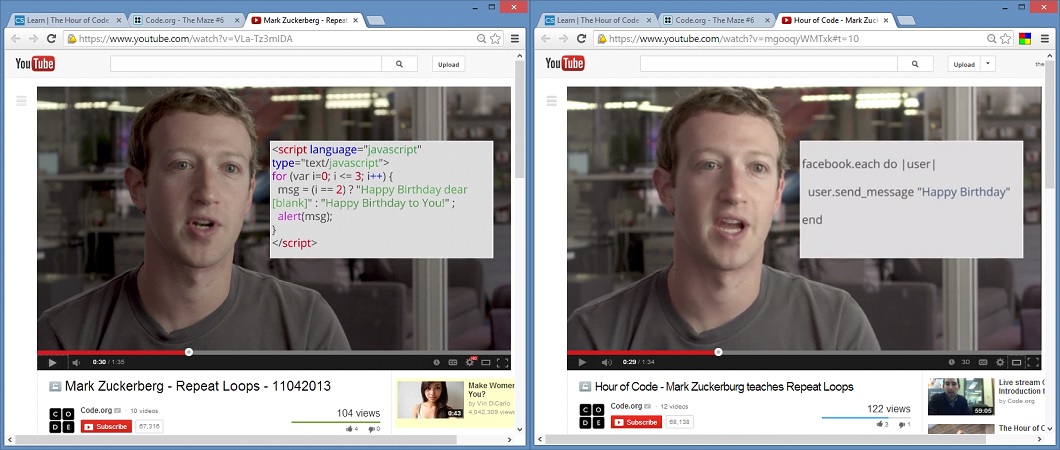
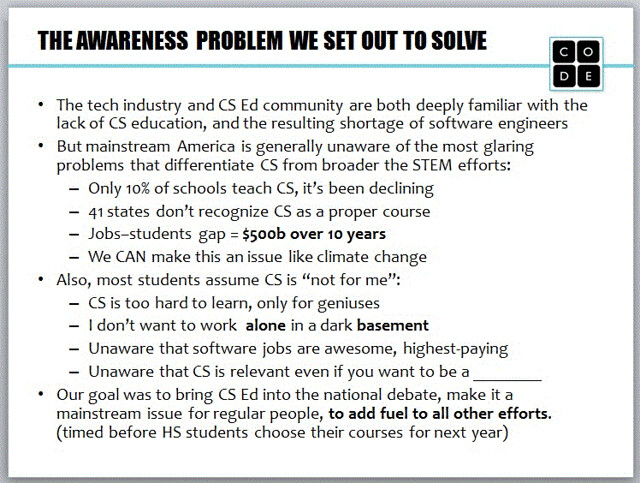
theodp writes "You wouldn't select Linus Torvalds to be the public face for the 'Year of Basketball.' So, why tap someone who doesn't code to be the face of 'The Year of Code'? Slate's Lily Hay Newman reports on the UK's Year of Code initiative to promote interest in programming and train teachers, which launched last week with a Director who freely admits that she doesn't know how to code. "I'm going to put my cards on the table," Lottie Dexter told Newsnight host Jeremy Paxman on national TV. I've committed this year to learning to code...so over this year I'm going to see exactly what I can achieve. So who knows, I might be the next Zuckerberg." "You can always dream," quipped the curmudgeonly Paxman, who was also unimpressed with Dexter's argument that the national initiative could teach people to make virtual birthday cards, an example straight out of Mark Zuckerberg's Hour of Code playbook (coming soon to the UK). Back in the States, YouTube chief and Hour of Code headliner Susan Wojcicki — one of many non-coder Code.org spokespersons — can be seen on YouTube fumbling for words to answer a little girl's straightforward question, "What is one way you apply Computer Science to your job at Google?". While it's understandable that companies and tech leaders probably couldn't make CS education "an issue like climate change" (for better or worse) without embracing politicians and celebrities, it'd be nice if they'd at least showcase a few more real-life coders in their campaigns."
Of course I'm not.
But seriously, am I the only one who doesn't give a shit?
Look, don't code. Don't encourage your kids or students to code. It'll make those who do more valuable. Do mechanics worry about everyone on the planet knowing how to fix their car? Do carpenters spend countless hours navel-gazing about bringing carpentry to school children and girls and the average CEO? Do HVAC specialists?
Do whatever the hell you want to do. The fewer who want to code, the better for the negotiating power and leverage of coders and technologists going into the future.
It's like literacy or numeracy or basic understanding of science. You have a problem as a culture if it is culturally acceptable to say "I can't do math" or "I can't understand written language" or "I have no idea about the universe around me or how people go about understanding it" or "I can't read or write logical directions."
Do you expect everyone to be a best-selling novelist (or a writer that is enjoyed for all history?) No.
Do you expect everyone to be the next Ramanujan? No.
Do you expect everyone to be the next Knuth? No.
But it is expected that everyone have basic skills in these kinds of things. It's just necessary to understand the world. If you don't understand these kinds of things -- if you don't have basic skills in language or mathematics or logic -- then you are at a disadvantage in modern society.
I group computer science'logic here separate from Mathematics. Perhaps it shouldn't be. But having a population that doesn't understand things like this shuold be considered as problematic as a population that can not read and write.
-- Erich
Slashdot reader since 1997
I would hate to live in the world that so many or /. readers seem to live, in which only people who know how to do something can do it, or where coding is a magic that must be protected from the masses. When I learned coding my parents did not know if it would good or bad because few people could do it, but in middle school I was sat down at a teletype machine for an hour a day to learn. I high school I sat down at a terminal and learned to code for real. This taught me problem solving, algebra, trigonometry, and a whole bunch of other stuff that I would haven't learned as well otherwise. Which is beside the point, as coding itself, like reading, writing, and maths has value
I must also mention that I was fortunate because I had teachers who actually knew programming as work skill, one from IBM, so I was not learning it as wrote, but as craft. There were no tests to pass, other than being able to create a product.
And really teaching to code is not that hard, at least if you are not worried about tests and objectives and things that generally ruin the educational environment. A few summers ago I taught a group of kids, 12-17 years old, how to make an online application in Python, using nothing but a terminal application and online account, creating one sub-domain for each student.
So I don't care how is encouraging kids to code. i don't care if they are going to fail every test that comes out. All I would want to do is expose every student to a method of problems solving, let them go through some activities that doesn't involving copying code snippets to make a robot move, and allowing them to have some success and build confidence in them selves. Not a test, not a competition, not a game, just good old fashion legitimate problem solving.
"She's a scientist and a lesbian. She's not going to let it slide." Orphan Black
Coders, in general, aren't media personalities. Their appearance and mannerisms don't appeal to the masses. They especially tend not to be politicians. As such, it makes no sense to make them the public face of an effort intended to get the attention of a general audience.
Coders would only inspire natural-born coders. To inspire people who have never thought about it before, you need people to whom they can relate...specifically, non-coders.
This shines a light on how misguided the approach is. The goal of creating a significant increase in the labor-supply of eager-and-able coders will fail. Coders are very much born rather than made, and anyone who is "made" into a coder will leave the industry once they learn what conditions are really like.
The only way to get talented-but-uninterested people interested is to offer them jobs that treat them well and pay them well. All else is bullshit.
This all has a familiar feel to it.... What the big companies really want right now is cheap programmers, not more programmers. They're clearly hoping that increasing supply will lower their labor costs, whether it's by pushing the "year of code" or by increasing HB-1 visas.
Have you read my blog lately?
Yeah, there is no such thing as a competent spokesperson who also knows how to write code. Because knowing how to talk to people and knowing how to program computers are mutually fucking exclusive. Basically, all coders are mentally deficient when it comes to interacting with other human beings. I'm sure that's exactly what non-coders fucking need to hear.
Apparently, the campaign was doomed from the beginning.
With all due respect, if the folks who made Beta had learned to code, then maybe the world would be a better place.
Beta is not bad code. It is bad design.
I learned almost entirely from books. I've no idea what Kernigan and Ritchie were like in front of a class -- I was in the wrong country to find out -- and for all I know they might have written The C Programming Language in their moms' basements. Ditto Knuth, ditto Booch, and so on. Sure, there's no reason for a programmer not to be a great presenter, but there's no reason they have to be for us to learn from them.
Quidnam Latine loqui modo coepi?
Excess coders are not something I worry about. Why? Same reason performing musicians don't worry about little Timmy tooting on a recorder in 2nd grade. Odds are Timmy will get frustrated just like I did when I tried to play that damned thing. Even if Timmy has "talent", odds are he won't be able to make money at it. Even if he makes money at it, odds are it won't hurt the other players.
I think coding is a lot like music in that regard. Fine, teach "coding appreciation" and have coding classes just like you have music appreciation and music classes. Most people will suck at it, only a few will make money, and of that subset only a few will be noteworthy.
For all intensive purposes, "whom" is no longer a word. That begs the question, "who cares"?