Slashdot Mirror


Non-Coders As the Face of the Learn-to-Code Movements

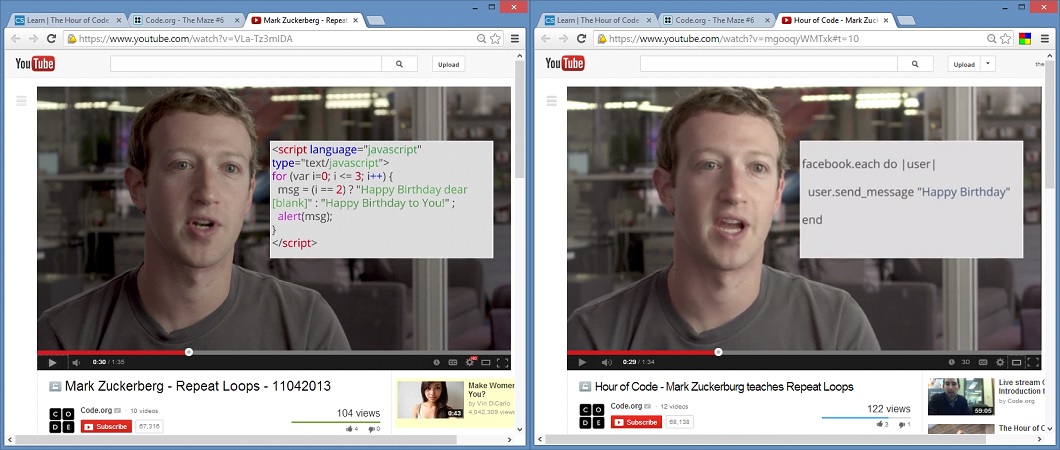
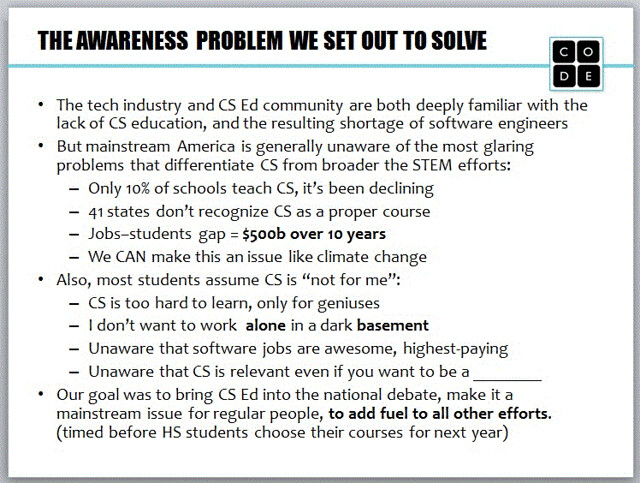
theodp writes "You wouldn't select Linus Torvalds to be the public face for the 'Year of Basketball.' So, why tap someone who doesn't code to be the face of 'The Year of Code'? Slate's Lily Hay Newman reports on the UK's Year of Code initiative to promote interest in programming and train teachers, which launched last week with a Director who freely admits that she doesn't know how to code. "I'm going to put my cards on the table," Lottie Dexter told Newsnight host Jeremy Paxman on national TV. I've committed this year to learning to code...so over this year I'm going to see exactly what I can achieve. So who knows, I might be the next Zuckerberg." "You can always dream," quipped the curmudgeonly Paxman, who was also unimpressed with Dexter's argument that the national initiative could teach people to make virtual birthday cards, an example straight out of Mark Zuckerberg's Hour of Code playbook (coming soon to the UK). Back in the States, YouTube chief and Hour of Code headliner Susan Wojcicki — one of many non-coder Code.org spokespersons — can be seen on YouTube fumbling for words to answer a little girl's straightforward question, "What is one way you apply Computer Science to your job at Google?". While it's understandable that companies and tech leaders probably couldn't make CS education "an issue like climate change" (for better or worse) without embracing politicians and celebrities, it'd be nice if they'd at least showcase a few more real-life coders in their campaigns."
91 of 158 comments (clear)

  1. Spokespeople? by Anonymous Coward · · Score: 2, Funny

    Actually, yes I expect most of them to have nothing to do with the actual endeavor involved.

    It's very rare for the President of the Hair Club for men to be in the advertising.

    1. Re:Spokespeople? by daem0n1x · · Score: 1

      Actually, yes I expect most of them to have nothing to do with the actual endeavor involved.

      It's very rare for the President of the Hair Club for men to be in the advertising.

      And not knowing how to code is the main reason why they lend themselves to lead these stupid initiatives in the first place. If they knew how to code they would know it's not something the vast majority of people can, or want, to do, and how dangerous a clueless coder can be.

    2. Re:Spokespeople? by bugs2squash · · Score: 1

      I disagree, the bar does not need to be raised very high to get a lot of productivity gains. I have been astounded how long people spend trying to do simple data mining or formatting that would take a few minutes if they could just code a simple script or pipe together a few bash commands. In my experience, having a little understanding of something leads to a greater appreciation of people who are highly skilled in that discipline, not the other way around.

      --
      Nullius in verba
  2. First Things First by BoRegardless · · Score: 1

    Writing, reading and arithmetic. Then how do you organize a task, a problem. Define what you have, define the goal, investigate what help you can get from tools/people & then define a plan which might get you to the goal. School doesn't tend to teach how to solve problems or tasks early on, but they can do that.

    1. Re:First Things First by Anonymous Coward · · Score: 5, Insightful

      Coders, in general, aren't media personalities. Their appearance and mannerisms don't appeal to the masses. They especially tend not to be politicians. As such, it makes no sense to make them the public face of an effort intended to get the attention of a general audience.

      Coders would only inspire natural-born coders. To inspire people who have never thought about it before, you need people to whom they can relate...specifically, non-coders.

      This shines a light on how misguided the approach is. The goal of creating a significant increase in the labor-supply of eager-and-able coders will fail. Coders are very much born rather than made, and anyone who is "made" into a coder will leave the industry once they learn what conditions are really like.

      The only way to get talented-but-uninterested people interested is to offer them jobs that treat them well and pay them well. All else is bullshit.

    2. Re:First Things First by __aaltlg1547 · · Score: 5, Insightful

      Yeah, there is no such thing as a competent spokesperson who also knows how to write code. Because knowing how to talk to people and knowing how to program computers are mutually fucking exclusive. Basically, all coders are mentally deficient when it comes to interacting with other human beings. I'm sure that's exactly what non-coders fucking need to hear.

      Apparently, the campaign was doomed from the beginning.

    3. Re:First Things First by TapeCutter · · Score: 1

      Get over yourself, you were not "born to code" any more than a king is "born to rule".

      --
      And did you exchange a walk on part in the war for a lead role in a cage? - Pink Floyd.
    4. Re:First Things First by gnasher719 · · Score: 1

      Writing, reading and arithmetic. Then how do you organize a task, a problem. Define what you have, define the goal, investigate what help you can get from tools/people & then define a plan which might get you to the goal. School doesn't tend to teach how to solve problems or tasks early on, but they can do that.

      My personal problem solving algorithm goes like this: Step 1: Find out what you want to achieve. Step 2: Find out how to achieve it. Step 3: Do it. But usually what I observe is the headless chicken algorithm: Step 1: Get all flustered and jump from one argument to the next. Step 2: Go back to Step 1.

    5. Re: First Things First by Eskarel · · Score: 1

      Most big name coders also seem to think this idea of trying to teach coding to non coders is rather idiotic. There are better ways to teach the basic skills and the detailed skills are all going to be silly.

    6. Re:First Things First by master_kaos · · Score: 1

      Yeah but you don't need "in general" for a spokesperson, you only need that select few.

    7. Re: First Things First by i.r.id10t · · Score: 1

      I think teaching the concepts - how to think about the common programming tools (variables and then arrays, logic, loops, objects, object oriented vs. proceedure oriented, connecting tovarious data sources, etc) without even really writing any real code.

      If someone is still interested in learning how to code after that, then it is time to break out the text editor and compiler/interpreter of choice.

      --
      Don't blame me, I voted for Kodos
    8. Re:First Things First by rtb61 · · Score: 1

      If you are talking about Lottie Dexter than this might help explain things http://politicalscrapbook.net/.... So if your questions is who the hell is she fucking to get this job the answer is someone closely involved with Iain Duncan Smithâ(TM)s thinktank the Centre for Social Justice (yes, it is a PR=B$ double speak title).

      --
      Chaos - everything, everywhere, everywhen
    9. Re: First Things First by Eskarel · · Score: 1

      I think that having courses like that available is an excellent thing, I think staff pointing students who might be interested in such courses into them is also great. I think that actually teaching the concepts you're talking about to every student is a great way to get a whole mess of students even less interested in schools.

      Just because we love doing it doesn't mean everyone does, and there's a reason why computer programming teams tend to have more than their fair share of people with autism spectrum disorders.

    10. Re:First Things First by homb · · Score: 2

      Bullshit. I know how to code and I know how to speak. It's just a matter of spending the time and energy to LEARN TO SPEAK.
      Structuring your speech, engaging the audience, modulating your voice, moving your body. This can be easily learned. Emacs bindings are insanely tougher.

    11. Re:First Things First by ranton · · Score: 1

      Yeah, there is no such thing as a competent spokesperson who also knows how to write code.

      Oh really? Care to name some examples?

      First off, I don't know many career paths where you can point to individual spokespersons who encourage people to go into that profession. From my time in high school and college I don't remember large campaigns getting people into the fields of law or medicine or journalism or theater. So if you looking for some kind of evangelical spokesperson for software development or any other profession you probably will not find one.

      But as far as examples of coders who have strong communication skills, there are likely tens of thousands of them out there. Many software consultants are competent salesmen whose primary competence happens to be software. If you go to seminars run by large software companies you will find many developers with strong public speaking skills.

      There probably is a slightly lower percentage of developers with good communication skills than there is in other professional industries, but software developers are by no means socially inept as a rule.

      --
      -- All that is necessary for the triumph of evil is that good men do nothing. -- Edmund Burke
    12. Re:First Things First by gcobb · · Score: 1

      I disagree. Many of the marketing people in the B2B side of tech industries are former coders. They may not be current developers, but they have the background and experience to talk knowledgeably while also being marketing professionals.

      There are plenty of people with the crossover of coding experience and good PR and interaction skills. Why aren't they being used in these projects?

  3. Am I the only one.. by Seumas · · Score: 5, Insightful

    Of course I'm not.

    But seriously, am I the only one who doesn't give a shit?

    Look, don't code. Don't encourage your kids or students to code. It'll make those who do more valuable. Do mechanics worry about everyone on the planet knowing how to fix their car? Do carpenters spend countless hours navel-gazing about bringing carpentry to school children and girls and the average CEO? Do HVAC specialists?

    Do whatever the hell you want to do. The fewer who want to code, the better for the negotiating power and leverage of coders and technologists going into the future.

    1. Re:Am I the only one.. by khasim · · Score: 4, Interesting

      Do mechanics worry about everyone on the planet knowing how to fix their car?

      Watch the Jeremy Paxman interview. It is hilarious. This isn't about mechanics telling other people to learn how their car works.

      This is people who can't tell a piston from a pylon that OTHER people need to learn to be a mechanic.

      The woman in that interview said that if she knew how to code then she could have saved money by doing her own graphics for her website (which she would also be building). Look up WordPress! HTML is "code" only in a very broad sense. And a year of learning JavaScript won't do much to teach you Apache/IIS administration.

      The problem here is that "code" is being used as a synonym for "computer magic".

      Learning more stuff usually does not hurt. Anyone who wants to learn to code should be encouraged to learn to code. Or to learn website administration. Or to learn graphic design. Or to learn to be a mechanic.

      But, as Jeremy Paxman pointed out, is it better to put the focus on code or should money be spent getting people to learn Mandarin Chinese?

    2. Re:Am I the only one.. by JackDW · · Score: 5, Interesting

      But Zuckerberg and the other industry leaders don't want programming skills to be valuable. They want programmers to be cheap and easily replaced, like unskilled workers in a factory. The "year of code" is not for the benefit of school children, or programmers in general. It is for the benefit of the upper management of major corporations, who live in hope that good programmers will one day be cheap.

      Imagine that instead of the "year of code", it's the "year of football". The government notices that the England soccer team is not very good. The soccer industry finds that good players are really expensive, and wishes that it could recruit a few more good players straight out of school while they are cheap. They get together with this initiative called the "year of football", with the aim of (1) reducing the cost of employing good football players, and (2) improving the performance of the national team.

      The immediate result is a massive investment: a soccer coach for every school, extra soccer lessons, one football to be provided to each child and so on.

      But of course it achieves nothing, because the children who love playing football are already playing it in their spare time. The impact is only on the children who hate football and don't want to play it. They are forced to take part in this boring activity, developing skills they don't want in order to play a game that they don't enjoy. They come to hate football even more than before.

      And, because the children who love it are forced to play with children who hate it, this ruins the subject for everyone. They all hate having to learn about basic stuff like how to pass a ball and how to tell if someone is off side: the good players already know this, and the others don't care. Meanwhile the schools spend less time teaching general subjects that are widely useful. Everyone loses.

      --
      You're an immobile computer, remember?
    3. Re:Am I the only one.. by narcc · · Score: 4, Insightful

      Don't encourage your kids or students to code. It'll make those who do more valuable.

      There it is. Fear.

      It's the reason you hear nonsense like programming requires a "special mind" and should be reserved for a select few.

      It's pathetic. Writing code is easy. Ridiculously easy. Hell, back in the 80's it was common for kids under 10 to teach themselves how to program. Anyone can learn to write code -- and that terrifies some people.

      "Oh, but you need to be special to do it well" you cry, hands trembling, desperate to still believe that you're exceptional. All it takes to be a good programmer is practice. It's no different than any other skill. The more you work at it, the better you become. (Even the thickest trend-following, meme-repeating, slashdotter will improve eventually.)

      The fewer who want to code, the better for the negotiating power and leverage of coders and technologists going into the future.

      The world doesn't owe you a living. You can also improve your employment prospects by killing anyone better, better educated, and more experienced than you. It's just as stupid. It's much more sensible to diversify your skill-set. You might still be a trembling coward, but at least you won't be a one-trick pony.

    4. Re:Am I the only one.. by TapeCutter · · Score: 3, Interesting

      Believe it or not, a lot of mechanics and carpenters are proud of their skills in the same way programmers are, they do indeed want the basics of nail hammering and tyre changing taught to all school children, and expend considerable effort toward that goal.

      --
      And did you exchange a walk on part in the war for a lead role in a cage? - Pink Floyd.
    5. Re: Am I the only one.. by Anonymous Coward · · Score: 2, Insightful

      You err on this, completely. Coding requires capability to abstract, think in abstract terms, reason logically, progress step by step in minute detail, while making sure it all fits together and makes sense in the grand scheme of things. All of that preferrably in your own head and with a high tolerance for frustration in expectation of little more positive feedback than the feeling that you have just created the f**ing best thing scince sliced bread, but who gives a damn.

    6. Re:Am I the only one.. by AmiMoJo · · Score: 1

      But, as Jeremy Paxman pointed out, is it better to put the focus on code or should money be spent getting people to learn Mandarin Chinese?

      It would be interesting to know how useful each of those will be to a school child in their later life. Of course we can't really know for sure, but based on how many who studied French or German in the past and then went on to use it in a commercial capacity I doubt coding skills are any less valuable.

      Of course not everyone will use them, but that's how school works. As well as the core subjects like maths and English you learn a bit of everything else because at age 10 you have little idea what you want to do in later life, or what you are good at.

      --
      const int one = 65536; (Silvermoon, Texture.cs)
      SJW, n: "Someone I don't like, and by the way I'm a fuckwit" - AC
    7. Re:Am I the only one.. by khasim · · Score: 1

      Of course we can't really know for sure, but based on how many who studied French or German in the past and then went on to use it in a commercial capacity I doubt coding skills are any less valuable.

      Look at the device that you used to type those words. Whether it was a desktop or laptop or tablet or smartphone or whatever it probably was not manufactured in France or Germany.

      It was probably manufactured in China. Then shipped to wherever you are.

      Now look around and see how many other items were manufactured in China. For different companies.

    8. Re:Am I the only one.. by NapalmV · · Score: 3, Insightful

      When the hiring is done by an MBA who has an ingrained "go for the cheapest alternative" knee-jerk reflex, you should indeed be terrified.

    9. Re:Am I the only one.. by JackDW · · Score: 1

      It's not a worry. A company that would hire cheap, bad "programmers" is not somewhere I would want to work anyway.

      --
      You're an immobile computer, remember?
    10. Re:Am I the only one.. by Anonymous Coward · · Score: 1

      All it takes to be a good programmer is practice. It's no different than any other skill.

      Thank you for this quote, as it allows those of us who are unfamiliar with code, but skilled in other areas, to see your post for the garbage it is.

    11. Re:Am I the only one.. by cascadingstylesheet · · Score: 5, Insightful

      Writing code is easy. Ridiculously easy.

      Um, right. It's so ridiculously easy that after decades of it, doing it even reasonably well is still a sought after and well-compensated skill.

      It's so ridiculously easy that people keep proposing these "teach everybody to code" things, and they don't work.

      It must be the Illuminati who keep it from working. Or those wascally wepubwicans.

      Hell, back in the 80's it was common for kids under 10 to teach themselves how to program.

      Um, I was around then. It wasn't "common" - it was only "common" among those who had aptitude for it. Like, you know, today.

    12. Re:Am I the only one.. by narcc · · Score: 1

      Sigh... You can't argue with creationists...

      Enjoy your fantasy. The rest of us will continue to live without fear here in reality.

    13. Re:Am I the only one.. by adolf · · Score: 1

      Look, don't code. Don't encourage your kids or students to code. It'll make those who do more valuable. Do mechanics worry about everyone on the planet knowing how to fix their car? Do carpenters spend countless hours navel-gazing about bringing carpentry to school children and girls and the average CEO? Do HVAC specialists?

      Look, I don't code either (unless you count hacking Perl every few years "coding"). I don't encourage kids to code.

      But not because it makes those who can/do code more valuable, because that's closer to eugenics than my username might suggest I'm comfortable with.

      And yet, I am mechanically-inclined. I fix my own cars. I fix other people's cars. Professionally? No. (Could probably be a "real mechanic" if I wanted to be, but I'm OK with it being a hobby.)

      And when I'm saving some friend $400 on a simple front brake rotor/pad replacement, I implore them to help. To kneel down on the stones with me, and at least see what I'm doing...and turn wrenches if they're game for that. It's easy and very straight-forward work, and anyone should be able to do it themselves.

      Household HVAC is also simple. I learned enough in a couple of months as a grunt under a brilliant mechanical engineer working on HVAC that there is no mystery to the why's and how's of it.

      But coding? Coding is closer to painting a portrait or a landscape, than it is to automotive or HVAC repair.

      When I start working on a car, I have constants: The car itself is a (big, expensive) constant. The problem that I'm solving is a constant. Normally the only variables are the cost, quality, and availability of parts.

      When I start hacking Perl, I have few constants. I have a problem to solve, which may or may not be constant. And I have so many options for dealing with that problem that it's a creative process moreso than an iterative process.

      So, I guess: Should people try to teach other people (kids, perhaps) how to code? Yes, they should try to do so, if only to allow their minds to know what creative opportunities they might have in the world.

      Should it be pushed and required? No, or at least no more-so than sculpting, painting, or sketching or [...]. Art is useful to some people, and coding is also useful to some people. Most people aren't good at these things.

      Should it be squandered so that existing coders, or those who find it naturally on their own, are allowed to be in (artificial) demand? No. Knowledge should never be squandered: If it's really easy enough that anyone can do it, then we're doing ourselves a disservice by not showing everyone how to do it.

      No art has ever been advanced through being purposefully reluctant to share information.

    14. Re:Am I the only one.. by lennier · · Score: 1

      Hell, back in the 80's it was common for kids under 10 to teach themselves how to program.

      Yes, exactly. I was there, I was that age. I remember how it was.

      Of course, the ROM-based 8-bit micros we bashed out 10 PRINT "INSERT NAME HERE RULES": GOTO 10 on weren't nearly as scary as a toxic HTML5/Javascript/PHP/MySQL soup of SQL injections and root vulnerabilities running on a three-tier Web platform. It was our parents who were scared of "breaking the computer" while we reassured them that no, a misplaced comma wasn't going to drain their bank account and launch the NATO missile arsenal, and a 'crash' just meant we had to hit the power switch. And we mostly just coded BASIC so we could get games running. But it was fun, and we learned a *lot* more than you do with Facebook and a Playstation.

      Things are a lot different now. I wish we did have coding environments half as safe and clean as a Commodore 64 or Atari 800. In fact, growing up in the 80s taught me a lot I had to unlearn when the Internet came along; for years it never occurred to me that commercial software could be so fault-riddled and plain dangerous to operate as Windows was. After all, I'd used machines with 8,192 *bytes* of RAM that were solid, stable, and just didn't crash unless you physically tripped over the power button. Your machine was totally air-gapped, totally safe, and could be reset to factory defaults instantly. And that was an environment where you could try anything and learn. It was intoxicating, ike having wings under your brain.

      But now... no, now we've built the Matrix we had nightmares about in the 1980s. Not the space-opera Wachowski Matrix; the Gibson Matrix, all neon and chrome and happy smiling avatars on the outside, and a horror show of broken crypto and corporate greed inside. And hacking has become as stupidly easy as downloading a rootkit and clicking 'go'. And there's no guarantee that your hard drive controller or your building HVAC server aren't under the control of the NSA or the Mafia.

      Good luck, guys.

      --
      You are not a brain: http://books.google.com/books?id=2oV61CeDx-YC
    15. Re:Am I the only one.. by serviscope_minor · · Score: 1

      It was probably manufactured in China.

      What about the machines used to manufacture those devices. Probably made in Germany.

      --
      SJW n. One who posts facts.
    16. Re:Am I the only one.. by serviscope_minor · · Score: 1

      "Oh, but you need to be special to do it well"

      First you say that. I agree, most people can do it. Fewer can do it well. Fewer still can be very good. But then to support your argument that it is not true, you say:

      It's no different than any other skill.

      To which I again agree. As if this some how supports your point. further you say:


      The more you work at it, the better you become. (Even the thickest trend-following, meme-repeating, slashdotter will improve eventually.)

      On which again we agree. The problem is you won't improve very much. Clearly, you've been here a while, and yet your rhetoric has not got very good. I expect it's improved, but it probably started from a low base and then didn't improve very far. This is desite years of practice.

      I guess you don't have the mind for it.

      --
      SJW n. One who posts facts.
    17. Re:Am I the only one.. by narcc · · Score: 1

      First you say that.

      Reading comprehension, it seems, is difficult for some people. Generally, people will improve that skill very much. Clearly, you've been here a while, and yet you still struggle. I expect it's improved, but it probably started from a low base and then didn't improve very far. This is despite years of practice.

      I guess you don't have the mind for it.

    18. Re:Am I the only one.. by Simon+Brooke · · Score: 2

      Well, give a shit. The only thing, in a globalised world, which keeps America and Europe richer than Asia and Africa, is that up until recently we've been better educated and technically more competent. That's no longer true. If you want your country to be rich enough to pay your pension in your old age, we've got to stay better educated - at least in the technical and engineering areas which increasingly drive the world economy.

      --
      I'm old enough to remember when discussions on Slashdot were well informed.
    19. Re:Am I the only one.. by Simon+Brooke · · Score: 1

      Writing code is easy. Ridiculously easy.

      Um, right. It's so ridiculously easy that after decades of it, doing it even reasonably well is still a sought after and well-compensated skill.

      It's so ridiculously easy that people keep proposing these "teach everybody to code" things, and they don't work.

      It must be the Illuminati who keep it from working. Or those wascally wepubwicans.

      Riding a bike is ridiculously easy, and most ten year olds can do it; but if you do it well enough to win the Tour de France you make a lot of money.

      People who dedicate themselves by long practice and careful study to any skill - even a 'ridiculously easy' one - become good at it, and if it's a valued skill, the good people are more valued. It remains a fact that the average ten year old can easily write programs which will give them enough positive feedback and sense of mastery that, with encouragement, they may put in the practice and study which will one day make them well compensated.

      And let's face it, a lot more people make a lot of money from writing code than from riding bicycles.

      --
      I'm old enough to remember when discussions on Slashdot were well informed.
    20. Re:Am I the only one.. by serviscope_minor · · Score: 1

      Ah but you must be wrong, because in your own words:

      "Oh, but you need to be special to do it well" you cry, hands trembling, desperate to still believe that you're exceptional. All it takes to be a good at reading comprehension is practice. It's no different than any other skill. The more you work at it, the better you become. (Even the thickest trend-following, meme-repeating, slashdotter will improve eventually.)

      --
      SJW n. One who posts facts.
    21. Re:Am I the only one.. by homb · · Score: 2

      Hell, back in the 80's it was common for kids under 10 to teach themselves how to program.

      Um, I was around then. It wasn't "common" - it was only "common" among those who had aptitude for it. Like, you know, today.

      Back in the 80's you had maybe 30% of kids who really knew how to use computers, let alone program. I'm not talking about games, I'm talking about being able to load up the OS, muck around, launch different programs and use them properly. Kids programming were the exception, just like they are now.

      Just because a loop is obvious to you doesn't mean it's obvious to others:

      "Why do we need these loop things? A counter? What's a counter? How does the computer know to go back and do it again? Where is the counter in the computer? What if I want to do it more times while I'm doing it? etc..."

    22. Re:Am I the only one.. by rioki · · Score: 1

      Designed in Germany...

    23. Re:Am I the only one.. by rioki · · Score: 1

      Honestly I think the quote nails it, even though not in the sense that GP meant it. I think coding is easy, you can pick up any programming language quite easily and learning to code is not more that a couple house away. Yet designing, writing, packaging and deploying an application that does not immediately break down in production is a different thing. It takes allot of experience to pull it off and like everything in life 10.000 hours of practice separates the novice from the expert. The problem is not that programming needs a special skill, but it need a special aptitude to put in all the work necessary to get good at it. Few people are ready to indulge in this odd activity. It does not help that to get anything interesting done it takes like forever.

    24. Re:Am I the only one.. by computational+super · · Score: 1

      > The fewer who want to code, the better for the negotiating power and leverage of coders and technologists going into the future. ... which is exactly the point of the initiative. People who can code want too much money, and have outrageous demands like the right to go home and see their families from time to time. Remember you're dealing with people who, deep in their hearts, believe that there's a simple, cheap, instant on-demand solution to absolutely every single problem they can think of (after all, that's what they were taught at MBA school). If the programmers can't produce something RIGHT NOW for a marginal cost of $0.00, then the problem lies with the programmers themselves.

      --
      Proud neuron in the Slashdot hivemind since 2002.
    25. Re:Am I the only one.. by Bite+The+Pillow · · Score: 1

      You may not have a choice, and that's the point. When the going rate drops, everyone is affected. There will always be exceptions, of course.
      But, before this goes away, it has to run its course. Why? Deep pockets of IT are behind it, the most to gain but also the most to spend.
      By the time they realize that paper qualifications mean squat because the good teachers are spread too thin, and people think real back office code is 10 lines of JavaScript - salaries will be depressed overall, and will take time to recover.
      I'm sure you're more awesome than me and can find a job anywhere, but to get one of the jobs that operates and pays at a high level, instead of accepting Access/Vba solutions that lose data, you will be relocating.
      I have no fear, but I fear for you and everyone else here. In 10 years we will know, because you will have college grads with 6 years experience in something they don't care for personally, and that will set the entry level salary, or wage perhaps.

    26. Re:Am I the only one.. by computational+super · · Score: 1

      > will produce code so bad they'll have to bring me in to fix it. That's not necessarily a great position to be in - you'll be six months behind schedule the minute you set foot in the door, and you'll spend half your time in meetings explaining why it's taking so long to fix "that one thing that went wrong". And God forbid you ever suggest a ground-up rewrite.

      --
      Proud neuron in the Slashdot hivemind since 2002.
    27. Re:Am I the only one.. by bugs2squash · · Score: 1

      There was a time when computers were more amenable to such things, less easy to screw up requiring expensive recovery, The raspberry pi has at least tried to address that end of the market. It's easy to hose the OS on the SDCard, but you probably downloaded and installed the (free) image on the SDCard yourself anyway, so you can recover from even the worse rm -rf * incident.
      I'm not sure most people could rebuild their windows laptops from the recovery CD that came with them so people are not as at liberty to mess with them as I was as a kid when my ZX81 and my Atari 800 ran from ROM and it was always just a power cycle away from being "back to normal".

      --
      Nullius in verba
    28. Re:Am I the only one.. by narcc · · Score: 1

      "Oh, but you need to be special to do it well"

      First you say that.

      Now take a look at your last post. You can puzzle this one out.

      Like any skill, it just takes practice!

  4. Because it's like Literacy. by Erich · · Score: 5, Insightful
    Because being able to use logic to write instructions that are correct and unambiguous is a skill that everyone should learn. And basically that's what coding is.

    It's like literacy or numeracy or basic understanding of science. You have a problem as a culture if it is culturally acceptable to say "I can't do math" or "I can't understand written language" or "I have no idea about the universe around me or how people go about understanding it" or "I can't read or write logical directions."

    Do you expect everyone to be a best-selling novelist (or a writer that is enjoyed for all history?) No.

    Do you expect everyone to be the next Ramanujan? No.

    Do you expect everyone to be the next Knuth? No.

    But it is expected that everyone have basic skills in these kinds of things. It's just necessary to understand the world. If you don't understand these kinds of things -- if you don't have basic skills in language or mathematics or logic -- then you are at a disadvantage in modern society.

    I group computer science'logic here separate from Mathematics. Perhaps it shouldn't be. But having a population that doesn't understand things like this shuold be considered as problematic as a population that can not read and write.

    --

    -- Erich

    Slashdot reader since 1997

    1. Re:Because it's like Literacy. by Antonovich · · Score: 1

      Because being able to use logic to write instructions that are correct and unambiguous is a skill that everyone should learn. And basically that's what coding is.

      It's like literacy or numeracy or basic understanding of science. You have a problem as a culture if it is culturally acceptable to say "I can't do math" or "I can't understand written language" or "I have no idea about the universe around me or how people go about understanding it" or "I can't read or write logical directions."

      The skills that are required for coding are the same skills that are required for numeracy (and real science). Abstraction and creating precise formal models is what coding is really about - the rest is just practice and a bit of wrote learning. In a technological society abstraction and model creation are paramount - everyone should know how to do it, and do it well. Is everyone good at maths today? No. Could they be? I think so, and so do many educators but society has decided that "some people are maths people, most aren't" instead of searching for alternative ways to structure education for people who don't succeed in the traditional formats.

  5. problem solving by fermion · · Score: 5, Insightful
    Is someone who does not know calculus unable to state the calculus might be beneficial to high school students? Is a parent who is illiterate not able to look on the work, see the value of reading and writing, and want that value for their kid.

    I would hate to live in the world that so many or /. readers seem to live, in which only people who know how to do something can do it, or where coding is a magic that must be protected from the masses. When I learned coding my parents did not know if it would good or bad because few people could do it, but in middle school I was sat down at a teletype machine for an hour a day to learn. I high school I sat down at a terminal and learned to code for real. This taught me problem solving, algebra, trigonometry, and a whole bunch of other stuff that I would haven't learned as well otherwise. Which is beside the point, as coding itself, like reading, writing, and maths has value

    I must also mention that I was fortunate because I had teachers who actually knew programming as work skill, one from IBM, so I was not learning it as wrote, but as craft. There were no tests to pass, other than being able to create a product.

    And really teaching to code is not that hard, at least if you are not worried about tests and objectives and things that generally ruin the educational environment. A few summers ago I taught a group of kids, 12-17 years old, how to make an online application in Python, using nothing but a terminal application and online account, creating one sub-domain for each student.

    So I don't care how is encouraging kids to code. i don't care if they are going to fail every test that comes out. All I would want to do is expose every student to a method of problems solving, let them go through some activities that doesn't involving copying code snippets to make a robot move, and allowing them to have some success and build confidence in them selves. Not a test, not a competition, not a game, just good old fashion legitimate problem solving.

    --
    "She's a scientist and a lesbian. She's not going to let it slide." Orphan Black
    1. Re:problem solving by khasim · · Score: 1

      Is someone who does not know calculus unable to state the calculus might be beneficial to high school students?

      Pretty much. Oh they can state that it "might be beneficial". But they cannot state HOW. Or WHY you should spend time learning calc instead of putting those same hours into learning German or another biology class or how to cook.

      Is a parent who is illiterate not able to look on the work, see the value of reading and writing, and want that value for their kid.

      That's different. You can be literate in English and illiterate in German. Whether it is an issue depends upon whether you can read the material where you live or not.

      I would hate to live in the world that so many or /. readers seem to live, in which only people who know how to do something can do it, or where coding is a magic that must be protected from the masses.

      No one is saying that people SHOULD NOT learn to code. If that is what they are interested in.

      The question is whether there should be a push to get more people to take a pre-intro to programming so they can do ... what?

  6. Linus Not Being A Subject Matter Expert by Ukab+the+Great · · Score: 1

    Has never stopped him from being an opinionated (if misinformed) spokesman on subject. Google "Linus Torvalds" and "usability" for examples. So yes, I would expect Linus Torvalds to be a spokesman for NCAA basketball, basing his opinion on the strengths and weaknesses of the competing teams CS departments.

  7. Been there, done that by 14erCleaner · · Score: 4, Insightful
    Back around 1980, there were a zillion magazine and newspaper articles around about the shortage of programmers, and about how computer science was the highest-paying thing to go into. The result was a boom in CS enrollment, followed by a glut of incompetent entry-level programmers who really wanted to be rafting guides or something. Once the dust settled there was still somewhat of a shortage, and salaries remained high despite all the telephone-sanitizers who tried to become programmers.

    This all has a familiar feel to it.... What the big companies really want right now is cheap programmers, not more programmers. They're clearly hoping that increasing supply will lower their labor costs, whether it's by pushing the "year of code" or by increasing HB-1 visas.

    --
    Have you read my blog lately?
  8. Bunch of Nathan Barleys by Bazman · · Score: 1

    Someone looked up all the people who were on the committee of this Year of Code thing. Only three of 23 had a geeky coding background. The others were a bunch of entrepreneurs and startup-biz types.

    Tom Morris blog

    How many of them even know what 'github' is? Just a bunch of Nathan Barley types who got lucky. Although it doesn't mean the organisation would be any better if Nathan's programmer sidekick Pingu was on the committee.

    See also

    Adrian Short blog.

    and see also all the episodes of Nathan Barley on YouTube if you've not seen it before.

    inb4FuckBeta

    1. Re:Bunch of Nathan Barleys by mjwalshe · · Score: 1

      I think you'd want some one who could set up cvs or other source control system from scratch and not just blindly use some purty precaned solution - hmm should I get my good Friend D to suggest to Ed that I could be a useful member of this quango :-)

  9. Re:So, non-coders think coding is easy. by maxwell+demon · · Score: 1

    Of course you can learn coding in a year. You'll not become a stellar coder. You might not even get recursion or pointers in that time frame. But you'll learn the fundamentals, and find out if you like it (in which case you'll continue to learn and get better by your own motivation) or don't (in which case you'll probably never achieve anything non-trivial in that field anyway and can safely omit learning more about it).

    --
    The Tao of math: The numbers you can count are not the real numbers.
  10. I love introducing non-coders to coding by handy_vandal · · Score: 1

    Introducing non-coders to coding ... it feels good ... it just does.

    --
    -kgj
  11. Re:I disagree by ShanghaiBill · · Score: 3, Insightful

    With all due respect, if the folks who made Beta had learned to code, then maybe the world would be a better place.

    Beta is not bad code. It is bad design.

  12. This is what I HATE! Misunderstood by no-coders by Ghost_75_24 · · Score: 2

    The one BIG misunderstanding about coders that we are slave monkeys who only come out from under our rocks to air out. This comes from non-coders who DO NOT understand, not just coding but the science in general. Here's a question for those non-coders out there; who do you think taught US?! QA coder who must know how to talk to people. A coder who must know how to share that knowledge in a classroom context. No every coder is a natural born coder. But, there are those that have the ability to do it, and that can be taught. You know..it's so funny. Einstein was an eccentric, yet he was a superstar to the non-scientific community. Think about that....

    --
    The 5 Tenets of TKD Courtesy Integrity Perseverance Indomitable Spirit
    1. Re:This is what I HATE! Misunderstood by no-coders by digitig · · Score: 3, Interesting

      I learned almost entirely from books. I've no idea what Kernigan and Ritchie were like in front of a class -- I was in the wrong country to find out -- and for all I know they might have written The C Programming Language in their moms' basements. Ditto Knuth, ditto Booch, and so on. Sure, there's no reason for a programmer not to be a great presenter, but there's no reason they have to be for us to learn from them.

      --
      Quidnam Latine loqui modo coepi?
    2. Re:This is what I HATE! Misunderstood by no-coders by Anonymous Coward · · Score: 2, Interesting

      While I prefer books, live explanation can be useful too.

      Internet gives you access to plenty of talks given by all kinds of people, and there are plenty of coders who held/hold a teachers job as well - they are pretty good at giving talks, usually. Check out Simon Peyton-Jones or Martin Odersky's talks, for example.

  13. Re:No you're not, but.. by crashumbc · · Score: 2

    Working in the medical field, coders can be VERY dangerous. Improperly coded shit kills people all the time... Do you want that IV machine's program coded by an idiot?

  14. Re:No you're not, but.. by khallow · · Score: 1

    I'd pay these sorts of concerns more credence, if the problem were universal and a large number of societies weren't punishing employers. But it's not. Instead, the problem of "useless people" really is a problem of the first world and some dysfunctional societies in the poorest parts of the world. Everyone else is hiring like crazy. Similarly, all sorts of costs and regulations have been added to the cost of an employee again in the same sort of societies that IMHO have "useless people".

    As I see it, if the cost of employing you is larger than the value you can deliver through your labor, then you just became useless to an employer.

  15. It's The British Way by residents_parking · · Score: 1

    ... I'm afraid. Only certain personal traits (such as good looks and charisma - no pun intended) are socially celebrated, while science and engineering talent are quite frankly milked and abused.

    The UK turned its back on science and engineering back in the 1950s and embraced the arts (nothing wrong with that) and the cult of management instead. That tide has not turned; if anything it is getting worse.

    When I joined the IEE (now IET) back in 1990 there was an assumption that everyone with an engineering degree would be in management by age 30. That's only 10 years (and not the best years) of engineering usefulness.

    Now I see India making the exact same mistakes. We have to deal with 22 year old rookies who don't have the experience (I work in firmware with a strong analog emphasis) to deliver production code.

  16. Hottie Lottie Lol by Anonymous Coward · · Score: 1

    The interview was hilariously bad, but here's something interesting. Lottie is what, late 20s/early 30s? UK schools have had computers since the 1980s (and before for some places) & many schools did 'Computer studies' which included basic programming. On top of that we've had affordable home PCs for the best part of twenty years, broadband Internet for a decade, a 1980s computer literacy campaign, a 1990s Internet campaign, any bookshop full of programming tomes and YET... this lady can't code and clearly knows next to nothing about computers!???

    In fact the whole language of this debate is moronic - what do they mean by 'code'? Programming? Putting together web-sites? Knocking up 'apps' using pre-programmed bits? Honestly, its like if we had an English literature promotion campaign and the boss went on TV saying 'Is important to read words'... 'what sort of words?'... 'Am not sure. Get back to me in 2015'...

  17. Because it's not really about anyone learning code by cascadingstylesheet · · Score: 1

    Because it's not really about anyone learning to code. Doesn't seem to be, anyway.

    It's about looking (and perhaps feeling) like you care about the "right" things. No need for actual code knowledge for that.

  18. There are other ways. by Anonymous Coward · · Score: 2, Interesting

    Because being able to use logic to write instructions that are correct and unambiguous is a skill that everyone should learn.

    Coding isn't the only avenue for logical skills. There are off of the top of my head; philosophy, mathematical proofs, writing essays, writing cooking recipes, learning to play chess, and everything in basic sciences..

    There are other avenues for intelligent and creative people than coding and coding is a relatively easy skill to pick up. I am unconvinced that coding adds anymore to a kid's education than reading, writing, mathematics and science. And the way things are in the US, teaching basic science should be a MUCH higher priority than computer science; let alone coding. Maybe if we pushed more of the basic sciences, we'd have less ignorant asses like Ken Ham and less people falling for his "beliefs".

  19. Re:What about a PHD for all + no question asked lo by Hognoxious · · Score: 1

    What about being able to string a coherent sentence together, you fucking thick oaf?

    --
    Confucius say, "Find worm in apple - bad. Find half a worm - worse."
  20. html designers and css guru's... by Mister+Liberty · · Score: 1

    call themselves coders, so I see no problem with
    Linus presenting himself as a basketball player.

  21. Computers Made Simple by Anonymous Coward · · Score: 1

    I've got a book here, Electronic Computers Made Simple 1968 edition (yeah, you read that right) by Henry Jacobowitz. It's brilliant, there's an 'Introduction to the analogue computer' featuring a bit of calculus, some material on op-amps & servomechanisms, a chapter on number systems, one on Boolean algebra, a clear overview of transistors, digital electronics & how they fit together in gates, a look at programming (which to be fair doesn't feature any actual code though does describe techniques such as branching) and finally an end chapter promising that 'micro-miniaturization' will be the next big thing. It ends with the words 'The computer era has hardly begun'.

    The book was aimed at self-learners and could be picked up in any book shop for a hefty 10s or around £7 in today's money.

    Hence before most of us were born, and before you could get access to a working computer publishers were printing perfectly good educational guides for the (then) new technology that any working-class kid could study with a bit of effort.

    Now we've got airheads on telly & dopy ad campaigns. Grim.

  22. Re:So, non-coders think coding is easy. by symbolset · · Score: 2

    Dong Nguyen did. You don't have to be the next Brin or Linus. Being the next Nguyen would be more than enough for most of us. It certainly was more than enough for him.

    --
    Help stamp out iliturcy.
  23. Re:No you're not, but.. by Anonymous Coward · · Score: 1

    Incompetent coders cost quite a lot of money. They take longer to get anything done (if they ever get it done), and the bugs they cause cost money for you and your clients, and harm your reputation among your clients, and they cost more money to fix, and so on. A team of incompetent coders will drive their employer right out of business.

    So, I disagree that foisting coding skills on to people who aren't good at it will do them or anyone else any good.

    As an aside, there are plenty of people who would be very competent food-growers, but who are unemployed, precisely because there is no market for food-growers. We produce so much food, in fact, that the government pays land owners to let their fields lie follow, actively blocking those who would happily work the fields for a wage. This is one example of a broad trend that produces the unemployment you are lamenting: the problem is not that most people can't do anything at all, the problem is that we simply don't need them to do anything.

    You won't solve this problem by trying to impose a highly specialized and advanced skill set on to a population of people who have generally average abilities.

    Feel free to try, though.

  24. Excess coders are not something I worry about by istartedi · · Score: 3, Insightful

    Excess coders are not something I worry about. Why? Same reason performing musicians don't worry about little Timmy tooting on a recorder in 2nd grade. Odds are Timmy will get frustrated just like I did when I tried to play that damned thing. Even if Timmy has "talent", odds are he won't be able to make money at it. Even if he makes money at it, odds are it won't hurt the other players.

    I think coding is a lot like music in that regard. Fine, teach "coding appreciation" and have coding classes just like you have music appreciation and music classes. Most people will suck at it, only a few will make money, and of that subset only a few will be noteworthy.

    --
    For all intensive purposes, "whom" is no longer a word. That begs the question, "who cares"?
    1. Re:Excess coders are not something I worry about by narcc · · Score: 2

      The difference, of course, is that the terrified developers out to improve their future employment prospects are all about the same level as Timmy.

  25. Re: No you're not, but.. by Anonymous Coward · · Score: 1

    That is pricesely the reason why we shouldnt invite everyone to learn a litle bit of coding. We dont invite everyone to build a little bit of bridges, just because it s so much fun, do we now?!

    Btw, here are the missing symbols, fillem in as desired: 't''' (typing comments on a Galaxy Nexus 10 is no fun on /.)

  26. Re: No you're not, but.. by Anonymous Coward · · Score: 1

    Indeed. Yet curiously with CS and IS jobs people much rather pay an exorbitant amount to a business major to market a crapy product than to hire a competent CS major to create proper product that anyone can sell. After all selling is just a numbers game, put in a hundred to get 2, put in a thousnad to get 20.... Cant do that with coding, where paying one properly typically yields better results than paying ten poorly.

  27. watch the video it is hilarious by Anonymous Coward · · Score: 1

    And sad at the same time. She has the looks though, can't argue that.

  28. That's a comforting notion... by reluctantjoiner · · Score: 1

    But the mindset that lead to the poor code being produced in the first place will also be unable see that the solution is to bring in a professional to do it right.

    Non coders only see the physical component of coding and can't see anything else; just as if I watch a carpenter work, I won't recognise the skills applied there. Applied to management, they don't know that they don't know, and therefore use the only criteria they understand, which is price.

  29. Re:I disagree by andyhhp · · Score: 2

    Beta is not bad code. It is bad design.

    It is unknown code and bad design, which is arguably worse.

  30. Zuckerberg... by sky770 · · Score: 1

    "I might be the next Zuckerberg."

    *pauses* you wouldn't want to do that..

  31. Re:No you're not, but.. by gnoshi · · Score: 2

    And yet there was still the Therac-25 case where bad software design and a race condition leading to lethal radiation doses.

    The people who designed the system and wrote the code may not have been idiots, but clearly problems made it through the testing process and killed three people (as well as affecting others).

  32. Re:What about a PHD for all + no question asked lo by jones_supa · · Score: 1

    Joe, try reading back your own sentences. They are sometimes incredibly hard to read. :) Add some punctuation there or break them down otherwise.

  33. Re: This is what I HATE! Misunderstood by no-coder by Anonymous Coward · · Score: 1

    Care to give an example of what you mean??

  34. G-Code by ShoulderOfOrion · · Score: 1

    Teach the teenagers G-Code. Give them 3-D printers. Reap lots of creativity, most of it indictable.

  35. What's the big deal. by Dcnjoe60 · · Score: 1

    It's a marketing campaign. First and foremost, you would hope they know marketing. They can always have technical staff for the details. I'm pretty sure movie directors don't have the technical skills involved with the subject matter they are making a movie about.

    Maybe it's a good thing to have somebody who isn't "in the field" trying to spark the interest of others. After all, most of the coders I know would not be good spokespersons to entice others to the field.

  36. Re:I disagree by Ash+Vince · · Score: 1

    Beta is not bad code. It is bad design.

    It is unknown code and bad design, which is arguably worse.

    Actually, that is probably one of the reasons beta exists.

    The old slashdot code is old and was apparently written by someone who no longer has anything to do with the site.

    In light of this the current developers want to tear it all down and start again like a great many developers do in that situation. It is REALLY hard to maintain and extend a huge site, that was created by someone else, On top of it being difficult it is also not as much fun as creating something new from scratch. Then finally if you develop any website now you are more likely to do it using a bunch of webservices that either website or things like an iphone/andoid app can interact with.

    --
    I dont read /. to RTFA, I read /. to offend people in ignorance.
  37. Can we just kill these movments please!? by sfdrew83 · · Score: 1

    All these coding campaigns really piss me off. We should not be trying to teach kids how to write computer code. If people want to do it as a hobby—fine; if they want to get a real education and do it professionally—fine, but can we all stop pretending that everybody and their grandma needs to learn a programming language? They should learn something more useful instead, like how to communicate better, or more Math, or how to cook, or anything really. Programming was a major passion for me for almost a decade, and I still enjoy it, despite moving on to focus more on Math. I also think that a lot of us have an extremely bloated sense of self-worth, and think programming is far more valuable as a skill than it actually is. You can't program a computer to do something you can't do, so what we really need are people better at Math, communicating, analytical thought, and problem solving.

  38. Re:No you're not, but.. by coofercat · · Score: 1

    I don't really care who wrote it, but I do care who spec'ed it, who tested it and who's got plenty of money that they don't want to lose when it goes out to the public.

    The point here is that you can actually have an out-sourced programming goon from elbonia write the code, or you could have the genius aliens from the planet Zod do it for you. You still need to test it actually works. Since you can't trust a vendor to test their stuff responsibly enough, you have to have anti-vendor weapons, like being able to strip them of their money/assets/etc when they make a mess of it. You could have a third party do the testing (like government regulators), but they tend to be pretty inept and a lot less accountable.

    As for whether everyone should code or not - everyone should, just as everyone should learn to speak in a second language. You don't need to become fluent and able to blend in any situation, but having a passing knowledge of it makes you a more rounded person, and thus more able to think in different ways as the situation demands. Whether or not you actually do any coding or not in your future life is largely irrelevant.

  39. Itch to Scratch vs. Transform into "Coder" by Anonymous Coward · · Score: 1

    My wife is a "non-coder" - a physician with no interest whatsoever in computers beyond what they can do for her. Last year she learned to do sophisticated things in R over the course of a few weeks because she wanted to be able to analyze her own research. She had no prior programming experience.

    There is a difference between adopting programming as a profession and learning how to use parts of a language or platform in pursuit of particular goals. The second is probably far more common, perhaps even among the /. crowd. The code.org message that programming can be easy and empowering is true in many situations, even if code.org has no idea what those situations are and have a messenger who has never been in one of those situations and can't articulate a single one of them or be credible in any way.

    Math and programming, for most non-experts, are things you have to do to get something else done. Home Depot ads aren't about tools, they're about what they get you. We may as well start promoting "hammer time" if we think advertising "code" is going to get any kind of results.

  40. Re:No you're not, but.. by ranton · · Score: 1

    Bugs make their way into production code. No amount of processes will ever change that. The more incompetent programmers you have, the more likely these bugs will slip through the cracks in your processes.

    I have worked with and studied under software engineers that worked with the FDA on better methods for validating that medical devices are safe. It is by no means a perfect science. There simply isn't enough time and money to test all medical devices to the degree you seem to think is possible. The FDA relies heavily on just their experience and their ability to identify bad "smells" in the documentation provided by companies. I am amazed that our medical devices are as safe as they are.

    --
    -- All that is necessary for the triumph of evil is that good men do nothing. -- Edmund Burke
  41. We don't need any more Zuckerbergs or Jobs by davydagger · · Score: 1

    The media is doing what the media does best, focusing on photogenic rich celebrities like Jobs and Zuckerberg.

    Of course they also made a lot of money for investors as well.

    But how much did they really give back to the computer community?

    The answer is both made us all a lot less secure.

  42. Re:No you're not, but.. by Anonymous Coward · · Score: 1

    Frighteningly, software for medical instruments do not have to go through any sort of validation process, nor do those who work on them need to be certified.

    There are two local companies where I live. One create medical lasers and the software to control them, the other creates gambling machines.

    Guess which company has to spend tens of millions of dollars every year getting their products tested and certified?

    Hint: not the medical laser company.