 Slashdot Mirror
The Shrinking Giant Red Spot of Jupiter
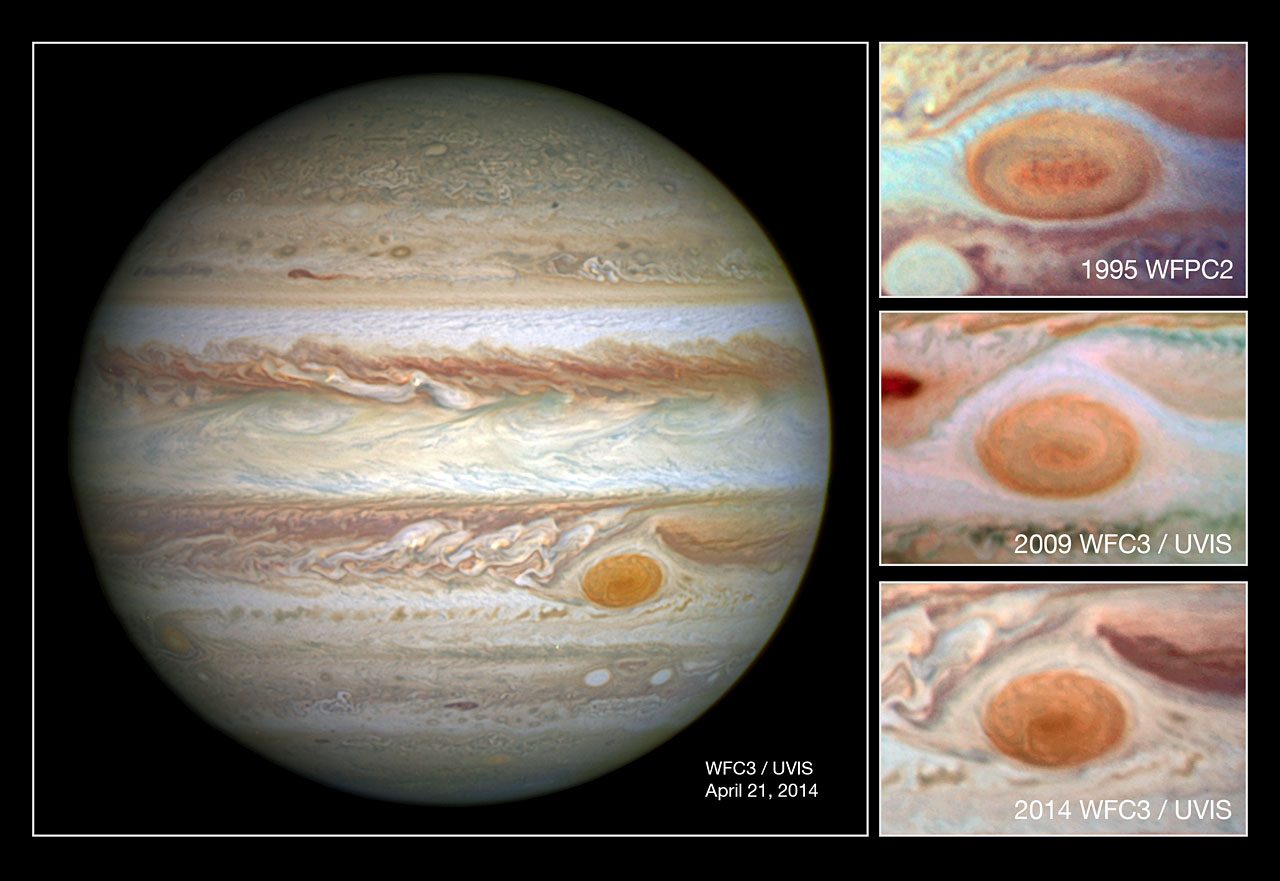
schwit1 (797399) writes "Jupiter's trademark Great Red Spot — a swirling storm feature larger than Earth — is shrinking. This downsizing, which is changing the shape of the spot from an oval into a circle, has been known about since the 1930s, but now these striking new NASA/ESA Hubble Space Telescope images capture the spot at a smaller size than ever before."
Must be global warming...
"A door is what a dog is perpetually on the wrong side of" - Ogden Nash
all these planets are yours except europa
Signature v3.0, now with 42% less memory usage.
The average Jovian's carbon footprint is much heavier than a Terran's.
"The average reporter we talk to is 27 years old......They literally know nothing." - Ben Rhodes
Another testament to one of the most amazing "machines" ever created. Hubble is a truly awesome telescope, and the pictures that come from it continue to amaze and astound us.
We all know it shrinks when it gets cold.
downsizing
In my organization, we call it rightsizing. Of course, we didn't call it that while we were expanding.
Tic-Tac-Toe, Global Thermonuclear War, and relationships all have the same winning move.
What has keep it going all these years?
Didn't Arthur C. Clarke write about this - like right before the Monolith ignited Jupiter? ;)
For those that don't RTFA it seems like the rate of shrinkage has dramatically accelerated in the last few years - the extent of this being something that probably ought to be included in the summary. It was ~23,500km across when the Voyager probes imaged it in 1979/1980 and is down to ~16,500km in the latest Hubble image, yet the current rate of shrinkage is quoted at almost 1,000km/year since 2012. That makes me think it's behaving like many Terrestial storms and it's going to blow over and dissipate quite quickly, which could mean that it could be gone entirely before the end of the decade. While it was never going to be around indefinitely I'm still somewhat stunned at the notion that I'm probably going to outlive something that has always seemed like a permanent fixture and a defining feature of Jupiter akin to Saturn's rings.
UNIX? They're not even circumcised! Savages!
5 crews of 7 astronauts have gone into space on repair missions, including the first mission to repair Hubble's faulty lenses that would have rendered it useless. Add to that the 5 astronauts that took Hubble into space in the first place and you have a total of 40 people in space. Some of those 40 may possibly be the same across 6 missions, I'll let you research that yourself.
Pluto isn't a planet, and now this? It's a sad day indeed.
Maybe it just got out of the pool...
What has keep it going all these years?
As I understand it (I DON'T study this, but just recall previous articles):
The Great Red Spot is a big storm. It happens that the dynamics of storms on Jupiter is such that they move east/west at different speeds, and when they collide they combine. So Jupiter usually has a big Borg storm that has been growig by assimilating little storms more than it has been shrinking by "blowing out".
I have also read that such storms, though very long-lived, have died out even in the geologically-short period Jupiter has been observed, and new ones grown up later - not necessarily in the same hemisphere.
I haven't heard of a situation where there have been two or more of them - either one each in the northern and soutern hemisphere or two in the same hemisphere at different lattitudes. But observation of Jupiter is young in terms of the length of its weather cycles.
Similarly, Earth's ocean currents are also apparently "weather" - exhibiting positive feedback and chaotic behavior, not just a constant response to heat sources, sinks, and seabed geometry - but with an even longer time scale than Jupiter's storms.
Bantam Dominique roosters crow a four-note song. Once you've heard it as "Happy BIRTHday" you can't NOT hear it that way