 Slashdot Mirror
Average HS Student Given Little Chance of AP CS Success
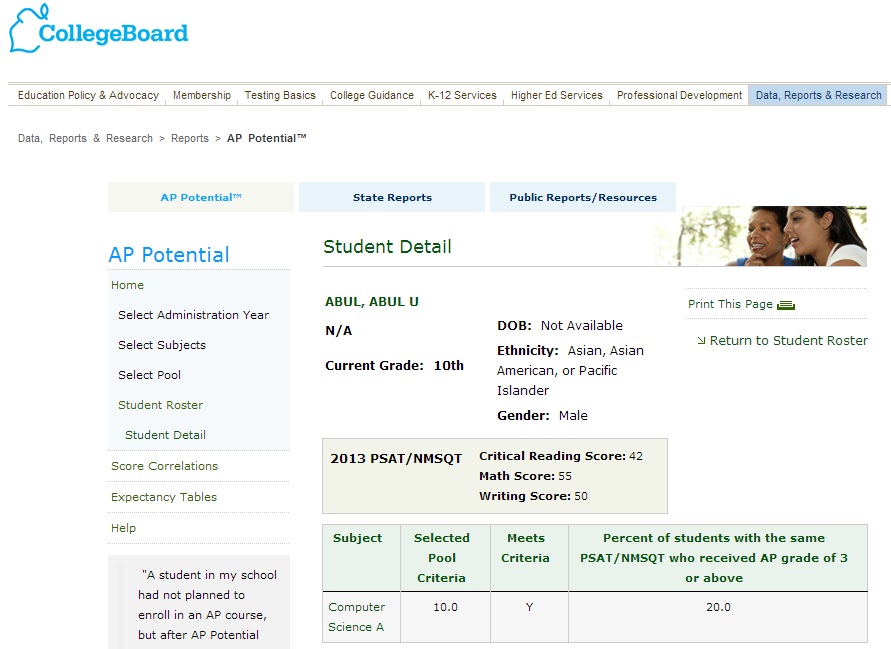
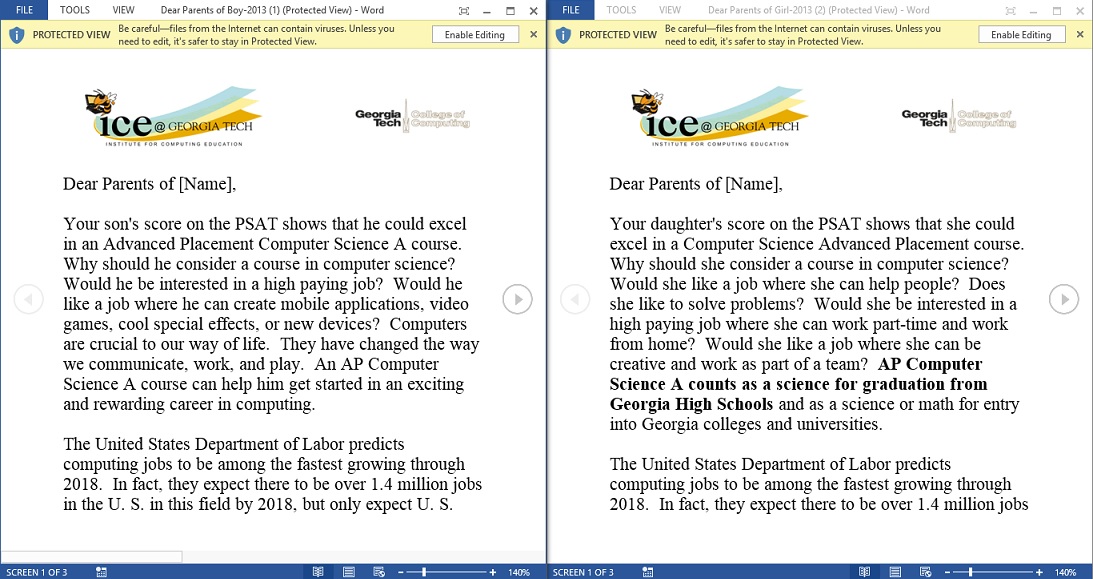
theodp (442580) writes AP Computer Science is taught in just 10% of our high schools," lamented The White House last December as President Obama kicked off CSEdWeek. "China teaches all of its students one year of computer science." And the U.S. Dept. of Education has made the AP CS exam its Poster Child for inequity in education (citing a viral-but-misinterpreted study). But ignored in all the hand-wringing over low AP CS enrollment is one huge barrier to the goal of AP-CS-for-all: College Board materials indicate that the average 11th grader's combined PSAT/NMSQT score of 96 in reading and math gives him/her only a 20%-30% probability of getting a score of '3' on the AP CS exam (a score '4' or '5' may be required for college credit). The College Board suggests schools tap a pool of students with a "60-100% likelihood of scoring 3 or higher", so it's probably no surprise that CS teachers are advised to turn to the College Board's AP Potential tool to identify students who are likely to succeed (sample Student Detail for an "average" kid) and send their parents recruitment letters — Georgia Tech even offers some gender-specific examples — to help fill class rosters.
Average SD article containing TM unclear ABR in TI
According to our presently available research and body of technique is there really anything on the table that 'results in outstanding academic ability'?
We know about some "Don't fuck it up" procedures (lead is not a dietary supplement, lots of early childhood stimulus is good, malnutrition stunts mind as well as body, etc.); and we know some things about getting better or worse results out of students of a given level of ability; but for anything that has some element of 'born, not made', it's a good day when we can accurately identify the good candidates, much less upgrade inadequate ones.
If your thesis is that 'difficult things are hard and most people can't do them', it wouldn't much matter if the K-12 focus is 'self-esteem', 'classical philology', or 'Measure Theory Bootcamp: No Place For The Weak.'
They keep mentioning AP but its not actually written anywhere what this abbreviation stands for.
"AP" means "Advanced Placement". It is basically a college level class taught in high school, and intended for advanced college-bound students. The "news" in TFA is that "average" students would have difficulty in these classes. In other news: the sky is blue.
According to our presently available research and body of technique is there really anything on the table that 'results in outstanding academic ability'?'
Parental involvement.
Oliver.
I teach a section of AP Computer Science, so I'm getting a kick out of these replies...
To people who don't have any programming experience coming in to the course, the class is a real bear. One of the big issues from the early days of the exam was the push-and-pull between high school instructors and college professors over just what an AP computer science student should proficiently be able to do.
The professors won, and began to dominate the content choices of the course and the exam. Of course, they were full of shit when they did so, and found that people who passed the course weren't usually well prepared for additional CS courses unless they had additional experience outside of APCS. This means that APCS wasn't the predictor it should have been. So there's been all kinds of fun content changes over the years. (I'm not talking about the language change from Pascal to C++ to Java; the material on the exam will be changing about 20% for just the coming year, for example, and I'm making sure I'm at an AP seminar this summer so I can properly prepare.)
As trite as it sounds, part of the challenge is funding. In Texas, where I teach, AP Computer Science is funded with the usual tax dollars, where "business programming", which is too often VB-oriented, is funded at a higher level, making it a more attractive course if you're going to teach programming. Districts and high schools are financially disincentivized from offering this course, and lesser resources are generally available.
Want to teach Microsoft Office? Here, have a brand new lab. Then have a new one three years later. Want APCS? We're sure we can scrounge up something for you. And then they wonder why no one teaches AP Computer Science. Don't get me wrong; I actually think there's a lot of value to be gained out of a properly taught Office course with proper content. But the imbalance is too great.
About 5 years ago, I was asked to go to a meeting of all of the AP teachers of the East region of Houston ISD, in order the share information and resources. (This was back when they grouped schools by geographic regions.) I really didn't want to go, but our counselor convinced me that it was important. So many if not most of the AP teachers are sitting there on gym bleachers. And we're told to meet our cohorts and talk amongst ourselves. And all of these signs go up for the different courses -- US History, Spanish, etc. And I'm sitting there at Computer Science. Then I look to my left, look to my right. And I realized that I'm the only one.
And that's what it's like to be an AP Computer Science teacher.
"You're never ready, just less unprepared."