 Slashdot Mirror
Average HS Student Given Little Chance of AP CS Success
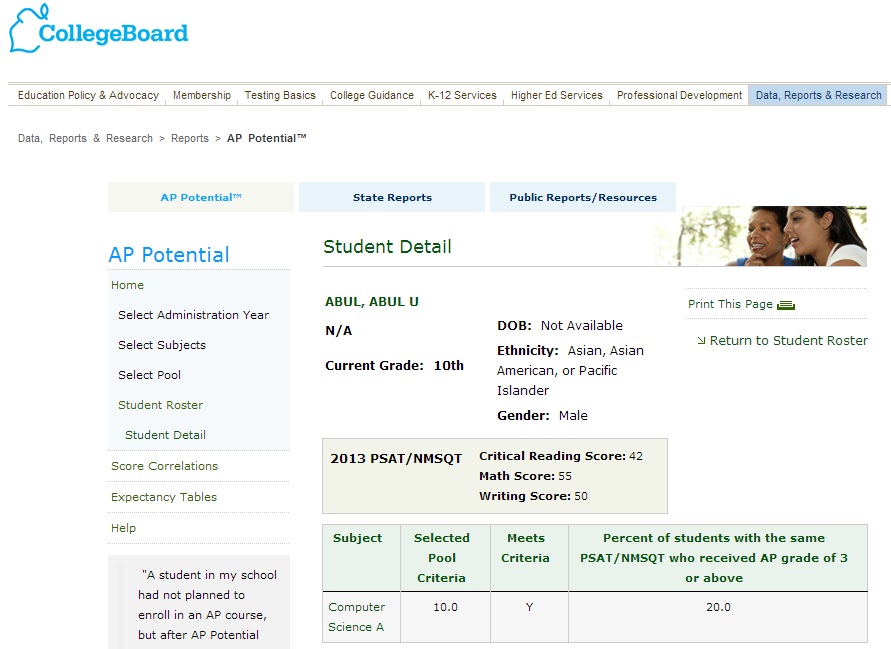
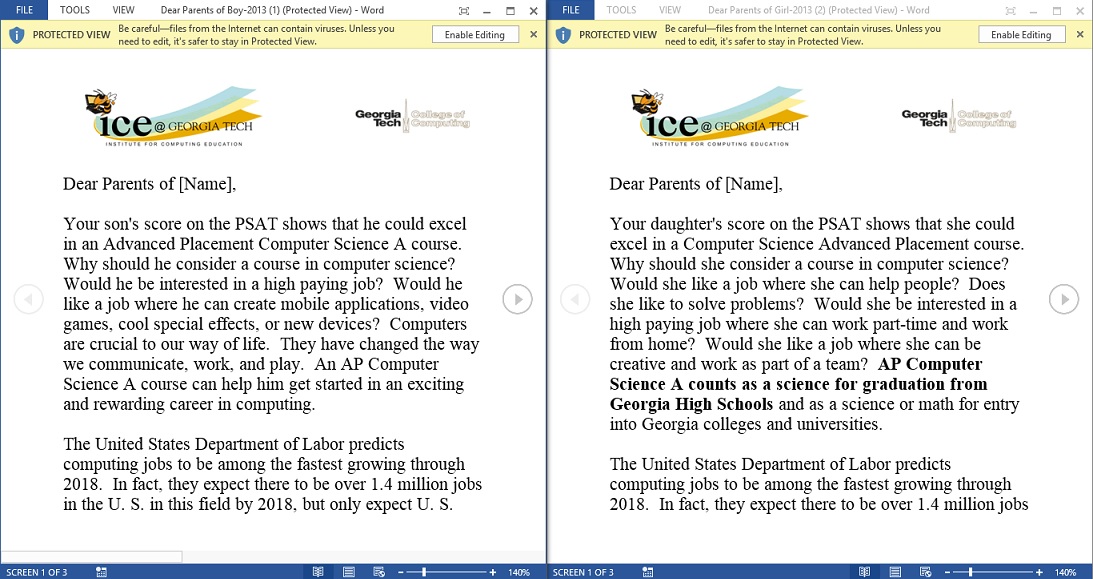
theodp (442580) writes AP Computer Science is taught in just 10% of our high schools," lamented The White House last December as President Obama kicked off CSEdWeek. "China teaches all of its students one year of computer science." And the U.S. Dept. of Education has made the AP CS exam its Poster Child for inequity in education (citing a viral-but-misinterpreted study). But ignored in all the hand-wringing over low AP CS enrollment is one huge barrier to the goal of AP-CS-for-all: College Board materials indicate that the average 11th grader's combined PSAT/NMSQT score of 96 in reading and math gives him/her only a 20%-30% probability of getting a score of '3' on the AP CS exam (a score '4' or '5' may be required for college credit). The College Board suggests schools tap a pool of students with a "60-100% likelihood of scoring 3 or higher", so it's probably no surprise that CS teachers are advised to turn to the College Board's AP Potential tool to identify students who are likely to succeed (sample Student Detail for an "average" kid) and send their parents recruitment letters — Georgia Tech even offers some gender-specific examples — to help fill class rosters.
Average SD article containing TM unclear ABR in TI
So you're suggesting that a K-12 focus on self-esteem doesn't result in outstanding academic ability?
This just in: difficult things are hard, and most people can't do them.
-Styopa
+1 WTF too many TLAs.
Well, when US schools put emphasis and financial focus on sports, something has to be cut or ignored. I live in Texas, and have seen middle schools with larger stadiums than what I had at my high school in Michigan. Sadly, throwing more money at the problem won't solve it, because it's too ingrained in our culture.
College Board materials indicate that the average 11th grader's...
The "average" 11th grader isn't going to be taking AP classes. There is a reason they call it ADVANCED placement. It's supposed to be hard. It's supposed to be for the top end of the bell curve.
They keep mentioning AP but its not actually written anywhere what this abbreviation stands for.
"AP" means "Advanced Placement". It is basically a college level class taught in high school, and intended for advanced college-bound students. The "news" in TFA is that "average" students would have difficulty in these classes. In other news: the sky is blue.
I took AP Computer Science in 10th grade, scored a 2 on it. I had some friends who were passionate about programming (doing it outside of High School like myself in C++) who ended changing their career choice just off of that test score, who also got 2s. On one hand, yes the AP class was great in that I got good practice every other day in C++ with a pretty good teacher there to ask questions, but the test itself I found very one sided for the folks who were great test takers. Just because I scored a 2, doesn't reflect the teacher's ability to convey how to do a linked list nor does it really reflect a student's abilities.
The emphasis in High School today shouldn't be "well Johnny you probably won't score a 3 so don't bother taking AP CS", but "Johnny we see you're really passionate about programming, why don't you take AP CS?"
They should integrate programming with math classes. They should start students using Mathematica or Sage as early as possible. Programming math problems would teach both math and programming. Students would see programming as a problem solving tool, and not just another burden of something else to learn. If they integrated programming into math classes they wouldn't have to worry about adding programming classes to their curriculum. They could also integrate programming into other classes like science, or even English.
I'm not sure we should hit kids with the full force of CS theory in their first CS course. I suspect there's a real benefit to giving them something with tangible results and immediately useful skills, like Javascript. Without that, I think they might be unable to see the relevance of the more advanced theory, and lose interest in CS altogether.
And we wonder why females have little interest in CS? The male version talks about gaming and creating toys, while the female version sounds like they want to target non-mathphobic social workers.
All the female programmers I know (yeah yeah, n=3, anecdata sucks) got into it for the same reasons as their male counterparts - The love of ripping into the metaphorical guts of a computer and bending it to their will. The love of gaming, whether or not it satisfies the current BS about "strong female protagonists". The pure joy of losing countless hours in the trance-like state we enter in a really good coding session.
Then again, they all self-describe as "Tom-boys", so I see it as entirely plausible that those women currently in CS simply fall into the small minority that do like the same things as male geeks. Even if that holds true, however, I find it fairly disturbing that anyone would seriously try to promote a CS degree by offering it in pink.
Even though there was a bit of a gap between the two schools' programs, 30 years ago you could get an introduction to programming and CS concepts in both of them. It seems like we've been back-sliding since then.
I'm trying to teach myself to set people on fire with my mind... Is it hot in here?
Waaaayyy back in the mid-90's, I took the AP CS test my junior year of HS. The test was scheduled right after I took the AP US History test in the AM (I rocked that test with a 5 and passed out of 2 semesters of history for it) and as my brain was fried, I staggered into the principal's conference room to take the AP CS test with another dozen or so kids from my class.
I completely bombed the test (a 2)... my brain was so scorched from the history exam that morning I couldn't make heads or proverbial tails of the essay questions. I got a 2, and I'm glad I did. Why? Because that was when the test was still being administered in Pascal, and by the time I got to college, my school had shifted over to C++ as their main "teaching language". It's no fun taking an advanced CS class when all your assignments take extra time while you give yourself a crash course in C-style syntax everybody else is taking for granted.
That said, despite the fact I flunked the test, my actual high school CS class was excellent. It meant that when I had to re-take intro-to-CS in college all I had to do was learn new syntax for the concepts I already knew; the overlap of the theory was pretty complete.
On another note, why would we expect the average high-schooler to pass a college-level CS exam? It's a hard test, just like it's supposed to be. And it's a subject that many students, no matter their other virtues, don't have much aptitude in. (I'd be interested to know what this one year in "Computer Science" that all Chinese kids are given actually consists of...)
All that said... yes, waaayyyy more than 10% of our high schools need to be offering the class. Every high school surely contains some students with both the aptitude and desire to take such a class.
All those jobs will be going to H-1B visa owners.
When Fascism comes to America, it will call itself Anti-Fascism, and tell you to give up your guns.
Throughout my entire educational career, I was a slacker. I got decent grades (if not straight A's) without studying, paying much attention in class, or doing homework. I have a natural aptitude for the humanities and the sciences, and am adequate in math. (Better with applied vs. theoretical math.)
My one exception was foreign languages; I have absolutely no ability whatsoever in foreign languages. In American, I can speed-read, and have reasonable facility with writing. In any other language, it mattered not at all how much I studied, practiced, or did my homework, I was horrible, even by the low standards of an American high-school foreign language class. French, Latin, even American Sign Language as an adult, and I was hopeless. I got barely passing grades in French and Latin out of pity more than anything else.
Some difficult things are simply difficult for some people, and no amount of hard work is going to fix that. Throwing students against subjects they are unable to master is a waste of resource and is discouraging for both the student and teacher. I'm not saying students shouldn't be challenged; just that the idea that "hard work" will magically enable a student to master any subject is toxic.
Muchas Gracias.
In all seriousness, would anyone like to provide a glossary?
CS I can guess, but AP??
Advanced Placement (aka 'grade inflation').
Faster! Faster! Faster would be better!
However, I reckon the real issue is that CS at university cares less about what you did at high school. They want Calculus/Further Mathematcs and Physics for sure, and having Chemistry is a help. It is rare than a college cares about AP CS other than in a token way. All this has the effect of making CS in high schools a complete and utter waste of time, for the student and for the school, which is why CS in high school will (unless things change) always have a wave of enthusiasm sinking back into a slough of "why did we even care?"
Think of it this way, if you go to university wanting to major in X (be it Art, Music, Languages, Sciences, Mathematics etc, anything but CS), they check that you've done X in high school. CS doesn't want X, they want Y and Z. So, the failing to have a proper CS program in high schools that would properly prepare students for CS (and for that matter Engineering and to a degree the Natural Sciences) is that the universities cannot or will not agree to what constitutes a proper preparation for CS.
What makes it worse is the likes of Google, Microsoft etc plump down money for these "feel good, everyone can/should code" initiatives. The kids, their families etc get all excited and then it hits them like a brick - the universities do not care.
I believe if the universities got their act together, or were presented with a solid CS program that fed into their undergraduate core on much more than a "Whee! We can now write functions!" (which is all AP CS provides) then things would get real and be of actual practical good to all. I know there's the smarts for this in high schools, and I know if universities got over themselves they'd be able to as a team come up with something great.
Now we learn from them?
The older ones amongst us might still remember how Japan was all the craze. Everything in your company had to be done the Japanese way. You had books and whole seminars dedicated to how the Japanese did stuff. Fully ignoring (just like this does) that there just might be a hint of a cultural difference that makes the systems fully incompatible.
Then the Japanese economy collapsed because, as we found out, it was all just a huge bubble they inflated for years. At first their economic growth was real. Well, duh! After WW2 their industry was in ruins. Growth rates in the two digit percentage are a given if you go from NOTHING to something. At least it's heaps easier than having two digit growth rates if you are already near the ceiling of what's possible.
Now the same shit again with China. Oh, China has an economic growth! We have to copy China! No, we don't you idiots! China has an economic boom because not only they had jack shit before but also because we let them. That's what makes China's economy grow by leaps and bounds. Going the Chinese way could only cripple our economy (actually, since we're already on the path, it does. Look around yourself and tell me that we're really so much better off than we were a decade ago). Why? Because we already have a living standard the Chinese may only dream of, and we don't have a USA that we can sell our cheap crap to.
Fuck, people, you can't simply copy another country and pretend it will work! Sure as hell it doesn't for economy, why the heck should it for education?
We used to have a Bill of Rights. Now, with the rights gone, all we have left is the bill.
allowing it (and its tuition) to be skipped
LOL, oh you're serious, let me laugh harder. If you think skipped courses due to AP credits reduce the number of hours needed to graduate at the vast, vast majority of schools you're mistaken. No, it will just let you skip an intro course and fill the hours requirement for your major for something a little less dull.
There are 4 boxes to use in the defense of liberty: soap, ballot, jury, ammo. Use in that order. Starting now.
I teach a section of AP Computer Science, so I'm getting a kick out of these replies...
To people who don't have any programming experience coming in to the course, the class is a real bear. One of the big issues from the early days of the exam was the push-and-pull between high school instructors and college professors over just what an AP computer science student should proficiently be able to do.
The professors won, and began to dominate the content choices of the course and the exam. Of course, they were full of shit when they did so, and found that people who passed the course weren't usually well prepared for additional CS courses unless they had additional experience outside of APCS. This means that APCS wasn't the predictor it should have been. So there's been all kinds of fun content changes over the years. (I'm not talking about the language change from Pascal to C++ to Java; the material on the exam will be changing about 20% for just the coming year, for example, and I'm making sure I'm at an AP seminar this summer so I can properly prepare.)
As trite as it sounds, part of the challenge is funding. In Texas, where I teach, AP Computer Science is funded with the usual tax dollars, where "business programming", which is too often VB-oriented, is funded at a higher level, making it a more attractive course if you're going to teach programming. Districts and high schools are financially disincentivized from offering this course, and lesser resources are generally available.
Want to teach Microsoft Office? Here, have a brand new lab. Then have a new one three years later. Want APCS? We're sure we can scrounge up something for you. And then they wonder why no one teaches AP Computer Science. Don't get me wrong; I actually think there's a lot of value to be gained out of a properly taught Office course with proper content. But the imbalance is too great.
About 5 years ago, I was asked to go to a meeting of all of the AP teachers of the East region of Houston ISD, in order the share information and resources. (This was back when they grouped schools by geographic regions.) I really didn't want to go, but our counselor convinced me that it was important. So many if not most of the AP teachers are sitting there on gym bleachers. And we're told to meet our cohorts and talk amongst ourselves. And all of these signs go up for the different courses -- US History, Spanish, etc. And I'm sitting there at Computer Science. Then I look to my left, look to my right. And I realized that I'm the only one.
And that's what it's like to be an AP Computer Science teacher.
"You're never ready, just less unprepared."
some college force you to take PE classes at full price and that price is LOT MORE then a good 2 year health club membership for just 1 class.
AP used to let skip classes not so much in the days of guaranteed student loans.
LOL, oh you're serious, let me laugh harder. If you think skipped courses due to AP credits reduce the number of hours needed to graduate at the vast, vast majority of schools you're mistaken. No, it will just let you skip an intro course and fill the hours requirement for your major for something a little less dull.
False.
Heck, it's even on the official AP exam website:
You can save money and get a head start on your degree when you enter college with credit youâ(TM)ve already earned through AP.
But if you're not convinced, let's look at some of the top schools in the U.S., and what they will do for a person with AP credit. Harvard says the following:
Students may be allowed to use an AP exam score (or appropriate international credential) to meet certain requirements (foreign language, introductory departmental course, etc.).
Students with a full yearâ(TM)s worth of advanced workâ"documented by AP exams, an IB diploma, or certain other international credentialsâ"may be eligible to petition for Advanced Standing. The College grants four Harvard full-course credits, the equivalent of a year of study, to those students who activate Advanced Standing.
In other words, you not only can pass out of a number of requirements, but you can also skip an entire year of college... at one of the top colleges in the U.S.
Even MIT, which is notorious for having one of the most restrictive AP policies in the U.S., will still give you credit for and let you pass out of the first semester of calculus or physics (both required of all MIT graduates) with sufficient AP scores. And you'll get unrestricted credit that can count toward miscellaneous electives you need for your degree or whatever for some other AP tests (e.g., humanities).
Bottom line: At the "vast, vast majority of schools," many AP courses WILL reduce the number of credits you need for graduation, as well as allowing you to skip intro classes.
You're right that many schools will still require you to take something else within your major to fulfill a minimum set of required credit hours. But you'll often still be able to use miscellaneous AP credits toward random electives.
Seriously -- do at least a minimum of research before you show your ignorance while wrongly making fun of somebody.
At Purdue for most math and science AP credits they still require you to take their own placement test during an orientation weekend.
Actually, if you read the MIT link, you'll note that MIT does precisely that for Chemistry and Biology credit, for example. If true, this souinds EXACTLY like one of the very schools I mentioned.
They flat out tell you during the physics one that maybe one kid a year will actually score high enough to opt out of the first physics class......so good luck.
Well, this link and this one both clearly state that getting a 5 on the physics C tests (as well as various scores on other science and math tests) will get you credit for various classes, including in the School of Engineering.
Now -- it's possible either (1) things have changed there since you were in school, or (2) you had to take some special version of physics or whatever in the engineering curriculum that was more advanced than they'd give you AP credit for -- but according to Purdue's own website, they DO give credit for AP classes in science and engineering with high enough scores.
I got no credit for my AP CS class because they just didnt consider it equivalent to anything in their first year engineering curriculum, maybe if I would have been going as a CS major and not CmpE it may have bought me something
Which is part of the point I made -- I agreed with the GP that sometimes you have to make a substitution in your major area. However, if you have AP credits in various things (say, AP European History or something), you should often be able to apply them toward requirements outside your major or elective credits, which could potentially save you time and/or money toward your overall degree.
Being able to get AP credit that counts towards requirements and graduation SOMETIMES != Being able to get AP credit ALWAYS. The GP was arguing for NEVER. I was saying SOMETIMES. You say "not ALWAYS." We don't disagree.
No, it will just let you skip an intro course and fill the hours requirement for your major for something a little less dull.
I took enough courses in the community college I went to that I had 3/4 of the bachelor degree credits when I transferred to the big university. They still required me to take two full years of classes, and I wound up taking classes like "African Politics" and "Cobol" just to get the credits. And "Linguistics". Not "less dull".
I'm fascinated by an article that claims that average students aren't getting AP. "Average" and "Advanced" are kinda orthogonal concepts.