 Slashdot Mirror
Computational Thinking: AP Computer Science Vs AP Statistics?
theodp writes: "What if learning to code weren't actually the most important thing?" asks Mother Jones' Tasneem Raja. "Rather than increasing the number of kids who can crank out thousands of lines of JavaScript, we first need to boost the number who understand what code can do." Computational thinking, Raja explains, is what really matters. So, while Google is spending another $50 million (on top of an earlier $40 million) and pulling out all the stops in an effort to convince girls that code and AP Computer Science is a big deal, could AP Statistics actually be a better way to teach computational thinking to college credit-seeking high school students? Not only did AP Statistics enrollment surge as AP CS flat-lined, it was embraced equally by girls and boys. Statistics also offers plenty of coding opportunities to boot. And it teaches one how to correctly analyze AP CS enrollment data!
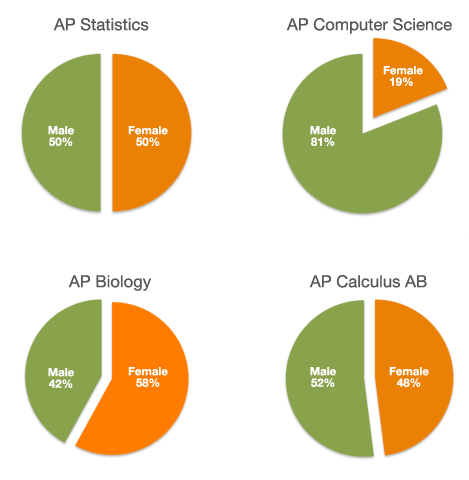
Statistics is indeed quite important, and whether AP CS or AP Statistics is a more useful use of a high-school student's time is a useful question (assuming they have to choose, which maybe they don't?). But AP Statistics is not teaching computational thinking; it's teaching statistical thinking, which is not the same!
Computational thinking, or to use an older term, procedural literacy, is the idea that people should understand how to think in terms of processes, procedures, etc. Rather than teaching programming, which often (especially at introductory levels) focuses a lot on the mechanics of a programming language's syntax and other idiosyncracies, the idea is to teach people how to even think about the basic idea of a machine that can execute programs. Many people can't do that: even leaving aside that they don't know C or Java or Lisp, they also don't really understand what an algorithm or a computer program is conceptually, and have absolute no idea what kinds of things can be computed and what kinds can't, or which are easy or harder to compute. They lack the ability to interact meaningfully with non-code representations of computation and algorithms as well, like flow charts or (natural-language) instruction sequences.
Statistical thinking is quite a bit different, more about proper use of data, quantification of evidence and uncertainty, etc. It can be complementary to computational thinking, but it isn't the same skill.
10 PRINT CHR$(205.5+RND(1)); : GOTO 10
AP stands for Advanced Placement. The program intends to offer college-level courses to high school students. Each course culminates in a standard exam in the spring which is graded on a 1-5 scale. Some colleges award college credit to their students for AP courses they took in high school, depending on the score and the exam.
Statistics is indeed quite important, and whether AP CS or AP Statistics is a more useful use of a high-school student's time is a useful question (assuming they have to choose, which maybe they don't?). But AP Statistics is not teaching computational thinking; it's teaching statistical thinking, which is not the same!
While I agree statistical think is different than computational thinking, to answer your question I think it is a better use of a students time to teach statistics. Properly taught, it teaches you to think about how to formulate a question, what data you need and how to analyze it. In short, it is as much about the problem as the answer.
Computational thinking, or to use an older term, procedural literacy, is the idea that people should understand how to think in terms of processes, procedures, etc..
SNIP
Many people can't do that: even leaving aside that they don't know C or Java or Lisp, they also don't really understand what an algorithm or a computer program is conceptually, and have absolute no idea what kinds of things can be computed and what kinds can't, or which are easy or harder to compute. They lack the ability to interact meaningfully with non-code representations of computation and algorithms as well, like flow charts or (natural-language) instruction sequences.
Again, I concur with you comments. That's why code monkeys are cheap and those who can actually develop a solution valuable; and the skills you mention don't become obsolete when a new language comes along. Unfortunately, far to many people equate the ability to code with being a computer scientist or engineer. That's not to say we don't need good coders but focusing on coding and forgetting the how and why behind it is doing them a disservice. I've also found the ones who can really write elegant code generally also think conceptually as well. Maybe I was lucky but when I took CS in high school the teacher made us explain and diagram what we are trying to do before coding, and rewarded accomplishing tasks in as few lines of code as possible. A she put it, "anybody can write a program with 100 lines to accomplish what can be done in 2."
Statistical thinking is quite a bit different, more about proper use of data, quantification of evidence and uncertainty, etc. It can be complementary to computational thinking, but it isn't the same skill.
True, but faced with learning statical thinking or how to write code I think the former is more valuable.
I'm a consultant - I convert gibberish into cash-flow.
It's not really a new debate, but the assumption that high school students will on average be better served by taking calculus instead of statistics could use some scrutiny.
Practically speaking, basic familiarity with statistics is also a form of civics - teaching kids when to call BS on bogus claims, helping them to understand what statistical significance means and doesn't mean, etc.
"Anyone who [rips a CD] is probably engaging in copyright infringement." - David O. Carson
This whole article is based on a fallacy - that Computer Science is teaching people to code.
This isn't what a Computer Science degree teaches you.
I am a teacher who has taught math and electronics in a high-performing public suburban school and currently teach math and computer science in a comparably performing urban preparatory school.
There are several reasons why AP CS enrollment has flat-lined as AP Statistics has surged (here are three that came to mind immediately):
1) There are a lot more kids taking Algebra as 8th graders. These kids (assuming success through the American four year Algebra, Geometry, Algebra 2, Precalculus sequence) need a course to take senior year. Most high school teachers will suggest AP Calculus or AP Statistics as an option. My previous employer went from 1 section of AP Calculus when I started to 7 sections of AP Calculus and AP Statistics by the time I had left (enrollment declined slightly during that time). Yes, the average AP scores went down a little during that time --- but I still think it's a good thing that more kids are taking the classes.
2) Lots of math teachers are willing and able to teach AP Statistics, but few can teach AP CS. In most states you need a separate license to teach it. I teach at a private school, so no such license is necessary (my undergrad is in electrical engineering, most of my work experience was software, and thus I feel comfortable teaching the course). The topics covered on the A exam (the AB, or harder, exam that I took in high school no longer exists) are not trivial. Inheritance, interfaces, polymorphism, and sorting/searching algorithms are all presented. Data structures topics (linked lists, stacks, queues, etc.) are not taught but could easily be taught in a follow up course, since most students taking AP CS at my school are juniors. Some of my teaching colleagues who know how to program would struggle with the object-oriented focus of the exam given that they came up during the Pascal era.
3) In the era of budget cuts, if you can only get 15 students to register for AP CS, it will not run in many schools. Sometimes it's feasible to run it every other year, but often that doesn't work. Many kids who are interested in programming cannot fit two semesters into their high school schedules. AP Statistics, however, fulfills the fourth year of mathematics that many schools require and thus is easier to fit into the schedule.
Let me say that I very much enjoy teaching the course. The examination in CS is challenging and well written. There are some topics that I'd like to see added (file input / output is not typically covered). I am confident in my students' ability to take Data Structures as a freshman if they pass the exam with a 4 or 5.