 Slashdot Mirror
Computational Thinking: AP Computer Science Vs AP Statistics?
theodp writes: "What if learning to code weren't actually the most important thing?" asks Mother Jones' Tasneem Raja. "Rather than increasing the number of kids who can crank out thousands of lines of JavaScript, we first need to boost the number who understand what code can do." Computational thinking, Raja explains, is what really matters. So, while Google is spending another $50 million (on top of an earlier $40 million) and pulling out all the stops in an effort to convince girls that code and AP Computer Science is a big deal, could AP Statistics actually be a better way to teach computational thinking to college credit-seeking high school students? Not only did AP Statistics enrollment surge as AP CS flat-lined, it was embraced equally by girls and boys. Statistics also offers plenty of coding opportunities to boot. And it teaches one how to correctly analyze AP CS enrollment data!
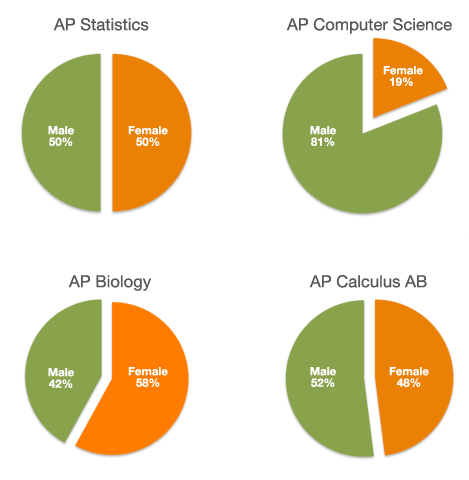
Statistics is indeed quite important, and whether AP CS or AP Statistics is a more useful use of a high-school student's time is a useful question (assuming they have to choose, which maybe they don't?). But AP Statistics is not teaching computational thinking; it's teaching statistical thinking, which is not the same!
Computational thinking, or to use an older term, procedural literacy, is the idea that people should understand how to think in terms of processes, procedures, etc. Rather than teaching programming, which often (especially at introductory levels) focuses a lot on the mechanics of a programming language's syntax and other idiosyncracies, the idea is to teach people how to even think about the basic idea of a machine that can execute programs. Many people can't do that: even leaving aside that they don't know C or Java or Lisp, they also don't really understand what an algorithm or a computer program is conceptually, and have absolute no idea what kinds of things can be computed and what kinds can't, or which are easy or harder to compute. They lack the ability to interact meaningfully with non-code representations of computation and algorithms as well, like flow charts or (natural-language) instruction sequences.
Statistical thinking is quite a bit different, more about proper use of data, quantification of evidence and uncertainty, etc. It can be complementary to computational thinking, but it isn't the same skill.
10 PRINT CHR$(205.5+RND(1)); : GOTO 10
AP stands for Advanced Placement. The program intends to offer college-level courses to high school students. Each course culminates in a standard exam in the spring which is graded on a 1-5 scale. Some colleges award college credit to their students for AP courses they took in high school, depending on the score and the exam.