 Slashdot Mirror
Education Chief Should Know About PLATO and the History of Online CS Education
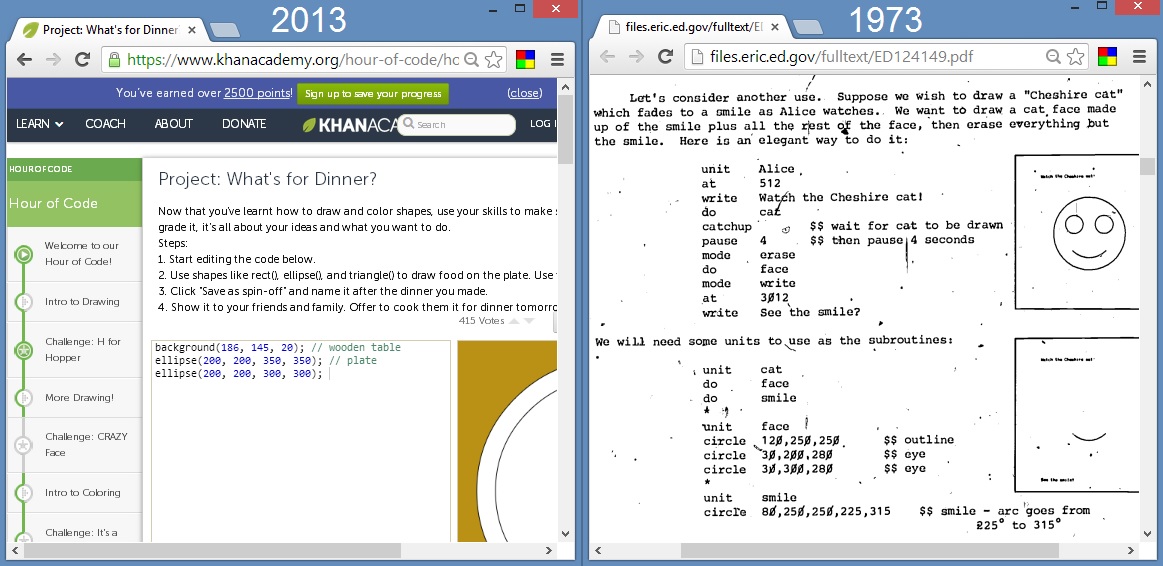
theodp writes Writing in Vanity Fair, U.S. Secretary of Education Arne Duncan marvels that his kids can learn to code online at their own pace thanks to "free" lessons from Khan Academy, which Duncan credits for "changing the way my kids learn" (Duncan calls out his kids' grade school for not offering coding). The 50-year-old Duncan, who complained last December that he "didn't have the opportunity to learn computer skills" while growing up attending the Univ. of Chicago Lab Schools and Yale, may be surprised to learn that the University of Illinois was teaching kids how to program online in the '70s with its PLATO system, and it didn't look all that different from what Khan Academy came up with for his kids 40 years later (Roger Ebert remarked in his 2011 TED Talk that seeing Khan Academy gave him a flashback to the PLATO system he reported on in the '60s). So, does it matter if the nation's education chief — who presides over a budget that includes $69 billion in discretionary spending — is clueless about The Hidden History of Ed-Tech? Some think so. "We can't move forward," Hack Education's Audrey Watters writes, "til we reconcile where we've been before." So, if Duncan doesn't want to shell out $200 to read a 40-year-old academic paper on the subject (that's a different problem!) to bring himself up to speed, he presumably can check out the free offerings at Ed.gov. A 1975 paper on Interactive Systems for Education, for instance, notes that 650 students were learning programming on PLATO during the Spring '75 semester, not bad considering that Khan Academy is boasting that it "helped over 2000 girls learn to code" in 2014 (after luring their teachers with funding from a $1,000,000 Google Award). Even young techies might be impressed by the extent of PLATO's circa-1975 online CS offerings, from lessons on data structures and numerical analysis to compilers, including BASIC, PL/I, SNOBOL, APL, and even good-old COBOL.
A presidential appointee who is ignorant and unqualified? Horrors!
Gamingmuseum.com: Give your 3D accelerator a rest.
My dad did a Masters in Math at Illinois back in the 60's. Part of his work was PLATO, and I still have an original manual. :)
"He who would learn astronomy, and other recondite arts, let him go elsewhere. " -- John Calvin, commenting on Genesis 1
I learned my first line-number BASIC (*ptui!*) on an ASR-33 teletype via time-sharing on a Control Data system in public school in Arlington, VA in 1975.
I wrote dumb exponentiation loop programs about Ben, and how his rats would take over the city.
Studying Plato's "The Republic" will give people insight into politicians, their shitty actions, their ability to bullshit people, and give them some tools to see through the rhetoric and be more impacting to their Government. I have been saying for decades that we need to get these classes back into schools and teach rhetoric and logic to a much younger age instead of restricting this to very few people at a college level.
Oh wait, this is PLATO which has nothing to do with political thought.. Yes, lets continue to neglect educating people about those dangerous bits of knowledge and continue pushing the industrial education system. Nothing new here.
-The wise argue that there are few absolutes, the fool argues that there are no probabilities.
Almost half the summary text is not linking to anything, why does nobody check these things?
In the 60s and 70s, home PCs were not common, the Internet was a research project and long distance phone calls were expensive.
Seems to me that kids who want to learn to hack around with a computer can quite well do so on their own, thank you. No need for some set of lessons, be they gov't-approved or not.
I mean, really: at the very worst, 10 minutes with a search engine, the term " introduction and tutorial for $LANGUAGE" or Stackoverflow should get anyone capable of comprehending what programming is in the first place off and running.
https://app.box.com/WitthoftResume Code: https://github.com/cellocgw
He must have thought those big round glowing tubes were a new experimental kind of light bulb.
Oh. U. Chicago. U Illinois(Urbana). Not the same. Too bad he went to the wrong school.
I visited in the 70's when I was in college to attend some talk about Plato and to see it in action.
Strange that my third-tier college in Detroit gave every student the "opportunity" to learn programming skills, and required it in many curriculums - certainly for any of the sciences, including political. Indeed, those of us in Computer Science were constantly bitching about the engineers and "those SPSS people" hogging the terminals. (That's why we developed some software for booting them off of their terminal...)
(In fact - like Bill Gates - I learned in high school first. We were lucky to have an IBM 1620, though. I didn't have to steal time-sharing!)
Was U. Chicago that far behind? Or did our Education Secretary just make a bad judgment that it would not be useful to him?
Oops...Duncan graduated magna cum laude from Harvard University in 1987, after majoring in sociology.
Wow, 40 links on a news summary ... am I supposed to spend all day on this item??
"Have You Ever Heard of Plato? Aristotle? Socrates?" ... "Morons!" "Really."
You're right. The $200 was based on the suggestion to "supersize" the order up to a full $198 ACM membership, so more than one article could be read. It appears Duncan has the budget for it. :-)
He's beyond clueless. I've met Arne Duncan. He is the emptiest suit I have ever met in my entire life.
Ironically I've met his deputy secretary too and his deputy seems quite smart and capable.
Perhaps the federal Department of Education is just a complete boondoggle?
Have schools really benefitted from this department, which was only formed in 1980? Has the quality of education gone up since then? Have the costs come down?
Arne Duncan's claim to fame is outsourcing Chicago schools to private for-profit corporations, undercutting the public school system. He's a world-class jerk and it's shameful that he's in charge of America's education policy. Shameful.
Remember kids, if you're not paying for the service, YOU ARE THE PRODUCT THAT IS BEING SOLD.
Heavens to Betsy!
I learned to program on PLATO. It was an AMAZING system. In addition to supporting a variety of development environments, their system used a proprietary language called TUTOR. A good bit of networking technology today is derivative of this amazing system. I wasn't rich, although I noted a lot of kids who had access to PLATO tended to be children of CEOs and such. My parents worked at a college that had a grant to have the terminals available. The games on the system were also amazing.
As a programmer, PLATO was a great example of the "cloud"-type systems that will eventually become standard.. what Google is doing and Adobe is now proposing was done in the 70s at Plato, with centrally-hosted apps that routinely are updated automatically. As developers we could put in requests for program features and see them reflected in newer versions of the API. 512x512 resolution, touch sensitive screens, multi-player, real-time games between people all over the world..... in the 70s.
By the way, the original PLATO system has been ported and is running over TCP/IP. If you're willing to donate to the project, they have been known to grant access to people wanting to experience what it was like. See: http://www.cyber1.org/
By the way if anyone has the archive of the PLATO game 0drygulch.. PLEASE contact them... we've been dying to find that code and put it online.
I went to the University of Illinois in the 80’s, I’d heard of Plato, but didn’t get to experience it. That said I had gone to a community college my first two years (Blackhawk College in Moline) and remember a multimedia learning experience involved slides, audio, and text input that really seemed to accelerate my learning on some writing fundamentals that may not have been up to snuff after high school. I remember thinking this is the way education should be. That experience didn’t linger however and it was back to a slog of just regular book learning.
I have thought on this over an over the last few decades. I took the huge Stanford AI course by Sebastian Thrun and Peter Norvig. I did well, but it was a disappointment in presentation and did not feel to be the accelerated learning sensation I’d had all those years ago at Blackhawk.
Why are we re-writing Calculus books over and over? Why isn’t there some insanely great multimedia interactive national curriculum for this sort of stuff. Why when we are busing kids around aren’t they on tablets watching lectures and doing interactive lessons?
I have seen the argument over and over that kids need individualized attention by teachers to do well, but I fail to understand why all the drudge assignment work and pre-scripted presentations have to be created and done by those same teachers. Why aren’t the teachers more like facilitators helping the kids to navigate and understand the material as created and presented by the truly best presenters online?
We frequently find mistakes in the material our child brings home that the teachers have prepared. We send it back with corrections explained to the teachers, but why should I have to proof read the teacher’s material? And our local elementary school is supposedly among the best here in Maryland. I can only imagine how abysmal the homework assignments are at poorer schools. Again, why are the teachers creating the homework assignments? I understand tailoring the explanations to the students as they struggle to master something, I don’t understand why the bulk of of assignments have to be custom created by the teachers, especially when they are going to flub it so often.
My wife and I spend a great deal of time educating our daughter, I feel it is almost home schooling and she gets very little from school itself. While she is an straight A student and we are proud, I am also angry we have to invest so much time and energy to teach her what she should be getting in school. Yes our daughter absolutely wants harder assignments and material in school, but the teachers hold back students like our daughter to keep the material at a level the bulk of the class can keep up with.
Letter To Iran
I remember PLATO from the mid-70's. It was available a number of universities, all "networked" together by using central servers. I even wrote course material in TUTOR (the PLATO language) for a class I was a TA for. Definitely ahead of its time.
I grew up in the 70s. I was a nerd and my friends were nerds. I don't recall any of my friends having an option to take classes like this
We did use terminals at the main city library to play games like Oregon Trail, but learning to code wasn't an option until I got past high school Algebra
My guess is that you needed a special invitation to get into these classes, and you could only get an invitation if your parents or teachers knew the right people.
I was a CS undergrad and never used the Plato system for structured learning, but played many an enjoyable hour in the basement of the CS building on a Plato terminal playing Empire. Was the best Star Trek game back in the day. Fantastic game for its day, and very fun after spending uncounted hours hacking some assigned programming task into shape.
Gooey Char? That's a little extreme don't you think? Certainly effective though.
--- Most topics have many sides worth arguing, allow me to take one opposite you.
Ted Nelson's Computer Lib / Dream Machines (c) 1974 has a section on educational systems, including PLATO.
The tagline was "You can and must understand computers NOW". Challenge accepted.
A.
...bringing you cynical quips since 1998
I took online courses on PLATO and wrote simple games for it. The hardware was laughable by today's standards - plasma screens that glowed orange text (and lines!) from a dark blue background with touch input provided on about a 1/2" grid coupled with hideously clunky keyboards having their own special function keys - but it was reasonably reliable and allowed some of the first really large scale research on CHI.
Not that anyone other than researchers actually gave a crap about that last part.
But the system was fun to write programs for. It had a pretty OK language for the day, called TUTOR, that contained necessary primitives to make it Turing complete along with others to let you write onto the screen in a variety of ways. Again, pretty primitive by today's standards, but enough to teach programming with - they were debugging the interpreter (I think Fortran) and I played with it once. Pretty advanced for the time with breakpoints being highlighted.
And of course this is back in the late 1970's. Before the PC was a gleam in IBM's eye. The whole thing ran as on a huge CDC 6600 running a custom OS (as many were, in those days). Odd instruction set by an even odder designer you may have heard of - guy named Seymour Cray. Quirkier than hell with 60-bit words, 18-bit address space, and 6-bit bytes (yes, we spoke octal). But that was back in the day when minicomputers were eating the lunch of the mainframe boys. CDC, whom the University of Illinois partnered with to productize the system, couldn't muster the resources or talent to market this system while swirling down the toilet.
And, like so many things in computing, we see progress, good ideas thwarted by, well, nothing but the fact that people are short-sighted and, if something doesn't make a buck for someone, we drop it on the floor. So it goes...
That is all.
US Education Chief Should Know About PLATO and the History of Online CS Educatio
Does online CS education also include lessons on how to make database columns wide enough to contain article titles?
(Or comment subjects)
Slashdot social media options: AIM, ICQ, Yahoo, Jabber and Mobile Text. Why no MySpace?
To clarify, Professional Membership PLUS ACM Digital Library: $198 (USD)
On June 3, 2010, the Computer History Museum hosted a 6-session conference on the PLATO learning system. Session 1 was entitled "A Culture of Innovation: What Don Bitzer Wrought." https://www.youtube.com/watch?... Session 2 was entitled "Innovations in Hardware: Mission-based Developments Led Other Places." https://www.youtube.com/watch?... Session 3 was entitled "PLATO Software: Driven by a Clear, Compelling Challenge." https://www.youtube.com/watch?... Session 4 was entitled "Online Education & Courseware: Lessons Learned, Insights Gleaned." https://www.youtube.com/watch?... Session 5 was entitled "PLATO Games: An Early, Robust Community of Multiplayer, Online Games." https://www.youtube.com/watch?... Session 6 was entitled "An Early Online Community: People Plus Computing Grows Communities." https://www.youtube.com/watch?...
I know we don't RFTA..but c'mon 17 links in one post? You expected me to open 17 tabs today??
It will be better to purchase from an owner who is a good farmer and a good builder.
Wish I had had access to Plato. So much came from it, including the genesis of Lotus Notes. Computer education was just starting in the late 60's. My 1968 high school physics class had a student teacher from a local college that taught us FORTRAN, on a RCA mainframe. We used punch cards the first year and then in 1969, a paper-tape teletype was installed. Kids will be kids. We quickly learned to save ASCII art on paper-tape and sent a foot long rendition of the finger to the operator's console. This was also before the days of using ***** to hide passwords, so a fish into the garbage can yielded the teacher's password and eventually the system admin's. A few grades were changed with no consequences, but when we tried the admin "shutdown" command before dismounting the drives - and it took a week to reboot the system - that was the end of my early computer training.
Why does Kahn need access to my gmail account? Free? not so much I think.
https://www.flickr.com/photos/...
Jack of all trades,master of none
Just what the C++ language needed, a gooey char to represent melted characters.
$200 for the 40-year old paper includes membership. Non-members get the paper for $15. Can you please not misrepresent?
Not that I'm defending this. The article should be free, and $15 is way too much (even the 24-hour "rental" for $3 is too much). But it isn't $200.
>when in reality they did
Sure, just like mine did. In the mid-80's, we had a total of 25 NovaNET terminals serving all 35,000 of us. Fortunately, it's not like there was a 1000+ student line at each terminal, since they were placed in a building hosting fewer than 500 students. All you had to do to join those privileged few was 1) be a 99th percentiler in several subjects; 2) give up the social connection of your 'home high school'; and 3) take two extra bus rides (totaling at least 30 minutes of transit) every day.
I agree. Every one of those other 34,500 students were just too fuckin lazy.
If he's 50, he was born in 1964, so he might have gone to college before Apple II's became widespread. But when I was in high school from 1972-1974, we had time-sharing access to a PDP-11 at the nearby state university (with one teletype shared for the entire school), so by 8 years later it's likely he had something a lot fancier. My wife's high school didn't have that - they used punch cards, which got batch-processed weekly.
I first encountered PLATO in college, and it had Notesfiles (which contributed significantly to the evolution of Usenet, as well as Lotus Notes), and the coolest-ever Star Trek game.
Bill Stewart
New Fast-Compression-only CPR http://preview.tinyurl.com/dy575ks
A lot of posters are missing the point, and stating that it's understandable that he didn't know about Plato, given it's limited availability.
Perhaps excusable. I read Computer Lib/Dream Machines and, yes, that was my first knowledge of Plato. And I was a Computer Science student and hobbyist.
But what he stated is that he did not have the opportunity to learn about computers. That's total nonsense. He apparently just avoided it. Any college student in engineering, social sciences, etc. in the 70's would have plenty of opportunity to take conventional classes, and in most schools they would have been required.
In primary school, I learned to sew, knit and program in Logo. Also papier mâché and finger painting.
In my first two years at high school I had cooking, sewing, woodwork (and working polyacrylic) and a couple of other things.
Then I went on to get three degrees.
Got them moderator blues I blieve I walk out the do', With these mod-points I been gettin', I 'most never post no mo'
My high school did not have computers. The junior college I attended did, for those that took programming classes. Radio Shak was selling the TRS-80, we'd hang out at the mall and play Star Trek on it. So no, computers weren't everywhere, but they weren't hard to find. I have to confess I'm not familiar with PLATO.
Never let a lack of data get in the way of a good rant.
Is someone here trying to imply that out elected leaders need to be competent? What nonsense! They only have to be compliant and obedient to their lords and masters on Wall Street, fossil fuels, defence contractors, big pharma, and big ag (Who did I miss?). They'll ensure that the "right" legislation gets written for them to pass by ALEC and other similar organisations.
PLATO of course predated the Internet, however it also predated most of the things we take for granted these days. For instance, graphical displays, multimedia content, high levels of interactivity, routine linking to other sources, and so forth. PLATO therefore had to do stuff like invent a workable visual paradigm (modern term is the UI). This level of creation was routine at the time.
More than anything though, PLATO took a serious stab at generating lots of content. Most systems of the day foundered on this point; even if the programmers overcame all the other hurdles, they often fell short on content. PLATO actually resembled a decent instruction system, fully loaded with courseware that students would be interested in taking.
PLATO looks antiquated today. It was really quite an achievement at the time though. And it had a certain cachet as a computerized training system, very Jetsons.
My opinion of course, but Aristotle was the Philosophical equivalent to Machiavelli in terms of society. He was very much a Sophist and though a student of Plato he was not well liked. Socrates remember was anti-slavery, and full on equal rights (including women's rights) which at the time was unheard of. Plato held the same beliefs but saw society as always falling to corruption (why he "quit" being an Athenian and got out of politics). Aristotle believe that people like him should be pampered by the state and provided slaves and luxuries.
Bright in Math, but weak in Psychology, Sociology, and Political sciences in terms of "Public good".
-The wise argue that there are few absolutes, the fool argues that there are no probabilities.
Try reading past the first paragraph. No, I read nothing else you said after the false accusations and ad hominem. If you don't understand the 2nd paragraph blame your public school and request clarification.
-The wise argue that there are few absolutes, the fool argues that there are no probabilities.
The comments seem to imply you can no longer experience PLATO. That's not true. There is an emulator for the PLATO Terminal available at: http://www.cyber1.org/ I even bought a really cool T-Shirt from them and a patch celebrating the 50th Anniversary of PLATO on June 2-3, 2010 in Mountain View California. Try it, if I remember right, even the old airplane design programs are there.
Remember "Press NEXT to begin".
A computer may beat me at Chess, but I always win at Kickboxing.