 Slashdot Mirror
SOTU: Community Colleges, Employers To Train Workers For High-Paying Coding Jobs
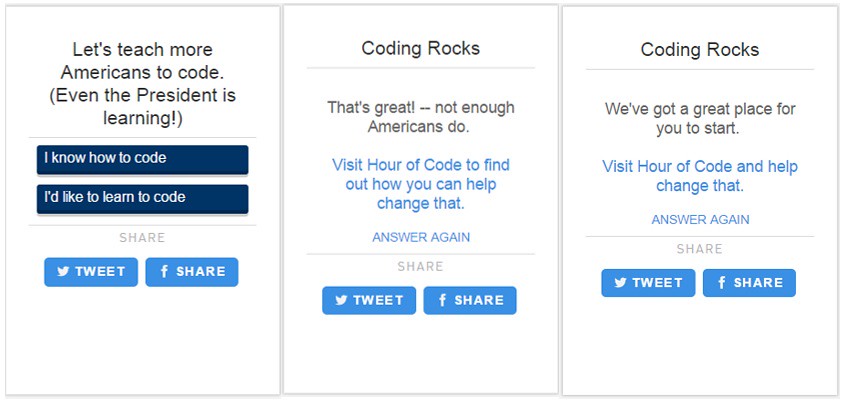
theodp writes: Coding got a couple of shout-outs from the White House in Tuesday's State of the Union Address. "Thanks to Vice President Biden's great work to update our job training system," said President Obama (YouTube), "we're connecting community colleges with local employers to train workers to fill high-paying jobs like coding, and nursing, and robotics." And among the so-called "boats" in the new "River of Content" that the White House social media folks came up with to enhance the State of the Union is a card intended to be shared on Twitter & Facebook which reads, "Let's teach more Americans to code. (Even the President is learning!)."
President Obama briefly addressed human spaceflight, saying, "I want Americans to win the race for the kinds of discoveries that unleash new jobs – converting sunlight into liquid fuel; creating revolutionary prosthetics, so that a veteran who gave his arms for his country can play catch with his kid; pushing out into the Solar System not just to visit, but to stay." He also called once more for action on climate change. Politifact has an annotated version of the transcript for more background information on Obama's statements, and FiveThirtyEight has a similar cheat sheet.
"we're connecting community colleges with local employers to train workers to fill high-paying jobs like coding
"Transparent" is a shit show that trades on every stereotype going. A man in drag is NOT a transsexual.
We'll be training kids with a two year degree to fill in jobs that don't exist. If you thought that another kid with a BA in communications was having a hard time just wait until we have thousands of kids who can do Hello World in Java and VB flooding a market that doesn't really exist... At least we can still count on everyone crying that we need more H1Bs.
Coding isn't a high paying job, and isn't what the country needs. A community college course that teaches how to code in a particular language, rather than teaching systems development, pays about the same as flipping burgers and produces systems like TJ Maxx, Target, Home Depot, and healthcare.gov.
Teaching millions of people computer code is like teaching everyone medical codes - it doesn't do them any good, and it doesn't do the country any good.
with over time and some specialties like anesthesia a nurse can make in the $120,000 range which is like top 10% of all income earners. but generic nurses aren't that well paid anymore because so many people went into the field in the last decade
"I want Americans to win the race for the kinds of discoveries that unleash new jobs – converting sunlight into liquid fuel;"
What next? Flying unicorn cloning?
Wow.
Never thought I'd see a day where POTUS would have a technical leg up on every judge presiding over the fate of coders.
When is National Train the Trainer day going to hit the calendar? Might as well, since training is being pushed this hard.
True statement, but you're talking about a Nurse Anesthetist. A Masters Degree level nurse and a specialized field as well. You can even go a step further and become a Nurse Practitioner, but now we're talking a PH.D level education.
I would expect anyone who wielded a Masters Degree in any meaningful field of study to have similar wages.
Most places are looking for BSN's these days at a minimum. You can still find jobs for LVN's and RN's, but most are transitioning to the BSN. ( Bachelor Degrees ) So if you want a career in Nursing, ( not that I expect many here on Slashdot will ) figure on doing the BSN program.
Suppose that's true, if you teach a million people medical coding, two will end up being doctors. And the rest end up unemployed because we only need a few thousand medical coding people. How is that good, to have 998,000 people waste their time (and your money)? Everyone would be much better off putting 1/100th the money into medical school scholarships - you end up with more doctors and nobody wasting their time, and you still have your money to spend on something useful.
Similarly, we need people who know systems architecture, comp sci, information security, electrical engineering, materials science - all of these disciplines are needed to build the systems of the future, and all pay well. Scholarships in these areas would be useful to the student and to the country. Teaching everyone a coding language doesn't advance anything they need or we need.
There are plenty of fields where a community college education is useful - welders, for example, earn more than code monkeys, starting with just a few weeks of schooling. In two years, they can get certified to do underwater welding, aerospace, etc - all of which pay much better than coding, because they are more useful than coding without understanding software systems design principles.
Chuckle.
You have to be VERY smart. I watched my other half go through Nursing school and the material / coursework is no joke. Your Science-Fu better be way up there. Especially Biology, Anatomy, Micro-Biology and Chemistry.
Lest we forget what this country was founded upon: http://en.wikipedia.org/wiki/L...
I teach Computer Information Systems at a community college, which includes some programming courses (C++, Java, JavaScript & PHP w/MySQL, etc.), and some non-programming courses on general computer use. When I teach a programming course, I teach it with the idea that the students I have need to be competent in order to succeed when they move on to a 4 year college. What ends up happening is about 1/3 will stop coming to class after about the first few weeks of school--just long enough to not have their Pell Grants and other financial taken away. Then they go off to party/play video games/whatever. About another 1/2 will struggle, complain that there's too much homework, that the homework is too hard, but they either don't post messages on the course message board, or they do it the evening before the homework's due. They also tend to skip class if they didn't get the homework done. Then about 1/6 excel in the course. They show up every time, do most of the homework, and try to assist other students who are struggling.
I've been teaching for 5 years now and this has been a consistent pattern. The first & last groups are typically composed of traditional students, and the middle one is mostly non-traditional students. I think the reason why NT students struggle so much is because they're shuttled into CS/CIS but have no technical background. They're told "go into computers, that's where all the jobs are", then they take the classes & struggle. I try to accommodate them as best I can, but there's only so much hand-holding you can do.
So basically from my anecdotal experience, you're going to be pissing away money on about 5/6ths of the students you're sending into the field. The number of successes may increase when this program kicks into gear, but that's not really going to be a good indication. "Why's that?" you ask. The answer is simple: There will be more smart students at community colleges who probably would have gone to a better 4-year school if community college wasn't "free".
I want to see everyone have as much success as possible, but the truth is, some students would be better suited for going straight into the job market rather than go to college. Most of the students in the lower 1/3 I mentioned previously either lack the intelligence, (but mostly) the maturity, or both.
Taking guns away from the 99% gives the 1% 100% of the power.
Those who end up on the far end of the bell curve won't be those who stop at a 2 year degree in "coding" at a local community college. The very best developer I know has a masters degree, 25+ years of experience, and STILL spends more time learning.
My objection to things like this are the false belief it instills that all you need to do to learn to be good at this is go to community college for a while, where you'll be taught by other people who aren't good at coding. If they were good, they'd be doing it, not making peanuts teaching community college. The second false belief is that it's a ticket to a high paying job. High pay comes with scarce skills. If you send everyone to community college and they actually do become good at coding, it won't be a high paying job.
We should send everyone to a 4 year school and teach them basic economics so they'd understand things like this. Doctors don't make a lot of money because their jobs are important or it costs a lot to train one. They make a lot of money because when you need one, you'll pay whatever you have to, and because there are a limited number of them. In the ideal world, we'd call that 4 year degree high school. It's terrible that people entering the real world don't understand this stuff, and it's why the US electorate falls for nonsense like this time and again.
In the UK its a common myth that doctors have it better than nurses.
It might be that way once you get to the upper echelon of doctors, such as surgeons, consultants etc, but for the bulk nurses have it much better.
Nurses have protected breaks, doctors are required to respond to calls regardless of what they are doing - which means you have 2 minutes to eat a meal in.
Nurses have protected working time limits, doctors do not and can work up to 75 hours a week (the EU Working Time Directive was supposed to curtail this, but what actually happens is your working time is averaged out across your entire working year, including 4 weeks of holiday...)
Nurses can offload all responsibility to doctors, and doctors cannot refuse that responsibility - a nurse can write "doctor informed" in the patient notes and absolve themselves of all problems later on.
On a typical night shift in a hospital with 600 beds, there were usually 2 - 3 nurses per ward (30 patients or so), and 2 or 3 doctors for the entire hospital, excluding A&E. Which means treating patients at either end of the mile long hospital is fun...
My wife worked out that, if you just correct for hours worked, she was paid worse than a porter in the hospital, let alone a nurse.
"It gives the impression that a high-paying job is relatively easy to get, and that's just not true."
I didn't get that impression at all and suggest that your thoughts and biases about what the president said gave you that impression. There was nothing in his remarks that implied it in a logical sense, although the president is almost certainly correct. If you can get more people coding, there will be better coders and some will get paid better than if they did not have such skills. Not all code leads to new insights into the structure of the universe or changes how the world works. Nonetheless, one can make a lot of money just coding financial transactions for a great many businesses, nothing earthshaking in terms of novel or brilliant code, but the stuff economies are built and run on nonetheless.
I applaud the President for this initiative as it gets people thinking about coding and computer science, as well as other technical professions. Sure beats more tax breaks for the wealthy as the solution to all the world's problems.
Nonsense. If you train a million doctors the worse that could happen is that you have nearly a million paramedics, some trained to do many of the simple or relatively specialized tasks that doctors already farm out to their nurses and aides already. The result would be no excuse for such high health care costs and wages for doctors, since much of what they currently do could be done for far less by paramedics or even in some cases by robots or medical devices.
Lets end the nonsense that the status quo is the best we can do.
You've gotten the cause and effect reversed.
Tuitions being increased led to the creation of the federal student loan program, not the other way around.
Tuition went up because the majority of colleges are state schools.
And State schools used to have low or almost non existent tuition because they were primarily supported by state taxes, NOT TUITION.
In the same past 20 years (actually goes further, to 30 or 40, around the same time the voodoo economics of trickle down theory started being pushed) as states started being taken over by the GOP, they reduced their budgets and therefore number of things supported by state funds. One of which was state colleges.
That's why tuitions went up.
They had to.
It had nothing to do with "the federal teat". You try to make an anti-government point, the actual reality of the situation was that tuitions were low BECAUSE OF (state) GOVERNMENT, and tax support. Tuitions had to go up in response to that funding being reduced or even cut off.
There are other factors that have come into play since (it's not a static picture, but a dynamic one), but the original reason that
The guy who said the election was rigged won the presidency with the second-most votes.
"Time to run screaming in the opposite direction."
Yeah, right into the hands of privatized education and diploma mills that are generating the most student debt.
That's the beauty of the President's plan. It asks for those who already are doing well to give something back so that deserving students can go to community college at virtually no cost.
I would rather see loopholes for "good will", "forward carry", "depletion allowances" and preferential tax credits for owning "rolling stock" eliminated, but since the GOP isn't going to do this, the only viable option is to ask those who make $500,000 per year to pay the same rates they did under Ronald Reagan.
Why should guys like Mitt Romney only get to pay 13% on his annual income in tax, while the rest of us pay 28% or more?
Why do so many advocate more tax breaks for Mitt Romney and less to educate average Americans?
Much higher (my ex-wife has a BSN, and pulled in $75k/yr in 2005 while working at a VA Medical Center in Utah... she made so much more than I did at the time, I could have qualified for alimony payments if I were female...)
Quo usque tandem abutere, Nimbus, patientia nostra?
If you can get more people coding, there will be better coders and some will get paid better than if they did not have such skills.
It helps just to know what coding is. There is a graphic artist working in the office next to mine. She once mentioned that she had 2000 images to resize, and it was going to take her a week to do them all. I gave her a one hour lesson on "what coding is" then I spent five minutes writing a perl script that was able to resize all the images in less than 30 seconds. She still can't code. But now, when she has a tedious and repetitive task, she knows to ask a coder for help.