 Slashdot Mirror
Man Says Tesla Autopilot Saved His Life By Driving Him To the Hospital (cnbc.com)
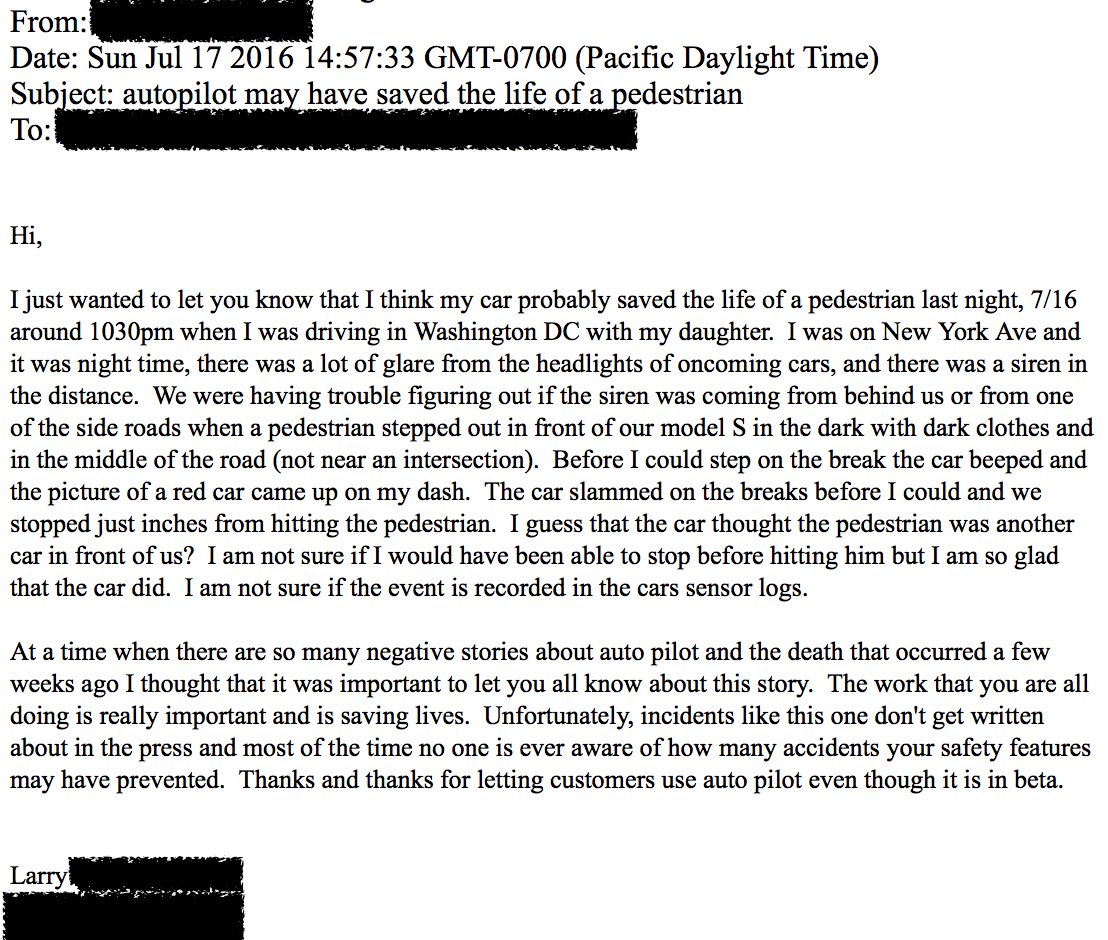
An anonymous reader writes: Last month a man sent an email to Elon Musk explaining how his Tesla Model S with Autopilot activated may have saved a pedestrian's life. Now, it appears Autopilot may have saved the life of a Tesla Model X driver. CNBC reports: "A Missouri man says his Tesla helped saved his life by driving him to the hospital during a life-threatening emergency. Joshua Neally is a lawyer and Tesla owner from Springfield, Missouri, who often uses the semi-autonomous driving system called Autopilot on his Tesla Model X. The system has come under fire after it was involved in a fatal Florida crash in May, but Neally told online magazine Slate that Autopilot drove him 20 miles down a freeway to a hospital, while Neally suffered a potentially fatal blood vessel blockage in his lung, known as a pulmonary embolism. The hospital was right off the freeway exit, and Neally was able to steer the car the last few meters and check himself into the emergency room, the report said."
Not to diminish the usefulness of the feature, but wouldn't it have made more sense to call an ambulance? The auto-pilate might be able to get you there, but if you need immediate treatment, the Tesla can't do much for you.
Don't risk wrecking or running over people on your way to the hospital. Call an ambulance. Even if it is expensive, if you can afford a $100K car you can afford to call an ambulance.
http://lkml.org/lkml/2005/8/20/95
In the vast majority of cases an ambulance is faster (and safer) getting to you than you are getting to the hospital and they can give you some treatment on the spot.
Man puts other drivers at risk by keeping driving after being severely impaired with the help of a half-baked autonomous driving system.
I don't see how this is a positive thing for society?
How often are we going to have these Elon Musk pandering articles. Tesla is the opposite of Apple around here. They can do no wrong.
It's as if 90% of the slashdot regulars have a hard on for Musk's hard on.
We'll probably see these stories highlighted non-stop until some sort of legal decision is made on the liability of the actions genuinely autonomous vehicles. Google, Tesla, and everyone else working on the tech will need constant need investor support and public reaction to happy stories otherwise they'll have to face the real question of liability.
The problem at hand: It doesn't matter how many people a car's autonomous driving doesn't kill, what matters is the number of people it fails to save. The same rule applies to humans: People cannot defend negligent or murderous actions by a listing of all the people that they didn't kill. What matters is harm committed, not harm evaded.
Moreover, can any company survive the of full liability of the loss of more than a few lives? Over 30,000 people per year are killed on American roads. Even if autonomous vehicles reduced that to 10,000 people per year (a 66% reduction!), their manufacturers/programmers would still be responsible for the death of 10,000 people! What industry could survive that liability? That many civil law suits?
Tesla's 'Autopilot' feature takes another person to the hospital. When will the carnage end?!
Corruption is convincing someone that the selfless ideal is the same as their selfish ideal.
Squad cars should have a way to enable a "Follow Me" feature so that an Auto-Drive car can be escorted to the correct location (and the needed persons could be at the CURB).
I thought they were now down playing that and saying that it's a lane centering safety feature.
I know it sounds harsh, but 30k automobile-related deaths per year is already statistical noise. It's not even 100 people per day. That's less than two in each state per day.
To put that in perspective: almost twice as many people die per year falling off things.
"There are a dozen opinions on a matter until you know the truth. Then there is only one." - CS Lewis (paraprhase)
It isn't clear how liability insurance would work for driverless cars, but I can assure you the insurance companies are as losing as much sleep on this as Elon Musk is
This feat was impressive, but it will do no good unless Autopilot takes the driver to a hospital that takes his insurance plan.
It isn't clear how liability insurance would work for driverless cars, but I can assure you the insurance companies are as losing as much sleep on this as Elon Musk is
No, all this means is that accidents largely shift from being individual driver liability to being product liability. Even assuming big expensive cases for failures, that's going to be a huge net savings on insurance costs.
Might have to buy a Tesla car. I had to go to the ER a few months ago, and a car payment can't be any more expensive than that 1.7 mile ride. (Seriously, almost $8,000 US for a freakin' 1.7 mile ride.)
So he knew he was in need of urgent medical attention and he knew his driving was severly impaired, but instead of getting off the road and calling an ambulance, he continued to drive, relying on a system not at all designed for such circumstances?
I have some sympathy for people who assume Auto Pilot will not have glaring blind spots due to trivial engineering shortcomings, but anyone who thinks it means you can drive while unconscious/dead is not fit to be on the road. Thank goodness he did not cause an accident on this busy freeway resulting in the injury/death of dozens of people.
This is the archetypal selfish cunt, who may have made a lucky call on this occasion, but certianly did not make the right one.
But "everyone knows" you're not supposed to do this, right? Tesla tells you not to do this; you agree not to do this. If the article had been "man dies by using autopilot instead of calling ambulance" that's what a lot of people would be saying, right?
I'm not saying that the feature should be disabled or making any claim as to whether or not it's a net benefit. But if you're going to take credit for these situations where the autopilot worked when the driver was clearly not in any condition to drive, then you should take responsibility for its failures instead of deflecting fault because the driver was "distracted" or "inattentive".
Squad cars should have a way to enable a "Follow Me" feature so that an Auto-Drive car can be escorted to the correct location (and the needed persons could be at the CURB).
How about this for an upgrade:
When a user of autodrive asks it to "take me to an emergency room" the system does this:
- Locates the nearest accessible emergency room.
- Starts going there.
- Starts flashing the lights in an appropriate pattern.
- Phones ahead to tell the emergency room personnel and/or 911 dispatch that it is coming and give them arrival time and route info.
- Establishes a handsfree voice link to the E-room people (perhpas via 911 dispatch if appropriate for the particular location) to aid in medical treatment preparation.
- The medical and/or 911 dispatch personnel, or the car (again as appropriate) notify the police.
- The police can provide an escort and the car allows them to take over management of the routing or if they are equipped for it. Going into "follow me" mode on a particular squad car can be one of the police-selected options.
Bantam Dominique roosters crow a four-note song. Once you've heard it as "Happy BIRTHday" you can't NOT hear it that way
I have had two PE's. The first was very painful. I could only take short, gasping, and painful breaths; I drove myself to the hospital. The second PE until my general practitioner found it with a D-Dimer; on her advise I drove myself to the hospital. So what kind of PE did the driver have?
Of that is just too convenient. I call bullshit.
No, probably not correctly.
http://lkml.org/lkml/2005/8/20/95
In my opinion, my car should just roll into house insurance. Just another $30K piece of property. If that property causes damage, I expect it to be covered by whomever messed up the programming.
Laws are rules for the court, but merely a bottom bar to hit for life. Think beyond laws in your actions always.
Medical care in the US yes, that is private. So you pay for ambulances. Fire, no that varies by region. There is no federal firefighting setup, for a lot of reasons. So it is a state and local thing. Generally, firefighters are paid for by county or city taxes. In the vast majority of places, this is the case. If you are actually in the city limits, it is essentially always the case.
The issue is unincorporated areas. They don't have city government services because, well, they aren't incorporated in a city. There is depends on how the state, or usually the county, handles it. Sometimes it is taken care of at that level. Taxes paid to the county are used to with fund rural fire departments, or get paid in to city departments to have service out there.
However some places decide they want to be cheap to have less taxes. In that case, ya you have to pay some other way. Usually it is directly paying the local FD, often run by a nearby city (or the county) but it could be paying a completely private agency. You could even contract out your own, if you really wanted.
Don't like it? Well then you may need to move somewhere with higher taxes. Sorry, that's the tradeoff. You wanted to live somewhere with a really low property tax, and probably low property cost, you get to pay direct for some of the things that tax would cover. Where I live it is mostly funded by city sales tax, and also some aid from the state, but there is a line for it on my property tax bill as well.
I don't have a ton of sympathy for people that want to live in a cheap, unincorperated area and then cry when they have to pay for things that are city services in a city like water, sewer, fire, and so on. Either move, or start a vote to incorporate. You can join (or form) a city, you know. It comes with paying more taxes though.
Unless the ambulance takes a really long time to get to your house (and in most cities they are distributed around town, usually in fire stations, they don't come from the hospital) you get treatment faster. Why? Because they can treat you. Ambulances are little mobile treatment rooms. They have an EMT and Paramedic who have a not insignificant amount of training, a radio back to doctors, and a ton of equipment. No, they are not as well equipped as a hospital, but they have a lot of shit, including most of what you'd want to keep someone stable until they reach the hospital. Also they can usually get there faster than you can since they have the whole lights n' sirens thing. That isn't magic, but it helps them move through traffic a lot faster than normal.
Let's say you live 30 minutes away from the hospital, presuming normal traffic. If you leave your house right away, and everything goes well (like you don't pass out) then you get there in 30 minutes and presuming they properly triage you you get full care then. However if you call an ambulance you may have to wait, but let's say one is at a fire station only 15 minutes away, particularly since they can move faster. So in that case you get treatment starting in 15 minutes, not full care, but people there to help, and you get full care in 40, because they get to the hospital in 25 minutes rather than 30.
It will vary based on where you live, of course, but it is information you can find out if you are interested. Usually, you'll be getting care a lot faster with an ambulance and it won't take that much longer to get to the hospital.
Also it can help with making sure you get care right away if you need it. The Paramedic will be doing triage on you, seeing how bad you are. If you are in a bad way and need immediate care, they will let the hospital know and they'll be ready. You'll be admitted straight away and seen to. However if you walk in, that sometimes doesn't happen. Hospitals assume, usually correctly, that if you are well enough to be able to get yourself to them, walk in and sit down, you are well enough to wait until there is time. Now hopefully they'll notice if you are in need of immediate care, but maybe not.
Come in on an ambulance though, and it is probably taken care of. If you are not seriously injured, no problem, you'll come in and wait if necessary, just as if you walked in. If you are in need of immediate care though, they'll make sure to have it ready if they can.
Hard to believe, I know.
Why is this so hard to believe?? Firefighters have no duty to risk their lives for people who don't pay them to. -- it's a local service paid for by local money.
Dude. You've been coding for too long. It may be time to interact with some flesh-and-blood humans. Because the only rational response in a modern society is WTF.
The fire department in ancient Rome used to stand around dickering about price while someone's house burned down. But these are not the dark ages.
Yet, that's not always true. My admittedly anecdotal evidence -- me not being dead now.
You could try a longitudinal study.
Real lawyers write in C++
The problem at hand: It doesn't matter how many people a car's autonomous driving doesn't kill, what matters is the number of people it fails to save. The same rule applies to humans: People cannot defend negligent or murderous actions by a listing of all the people that they didn't kill. What matters is harm committed, not harm evaded.
Moreover, can any company survive the of full liability of the loss of more than a few lives? Over 30,000 people per year are killed on American roads. Even if autonomous vehicles reduced that to 10,000 people per year (a 66% reduction!), their manufacturers/programmers would still be responsible for the death of 10,000 people! What industry could survive that liability? That many civil law suits?
What is really bugging people is the haphazard way in which Tesla is going about this.
I have very little confidence that Tesla has any real idea how many lives their auto-pilot will cost or save, nor that they have even tried to seriously study the issue. By all appearances Tesla sees itself as being in a race to be the first one with a self-driving car and they're been happy to ship the first version that seems reasonably safe.
As for these "happy" stories the first one actually had nothing to do with the self-driving "autopilot" but was instead a collision avoidance system (not unique to Tesla) when the self-driving more wasn't even activated.
As for this story the guy might have been just fine without the autopilot, having driven himself or called for an ambulance.
I'm fine with the idea of the legal system accommodating self-driving car defects, I suspect it already does something similar with medical devices. But I don't believe Tesla is showing a sufficient concern for safety considering how many lives are at stake.
I stole this Sig
Why does everyone flak the driver immediately instead of asking the basic question: was the driver on the freeway when he did this?
If he was, what would you have done in the same situation? Park your car at a corner, call medical, then wait for an ambulance while you bleed out?
Would you attempt instead to drive yourself to the hospital, just using the assist feature to gain some semblance of control as he did?
It would be stupid if he drove from his house, of course, but on the freeway in a vehicle with a hospital nearby, what's the best choice that he should've done?
Oh, the topic of the value of human life.
So you are right, 30K people a year is a small number for a cause of death... ~50% of all people in the US die from one of two causes, cancer, and heart disease... those things kill a LOT of people.
Guns, cars, falling off things, are statistical noise.
BUT, guns and cars kill young people, cancer and heart disease kill old people... society has gotten used to the idea of old people dying... young people dying is still a tragedy.
Now I've not run the numbers (and I would love it if some one did run the numbers) but the remaining life expectancy per cause of death would be a interesting number... (i.e. average number of years you'd be expected to live if you had not died from x cause, multiply it out by the number of deaths from that cause and you have the number of years of life that cause of death has cost people.)
Car accidents probably have a remaining life expectancy per death of about 30 years (numbers are high for the very young and very old, so averaged out ~30 years old seems like a fair guess to me) ... Heart disease and cancer probably have a rate closer to 0... meaning that every year we shave 900k year cut off of people's lives from car accidents, and 0 cut off from cancer or heart disease.
This is one of the main reasons I think self driving cars can only lead to the fall of humanity. I mean, he didn't call an ambulance because he knew damn well that when they found out he was a lawyer they would have taken the long way to the hospital and possibly stopped for a long lunch as well. Self driving cars have to be programmed to do this as well, otherwise before we know it we will be neck deep in lawyers and phone sanitizers.
There are three kinds of falsehood: the first is a 'fib,' the second is a downright lie, and the third is statistics.