 Slashdot Mirror
Nvidia Calls Out Intel For Cheating In Xeon Phi vs GPU Benchmarks (arstechnica.com)
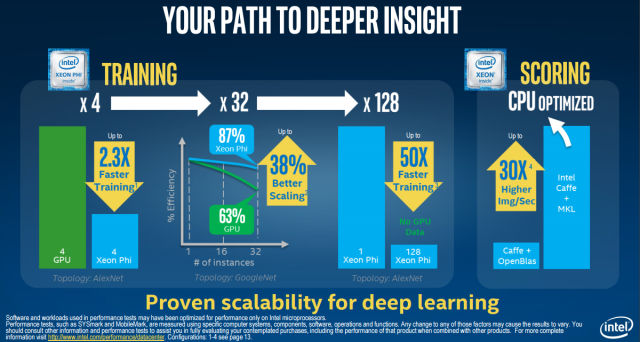
An anonymous reader writes: Nvidia has called out Intel for juicing its chip performance in specific benchmarks -- accusing Intel of publishing some incorrect "facts" about the performance of its long-overdue Knights Landing Xeon Phi cards. Nvidia's primary beef is with the following Intel slide, which was presented at a high performance computing conference (ISC 2016). Nvidia disputes Intel's claims that Xeon Phi provides "2.3x faster training" for neural networks and that it has "38 percent better scaling" across nodes. It looks like Intel opted for the classic using-an-old-version-of-some-benchmarking-software manoeuvre. Intel claimed that a Xeon Phi system is 2.3 times faster at training a neural network than a comparable Maxwell GPU system; Nvidia says that if Intel used an up-to-date version of the benchmark (Caffe AlexNet), the Maxwell system is actually 30 percent faster. And of course, Maxwell is Nvidia's last-gen part; the company says a comparable Pascal-based system would be 90 percent faster. On the 38-percent-better-scaling point, Nvidia says that Intel compared 32 of its new Xeon Phi servers against four-year-old Nvidia Kepler K20 servers being used in ORNL's Titan supercomputer. Nvidia states that modern GPUs, paired with a newer interconnect, scale "almost linearly up to 128 GPUs."
Only if you think this is new. Intel has been doing shit like this for year and keeps getting caught, there were two lawsuits against them from AMD a few years ago where they ended up paying AMD around $7B USD for doing things like this and other forms of anti-competitive behavior which resulted in multi-billion dollar fines. Then again, nvidia has been caught doing the same. Probably the best example most recently is with their "Hairworks" API, which is likely going to land them in hot water again. Nvidia got nailed a few years ago for anti-competitive behavior over shaders.
Om, nomnomnom...
It wasn't benchmarks, it was changing their commercial (as in users pay for it) compiler to ignore CPU flags for non Intel parts and not documenting it, then various illegal behaviour with effectively paying OEMs to not use AMD parts.
It's not so much "older" as "different" in the artificial benchmarking world. Real-world loads don't tend to follow benchmarks religiously, and the newer benchmark might favor a configuration that's not as good in real-world loads.
The classical marketing maneuver is to select from multiple sets of up-to-date benchmarks and pick the ones that favor your particular product. CPUBoss usually shows that one CPU outperforms another consistently (except for single-core vs threaded with dissimilar cores or SMT--fast clock wins single-core, many-cores wins threaded); and frequently shows the same benchmark tool using different strategies and rating each CPU faster than the other based on how it was configured, or shows that one benchmark favors one CPU and another favors the other.
This goes all the way up to real-world functional tests, where you select games which perform better because of some feature or strategy of your GPU and CPU. You have better shaders? Pick a shader-heavy game. Heavy parallelism? Pick a game that meshes with that. You've got fewer parallel operations, but a higher clock? Avoid games that work best with 387-core GPUs and pick ones that like that 1185MHz clock. Show off 6 or 7 games running at freakishly-high 292fps.
Support my political activism on Patreon.