 Slashdot Mirror
Nvidia Calls Out Intel For Cheating In Xeon Phi vs GPU Benchmarks (arstechnica.com)
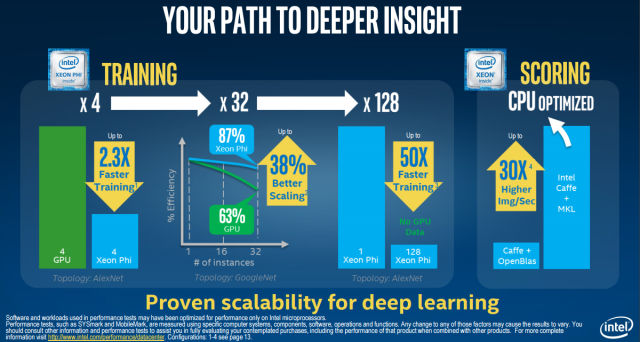
An anonymous reader writes: Nvidia has called out Intel for juicing its chip performance in specific benchmarks -- accusing Intel of publishing some incorrect "facts" about the performance of its long-overdue Knights Landing Xeon Phi cards. Nvidia's primary beef is with the following Intel slide, which was presented at a high performance computing conference (ISC 2016). Nvidia disputes Intel's claims that Xeon Phi provides "2.3x faster training" for neural networks and that it has "38 percent better scaling" across nodes. It looks like Intel opted for the classic using-an-old-version-of-some-benchmarking-software manoeuvre. Intel claimed that a Xeon Phi system is 2.3 times faster at training a neural network than a comparable Maxwell GPU system; Nvidia says that if Intel used an up-to-date version of the benchmark (Caffe AlexNet), the Maxwell system is actually 30 percent faster. And of course, Maxwell is Nvidia's last-gen part; the company says a comparable Pascal-based system would be 90 percent faster. On the 38-percent-better-scaling point, Nvidia says that Intel compared 32 of its new Xeon Phi servers against four-year-old Nvidia Kepler K20 servers being used in ORNL's Titan supercomputer. Nvidia states that modern GPUs, paired with a newer interconnect, scale "almost linearly up to 128 GPUs."
The real reason that Nvidia is bitching up a storm is that KNL has received a very positive reception in the HPC world.
Oh, and KNL is actually an absolute bargain in comparison to the requirements to get a high-end Pascal system setup, not only because you can buy an entire KNL system (not just a GPU card) starting at only $5000, but because it's self-hosting and doesn't need a high-end Xeon CPU just to feed the GPU. To put it in perspective, you could build a cluster of 26 KNLs for the price of one of those 8-way systems Nvidia is selling.
http://www.colfax-intl.com/nd/...
AntiFA: An abbreviation for Anti First Amendment.