 Slashdot Mirror
Researchers Create Algorithm That Diagnoses Depression From Your Instagram Feed (inverse.com)
An anonymous reader quotes a report from Inverse: Harvard University's Andrew Reece and the University of Vermont's Chris Danforth crafted an algorithm that can correctly diagnose depression, with up to 70 percent accuracy, based on a patient's Instagram feed alone. After a careful screening process, the team analyzed almost 50,000 photos from 166 participants, all of whom were Instagram users and 71 of whom had already been diagnosed with clinical depression. Their results confirmed their two hypotheses: first, that "markers of depression are observable in Instagram user behavior," and second, that "these depressive signals are detectable in posts made even before the date of first diagnosis." The duo had good rationale for both hypotheses. Photos shared on Instagram, despite their innocent appearance, are data-laden: Photos are either taken during the day or at night, in- or outdoors. They may include or exclude people. The user may or may not have used a filter. You can imagine an algorithm drooling at these binary inputs, all of which reflect a person's preferences, and, in turn, their well-being. Metadata is likewise full of analyzable information: How many people liked the photo? How many commented on it? How often does the user post, and how often do they browse? Many studies have shown that depressed people both perceive less color in the world and prefer dark, anemic scenes and images. The majority of healthy people, on the other hand, prefer colorful things. [Reece and Danforth] collected each photo's hue, saturation, and value averages. Depressed people, they found, tended to post photos that were more bluish, unsaturated, and dark. "Increased hue, along with decreased brightness and saturation, predicted depression," they write. The researchers found that happy people post less than depressed people, happy people post photos with more people in them than their depressed counterparts. and that depressed participants were less likely to use filters. The majority of "healthy" participants chose the Valencia filter, while the majority of "depressed" participants chose the Inkwell filter. Inverse has a neat little chart embedded in their report that shows the usage of Instagram filters between depressed and healthy users.
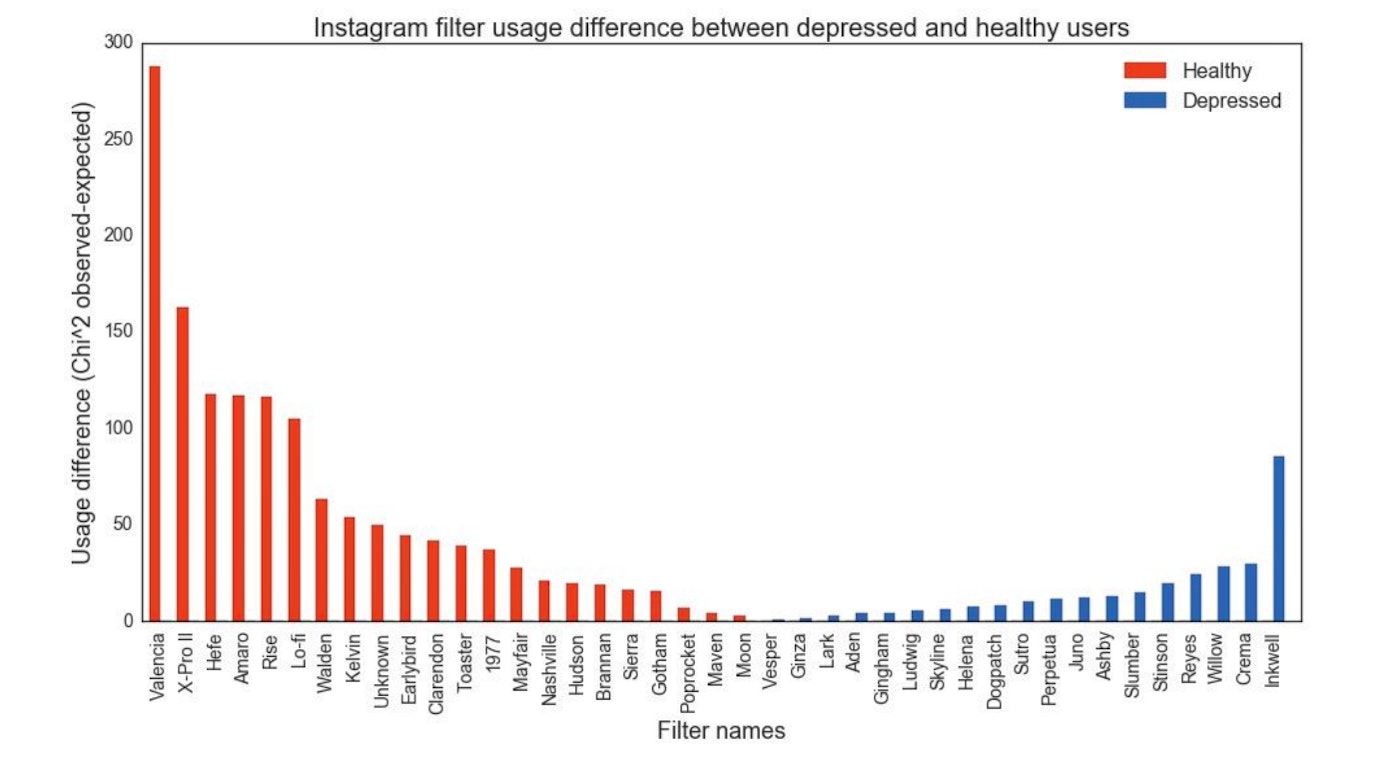
If my instagram feed is nonexistent, does that make me a nihilist? Or is it indicative of me not basing my worth on what random people think about my every waking moment? (Or is that twitter or Facebook .. its had to tell these days)
I am Slashdot. Are you Slashdot as well?
Hmm, 166 users, 71 of whom were known depressed. 70% accuracy means they picked 50 of the depressed people as depressed, and 28 (or 29) of the non-depressed people as depressed.
Given that the national depression rate is 6.7% (take that with a grain of salt), we'd expect to see, based on this test, 32.7% of the population found to be depressed. Of that 32.7%, one in seven would actually be depressed....
Color me less than impressed with this study.
"I do not agree with what you say, but I will defend to the death your right to say it"
Why do you think all of this data mining is going on? This sounds tin-foil hat, but, eventually, if not already, the government is using or will use this data against its citizens.
Another tool for insurance companies to preemptively cancel your policy.
if (instragram_feed.active == true)
depression=true;
else
depression=false;
Weaselmancer
rediculous.
then depression = yes
I think that might lead us to a conclusion that: "If you have an Instagram feed, you'll develop depression eventually"
I just find the number of people using Instagram depressing
Build a Man a Fire, and He'll Be Warm for a Day. Set a Man on Fire, and He'll Be Warm for the Rest of His Life.
tl;dr
Why didn't you just post a video? But more seriously:
I would've preferred it to have happened in your browser which could automatically poll certain bookmarked sites every x hours, and put any of those pages updated since your last visit into a special folder (would be really handy for the list of web comics I follow).
Congratulations, you just described an RSS reader, and the way I've been using it for two decades now. INOReader, for one, can even poll some social media sites. Did you seriously never learn about RSS? I mean, it's decades old and designed to do exactly what you're describing.
Velociraptor = Distiraptor / Timeraptor