 Slashdot Mirror
World Energy Hits a Turning Point: Solar That's Cheaper Than Wind (bloomberg.com)
A transformation is happening in global energy markets that's worth noting as 2016 comes to an end: Solar power, for the first time, is becoming the cheapest form of new electricity. From a report on Bloomberg: This has happened in isolated projects in the past: an especially competitive auction in the Middle East, for example, resulting in record-cheap solar costs. But now unsubsidized solar is beginning to outcompete coal and natural gas on a larger scale, and notably, new solar projects in emerging markets are costing less to build than wind projects, according to fresh data from Bloomberg New Energy Finance. The chart shows the average cost of new wind and solar from 58 emerging-market economies, including China, India, and Brazil. While solar was bound to fall below wind eventually, given its steeper price declines, few predicted it would happen this soon.
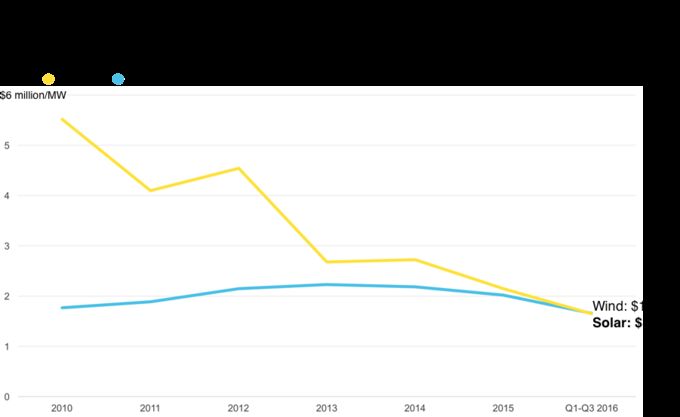
Very confused author. He shows a chart of capacity costs, not actual production cost comparison, then he starts talking about contract prices, which are a very different thing altogether.
Now that's great. That's like saying you're now finally running faster than the kid in the wheelchair.
Wake me when it gets cheaper than fossil fuel.
Errrr reading the statement above says.... "But now unsubsidized solar is beginning to outcompete coal and natural gas on a larger scale"
Cheap Natural Gas is what killed coal, not regulations. There's almost nowhere in the country now that some other form of generation won't be cheaper than coal.
I can't comment much about your situation, as I don't know where you live. I can, however, say this in general.
* Intermittency is nothing new to grid operators; through the entire history of power generation, they've been having to deal with demand fluctuation and random losses of plants and lines. Hardware is, and always will be, built to the minimum needed to statistically guarantee a given level of uptime
* There have been many, many studies on the issue of high-renewables grids - here's an example covering cost analyses on wind + solar + HVDC + NG peaking (no power storage) using current technology only.
* A HVDC grid actually saves about three times more than it costs due to lower hardware (and thus capital) requirements for grid operators. While HVDC lines and conversion stations pose their own point of failure risks, overall they increase grid stability against localized failures, particularly cascading failures (AC sync failures don't cascade over HVDC). The stability benefits of HVDC links has led to the US to use a number of them even without long lines, just to connect different disjoint grids together (the lines are the cheap part, relatively - it's conversion stations that are expensive). HVDC provides baseload from Quebec hydro to the northeastern US. Europe and China both make heavy use of HVDC - Europe mainly for submarine links, China mainly for bringing power from the interior to the densely populated coast (plus some HVAC). Both have huge expansion plans.
* Large HVDC grids cause both timeshifting (aka, it's nighttime wind in on the east coast during the evening demand peak on the west and on the west coast during the morning rush in the east coast; likewise with solar shifting) and weather diversity (whenever a front is moving off the east, there's almost always a new one (or more) that has come in from the west).
* Solar and wind tend to run counter to each other. Wind peaks at night; solar in the day. High pressure zones create low winds and lots of sun; low pressure zones create high winds and little sun.
* Combined with NG peaking, these factors can provide a statistically guaranteed uptime with low power costs.
* All of this is based around there being no storage - which is a pessimistic assumption:
** Dirt cheap storage can be had by uprating hydro turbine houses, combined with the aforementioned HVDC grid. Hydro thus shifts from baseload to peaking. There's extensive hydro on both coasts that can be uprated.
** Pumped hydro - as standalone plants or as modifications to existing plants - can often be affordable, but depends entirely on local geography.
** Compressed air has gained some interest, although is not yet cost effective.
** Batteries used to be by far the most expensive option, but their prices too have been plummeting, to the point that li-ion is starting to make some grid penetration. There's not going to be some huge takeoff of it at current prices, but given that large scale production (gigafactory, etc) is expected to halve costs, that would seriously take off. There's other rival chemistries also seeking for the low cost per-Wh / per-W crown.
But, storage is not a necessity when you have peaking, source diversity, and geographic diversity with a modern, well-connected grid.
Sometimes I doubt your commitment to Sparkle Motion.
Yes, right now natural gas is kicking everyone's ass -- especially coal. That's why those coal mining jobs aren't coming back. It's also why the four nuclear plants under construction in the US were contracted out almost a decade ago and in two of the four cases had to receive federal loan guarantees from the Obama administration.
But this might not last forever. China is making a push to move into natural gas electricity generation, along with the rest of the advanced economies, and the US is just starting to export. The market for gas is still expanding, and in ten years time the price situation may be quite different.
Obama has been a very pro-gas president, but he's also tried to hedge his bets by encouraging alternative technologies. This is a wise course of action because you can't conjure a new technology out of thin air just when you need it.
Post may contain irony: discontinue use if experiencing mood swings, nausea or elevated blood pressure.
The first clue for me is that his numbers for coal is lower than natural gas. That hasn't been true for years.
The EIA (Energy Information Administration) publishes costs for the total operation, maintenance, fuel, and total cost per kWh.
The site uses "mills per kWh" - or thousandths of a dollar per kWh.
The total costs are: /kWh /kWh /kWh /kWh
Nuclear: 25.71 - 2.57
Fossil (Oil & Coal) 37.26 - 3.73
Hydroelectric 13.42 - 1.34
Gas Turbine (Natural Gas) 33.24 - 3.32
It doesn't cover solar, but the actual 2015 costs are nowhere near what whoever57 claimed.
-- Sometimes you have to turn the lights off in order to see.
Li-ion is also starting to get some initial traction for local grid stabilization that my grow into a more generalized resilience that can allow for slower spin up times on peaking solutions.
> Frequently they underestimate owner's costs and T&D in these comparisons and only look at simplistic
> models of construction labor/material and fuel costs
Fuel costs... for solar?
> I can tell you that natural gas combined cycle plants are still far cheaper to build and run than solar or wind.
They simply are not. They are certainly competitive, but in the last two years or so the CAPEX side for PV and wind has been plummeting. Here's a reasonably up-to-date listing:
https://www.lazard.com/media/2390/lazards-levelized-cost-of-energy-analysis-90.pdf
Look on page 11.
And those subsidies are? I keep hearing about them, but all I ever get is some handwaving and "tax breaks" which are available to ALL companies, not just energy companies...
You mean besides the oil wars in the middle east that have cost trillions of dollars and caused the deaths of millions?
Besides the CO2 that's increasing Earth's greenhouse effect?
Besides the environmental damage (mining, oil spills, contaminated water supplies, fracking chemicals getting everywhere, etc) that never seems to get cleaned up?
Yeah, because besides all of those externalized costs, there are subsidies totaling around $30 billion per year! https://www.eia.gov/analysis/r...
Is that enough? Can we stop denying that fossil fuels are subsidized now? I'm tired of hearing this argument. Do some research instead of parroting that tired myth FFS.
The cost of the HVDC grid was a major point of the paper linked above. The answer, 0,3 cents per kilowatt hour, but saving 1,1 cents per kilowatt hour in reduced generation/peaking hardware capital costs. And yes, it's a grid of long lines with two endpoints, not a replacement for AC grids. It's for moving bulk power long distance, not between local substations.
Because simply saying "build a shitload of lines" gets you an article in Nature?
HVDC is not some hypothetically-might-be-good technology, it's increasingly forming the backbone of industrialized nations. The US is falling behind everyone else on this front. Even China is making the US look bad.
Sometimes I doubt your commitment to Sparkle Motion.