 Slashdot Mirror
World Energy Hits a Turning Point: Solar That's Cheaper Than Wind (bloomberg.com)
A transformation is happening in global energy markets that's worth noting as 2016 comes to an end: Solar power, for the first time, is becoming the cheapest form of new electricity. From a report on Bloomberg: This has happened in isolated projects in the past: an especially competitive auction in the Middle East, for example, resulting in record-cheap solar costs. But now unsubsidized solar is beginning to outcompete coal and natural gas on a larger scale, and notably, new solar projects in emerging markets are costing less to build than wind projects, according to fresh data from Bloomberg New Energy Finance. The chart shows the average cost of new wind and solar from 58 emerging-market economies, including China, India, and Brazil. While solar was bound to fall below wind eventually, given its steeper price declines, few predicted it would happen this soon.
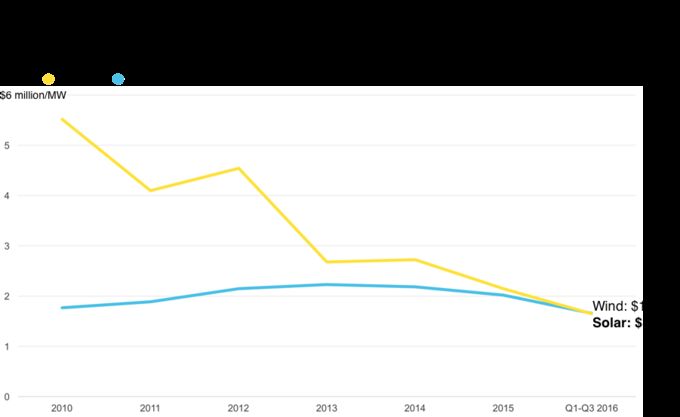
Wind has been cheaper than coal for 2 years with Solar only about a penny per/kw more. With solar approaching winds price both a far cheaper than even the cheapsest fossil fuel produced power in 100 year old (fully paid for coal plant). 4GWs of solarpower was installed last quarter and install rate is growing at 80%+ per year while prices are falling 20% per year for the last 6 years.
Whats funny to me is the jackasses that think solar and wind power are a partisan political issue, because they aren't.
Yeah, trade wars are lovely. Especially when the other side counters with retaliatory penalties.
Even if the price reduction curve slows, there's no reason to expect it to stop or reverse. A large portion of the cost of solar farms is the logistics and installation; it's not simply directly proportional to the cost of panels. All aspects of the cost of solar have been falling.
Likewise, technology is not going to just freeze. Just a dozen kilometers from my land, for example, Silicor is planning to build the world's first full-scale plant using an aluminum-based technology to produce solar silicon. Rather than using volatiles like silicon tetrachloride, it's done entirely in the liquid phase. They make a molten aluminum/silicon alloy (using aluminum from the smelter across the fjord), then cool it, causing the silicon to precipitate out as a layer on the top, with most of the impurities left in the aluminum (where they're harmless). The "waste" aluminum, now containing some silicon, is actually a more valuable alloy than the raw aluminum that they purchase, and is sold. A bit of aluminum is left on the silicon, which is dissolved (along with an additional amount of residual impurities) with hydrochloric acid, leaving polyaluminum chloride - a chemical in demand in water purification. In short, there's no waste products; everything that would be "waste" is actually value-added. And the lack of the use of volatiles makes it a comparatively green process.
Sometimes I doubt your commitment to Sparkle Motion.
"It was known since the 1950s, but due to political considerations, wasn't deployed. That's my version. "
Oh, you mean the Lawrence/Alvarez/Ghiorso MTA A-48? Whimsically named the Material Test Accelerator, originally designed to produce a gram of Neutrons a day, for... things..., it was later used to investigate "Burning" Nuclear Waste or "Breeding" Stockpile material, with a net positive Power Production.
The problem with the MTA was that getting all the Waste concentrated into a form capable of being irradiated was, and is, spectacularly dangerous.
"Do your own reading for real facts"
I don't need to read about it... I was there. The design was eventually refined into the Berkeley HILAC, in Building 71.
I know this triggers cognitive dissonance, but Obama is, in fact, pro-fracking, much to the displeasure of his base. He does favor more regulation than the industry would prefer, including regulations on worker safety and environmental impact.
It boils down to this: while burning more fossil fuel is bad for climate change, the growth of natural gas is largely at the expense of coal. Natural gas emits only half the net CO2 per BTU that coal does.
Clinton's plan was actually pretty good in this respect: continue the shift from coal to natural gas, but to hedge her bets with renewable technologies, locating renewable-related jobs in areas losing coal jobs. That's not as favorable to the coal miners as bringing back the glory days of coal, but the those days just aren't coming back. By 2020 the cost to generate a given amount of electricity with coal will be almost 1/3 higher than generating the same amount with natural gas. Even if you threw out all the safety and pollution regulations they aren't coming back, because you'd have to make coal 1/3 cheaper per BTU than gas before it could compete economically with gas plants, which are more efficient and cheaper to operate. You'd have to cut the price of coal by more than 1/2.
Post may contain irony: discontinue use if experiencing mood swings, nausea or elevated blood pressure.
There are lots of places in the world that are not the US, and don;'t have the same subsidy system you have. Wind and PV are doing even better there, mostly because they don't have entrenched billionaires like the Koch brothers spending millions of dollars to convince you it's all a plot.
Wow, that's a lot to read. It also looks a lot like one of the "negawatts" talks from Amory Lovins. I've read and heard a lot of explanations like this one, where it sounds so detailed and researched at first that it just must be true. The problem is that while there is a lot of truth in what you say the plan you spell out will not work. Explaining why it will not work would require a post much longer than yours to address the many many small details that were hand waved over. I'll try to explain this in a paragraph or three.
A big problem with wind and solar is that the energy production curves do not match well with demand curves. Claiming diversity in location and source, through the use of long power lines, will fix this is overly optimistic. To obtain this diversity requires large land masses that many nations do not have. If there is an international grid then this brings in politics that many people in Europe which rely on Russian natural gas would be familiar with. Using natural gas, or other fossil fuel back up, to maintain stability on the electricity grid means relying on cheap natural gas, a potential for no net reduction of CO2 output, and with the strong link between natural gas and electricity this means an actual reduction in energy diversity. In the USA this is not such a problem since natural gas is plentiful, domestic, and cheap, but the rest of the world is not as fortunate.
As you admit storage of energy is dependent on having a hydro electric dam nearby, if that is not available then storage gets expensive. If storage cost more than natural gas, which is almost always the case, then people will burn natural gas. Grid level battery storage, compressed gas, flywheels, or whatever, are just too expensive. This claim of using storage to solve this problem either violates the claim of being available now, or the claim of being available for cheap.
I'm no expert in energy policy but I have an education in electrical engineering and I've followed this for a very long time. What I've found is that any future energy plan that does not include nuclear power is always going to be lacking in some way. Had you made even a single mention of nuclear power in your post I would have had no complaints. Nuclear power is as "carbon free" as any other energy source that makes that claim. Nuclear power is reliable and plentiful. Nuclear power is also safer than any energy source we know. People will dispute my claims on nuclear power being cheap but then I must ask, how much is this "smart" grid, energy storage, HVDC transmission, and so forth going to cost? Nuclear power is only expensive now because we forgot how to do it. People will claim that wind and solar will get cheaper if only we invest in development, does this not also apply to nuclear power? So many people will claim that the problems with wind and solar can be solved with future technology advancements, I will agree so long as we can agree that any problems with nuclear power can also be solved with future technology.
We've been developing nuclear power for 70 years and it produces 20% of the electricity in the USA. We've been developing wind and solar power for much longer and it barely registers on the grid. I say that rather than continuing the insanity of throwing good money after bad on wind and solar that we put some money in nuclear and see that grow. We'd be much better off for it.
I am armed because I am free. I am free because I am armed.