 Slashdot Mirror
World Energy Hits a Turning Point: Solar That's Cheaper Than Wind (bloomberg.com)
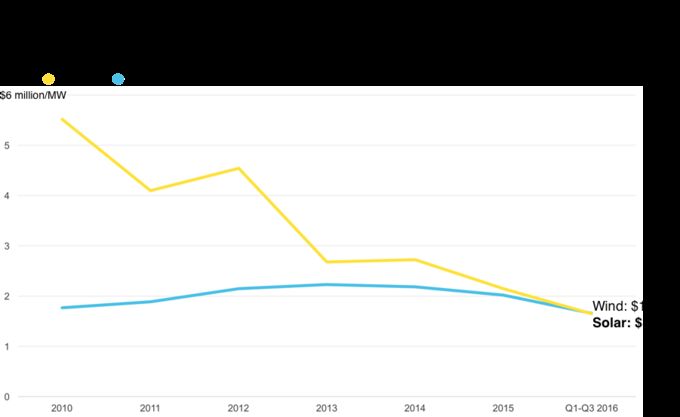
A transformation is happening in global energy markets that's worth noting as 2016 comes to an end: Solar power, for the first time, is becoming the cheapest form of new electricity. From a report on Bloomberg: This has happened in isolated projects in the past: an especially competitive auction in the Middle East, for example, resulting in record-cheap solar costs. But now unsubsidized solar is beginning to outcompete coal and natural gas on a larger scale, and notably, new solar projects in emerging markets are costing less to build than wind projects, according to fresh data from Bloomberg New Energy Finance. The chart shows the average cost of new wind and solar from 58 emerging-market economies, including China, India, and Brazil. While solar was bound to fall below wind eventually, given its steeper price declines, few predicted it would happen this soon.
Don't move that limbo bar, You'll be a limbo star, How low can you go?
Now that's great. That's like saying you're now finally running faster than the kid in the wheelchair.
Wake me when it gets cheaper than fossil fuel.
We used to have a Bill of Rights. Now, with the rights gone, all we have left is the bill.
Very confused author. He shows a chart of capacity costs, not actual production cost comparison, then he starts talking about contract prices, which are a very different thing altogether.
Where I live, we don't have sun every day. Not even close. 250 days of cloud coverage. Germany has more sun.
Average wind speed is 3 mph at 100ft above ground, so wind power isn't really an option either.
Mr. Fusion FTW!
Read about new nuclear reactors that burn existing nuclear waste into non-radioactive elements. Just re-burn and re-burn until all of the radioactive parts aren't. A full-sized trial reactor is being built, so this isn't 20-yrs away technology. It was known since the 1950s, but due to political considerations, wasn't deployed. That's my version. Do your own reading for real facts.
Aren't emerging market needs by definition significantly less than highly-developed industrialized market needs?
The reason solar is relatively inexpensive right now is because of Chinese panel manufacturing costs, or lack of them.
With the planned 45% (or short-term 15%, if he can't convince congress) tariff, solar may not be cheaper for very long. And/or if China continues to be aggravated about Taiwan.
Well, not here in the US, anyway. They'll still be cheaper everywhere else. Unless China actually stops subsidizing its manufacturers.
I've fallen off your lawn, and I can't get up.
The only way Trump is going to restore millions of coal miner jobs is to bomb this solar and wind installations out of existence. Coal can't exist with cheaper alternatives. Damn free market capitalism!
From what little I know, Thorium seems like it might be viable alternative.
Thankfully our dear leader Trump is nearly here. He is sure to repeal all those green energy subsidies and other absurd regulations so that all energy sources can compete on a level playing field.
We are nearly free of this liberal global warming hoax, people!
Glorious days are ahead!
Don't believe those fake news websites. I looked at multiple energy sources for my house and calculated out these:
Cite your sources or your numbers are meaningless and most likely fictitious. The numbers I've seen aren't even remotely close to that and you didn't bother to account for externalities like the cost of dealing with fossil fuel pollution.
Say thanks to communist party for subsidising 60% of your next solar panel purchase.
If we move to solar, we will suck up all the sun's light! How will we see and keep warm?
Good. I hope solar absolutely crushes wind. I'm firmly in the "don't want to live anywhere near a turbine" camp. Now you know somebody will retort that they're actually beautiful, don't kill that many birds, hardly ever catch fire, etc.; but I'm not sold. Yeah, they can be beautiful sometimes... in somebody else's neighborhood.
A turbine farm has a way of altering the landscape. Yeah, clean power; but the aesthetics of the environment are altered over entire regions. A solar farm can be tucked into a suburb and you don't even know it unless you can find a hill to climb where you can get a view.
Apparently you're unaware of a certain multi-decade trade imblance that completely moots your point but regardless, they're more than welcome to tax the shit out of our exports which would be.... what, shale oil and shitty movies??
The US exports lots of stuff. Here are the top 10 categories of exports. Machines, electronics, aircraft, vehicles, oil, medical technology, plastics, gems/metals, pharmaceuticals, chemicals. The US is the second largest export economy in the world behind China. In 2014 the US exported roughly $1.45 Trillion in goods.
So Trump being the asshole he is promising to be and starting a trade war will hurt Boeing, Caterpillar, GM, Ford, Intel, etc. Not to mention all of us when the prices of everything goes up in the ensuing trade war. Tariffs do not make things better. They save a few jobs at the expense of most everyone else.
That's what it takes to get ahead in the world. While the west, particularly the US, stopped short after decades of R&D yet before commercialization we handed the crown to China for a pittance. Forward looking governments that recognize the next trillion dollar industry. FYI, China is also the largest wind manufacturer and will soon be the largest nuclear manufacturer. But at least we got our fracking...
I can only imagine that this is due to the subsidized solar energy that drove the demand for the first installers and that drove down the price sooner than it would have without it.
The thing is obviously how much time was gained by it. Was it months, years or decades?
And by subsidized I mean not only in the US, but all over the world. If you see the solar fields in e.g. Northern Germany that is at the same height as Winipeg, Canada, so all of the US could easily use solar. Yes, it will be less efficient in the north as it will be in the south. Does not mean it can't be used at all.
Don't fight for your country, if your country does not fight for you.
early adopters of CFLs bought on the theorized cost savings over time of bulbs that were more expensive than incandescents. When was the last time you saw a Compact Fluorescent Light (CFL) actually live to its expected age? Yet it's that expected age that sets the predicted economy of those bulbs. I'm sure the same will be true of the early, expensive, LEDs. They will die younger than expected.
When I see the predicted cost of solar I think it's probably based on the hope that the solar cells and their requisit power conditioners and batteries and backup power systems don't fail or change costs to maintain over the years and years and years of their life expectancy.
Thus I have doubts that the amortized costs are as predicted.
One the other hand that doesn't really matter to the consumer. Some investor is going to eat that cost if the predictions are off. The rate payer is paying what the rates are right now based on that prediction not whatever the actual costs will be.
And my guess is that 30 years from now when we have worked all the kinks out of solar costs will be lower than natural gas and correctly estimated too. I just suspect that there's going to be a lot of utilities that eat it on this one and then public rate commissions will try to pass it along to consumers with surcharges.
I don't understand this. I've stood right underneath one on a windy day and it wasn't that much louder than the wind. Is the appearance the problem? I'd love some in my valley if they'd actually do something to reduce our extreme surface winds. Too bad they don't have as much of a reduction as one would like.
I've long been tempted to try to implement a low cost windbreak-turbine hybrid system, so that when you build a windbreak, you also get power from it - without it costing much more than traditional windbreak solutions. Basically, think posts with holes to feed cables through at regular heights and low abrasion bushings or coatings at the holes. Nothing particularly special. Push them into the ground as usual. Run a high tension metal wire through each holes, so that you now have a wire fence. Take a reel of spiraled metal or durable plastic, like a collapsible vertical axis wind turbine and cut it at a length to pass between each set of posts. The material should have enough give and be dull at the edges so that it does not injure people or livestock when spinning. Tightly clip the spiral around the wire so that it will exert a rotational torque on it when there's wind, turning each wire into something like a vertical axis wind turbine on its side. As for the wires, at regular intervals, rather than passing through a post, terminate them at a mini generator (bolted through the hole, with an anchor for the next wire to start on the far side). Declare one wire in the windbreak to be the "live wire". All mini-generators need to be rectified and voltage converted, then chained in series (upping the voltage) up to the live wire. Connections across the live wire are chained in parallel (upping the current). The beginning and ends of the live wire are routed into a breaker box for usage, after first passing through an inverter.
Seems like it should work. A challenge might be that performance would probably be pretty sensitive to wire tension, so if you want long runs (to reduce the number of generators / increase generator size), you'd need some combination of very good anchoring and/or an automatic tensioner. Also, being at ground level, you'd need to make sure that your materials are fatigue resistant, since turbulence is highest near the surface. There are certainly cheaper ways to make wind power, but if what you actually need is a windbreak and would like to get some power along with it...
Sometimes I doubt your commitment to Sparkle Motion.
Then we can cut subsidies and zero-interest loans to those companies, right? If they are at "parity" then let the market decide...
Browsing at +1 - no ACs, I ignore their posts. So refreshing!
Subsidies for archaic expensive outmoded fossil fuels are the problem.
No cost for pollution.
Exemptions for older less efficient fossil fuel plants.
Subsidies for fossil fuel extraction on public and private lands at rates often 1/1000th what they would be in a capitalist non-taxpayer-subsidized market.
Exemptions from costs for oil spills and the ability to go bankrupt and let the taxpayer pay for the cleanup.
In the last three months the total solar generation of power in the US has literally DOUBLED. Because, even with the massive fossil fuel subsidies, solar is cheaper than all forms of fossil fuels.
Read that again: solar is cheaper than all forms of fossil fuels.
And, yes, we can use variable energy sources to charge loads in places like Taiwan and even North Korea. So, are you SERIOUSLY saying America can't do BETTER than that?
-- Tigger warning: This post may contain tiggers! --
I would guess the exact opposite. They have a much larger deficit in production, and need more both to bring them more inline with our consumption patterns, and also for construction of better infrastructure.
This is a bit like saying "Luxry yachts are now cheaper than business jets." It means nothing in the energy economy, where solar merely equals the amount of electricity that the US generates by burning natural gas captured from landfills. And it's only slightly more meaningful than the 7.3 million Mwh we get from burning human excrement strained out of municipal sewer systems. It's the infrastructure that matters, and neither solar nor wind have scalable infrastructures today. Or in the forseeable future.
Oh, and the carbon footprint scare is total FUD put out by the wacky global warming alarmists.
If solar and wind are so cheap, how come my electric bill is skyrocketing so that PG&E can meet its renewables mandate?
Is solar able to compete because of super strict carbon / pollutant regulations? Or is it just actually cheaper? No one seems to answer that...
fossil fuel. Most of the cost of solar is financial so the goal is to sell whatever you got even if it is less that your financial cost. You can afford to do this as long as you sell at a higher cost some of the time. Fossil Fuel Power Plants have a minimum price based on the cost of the fuel they are burning. So solar can undercut fossil fuel especially when subsidized.
...say a carbon tax designed to recoup the many trillions of dollars that will need to be spent on adaptation to fossil-fuel-caused climate change and on compensation of whole climate-displaced populations and farmers, fishers etc and reconstruction of infrastructure destroyed in climate-change-induced wars... (such as Syria, Sudan,...)
then wind and solar would already be far cheaper than fossil-fuel energy.
We don't have such a tax or tax ramp plan, since the people who control the oil resource have most of the money,
and thus have most of the politicians,
and have most of the voters who are subject to the messages in paid marketing and disinformation.
Prediction: Too much uncomfortable truth in one post will probably get this downmodded as troll. That just shows how imbalanced current discourse on this topic has become, due to oil money interests.
Where are we going and why are we in a handbasket?
Don't worry, Trump will fix that.
First off elimination of the Tax loophole for electric vehicles.
Second, add a tax to solar and wind power.
Third additional subsidies to the fossil fuel industries.
Fourth reduce operating expenses of those industries by getting rid of business killing EPA and OSHA regulations.
Fifth, utilize federal govt. resources to make sure that projects like DAPL are completed as desired by his cronies in the industry.
Sixth, squash lawsuits associated with those industries.
The U.S. needs to shut up about how China's solar industry is unfair. If you don't like it, buy from American companies like SunPower and First Solar. Seriously sick of all the whining.
And those subsidies are? I keep hearing about them, but all I ever get is some handwaving and "tax breaks" which are available to ALL companies, not just energy companies...
You mean besides the oil wars in the middle east that have cost trillions of dollars and caused the deaths of millions?
Besides the CO2 that's increasing Earth's greenhouse effect?
Besides the environmental damage (mining, oil spills, contaminated water supplies, fracking chemicals getting everywhere, etc) that never seems to get cleaned up?
Yeah, because besides all of those externalized costs, there are subsidies totaling around $30 billion per year! https://www.eia.gov/analysis/r...
Is that enough? Can we stop denying that fossil fuels are subsidized now? I'm tired of hearing this argument. Do some research instead of parroting that tired myth FFS.
Just put up 5KW of panels last week, for a good price.
Our govt subsidies are going to shift next month and the current LNP government is pro -coal, anti-solar.
While every other country is going gangbusters on solar our dickhead government wants to dig up more coal.
Go well
I don't understand this. I've stood right underneath one on a windy day and it wasn't that much louder than the wind.
I support wind power, I think we need it. However I suspect that when they are in close proximity to each other there are infra-sound or perhaps standing acoustic wave issues that create mental health issues to nearby residents.
I say this not as an opposition to wind power but to try to understand if there is a connection there we need to be aware of when wind power is being deployed.
A better measure is levelised lifetime costs, as these include amortised construction capital costs too (otherwise solar looks nearly free):
Geothermal: 45.0
Advanced Gas CC: 57.2
Wind: 64.5
Hydroelectric: 67.8
Solar PV: 84.7
Advanced Gas CC with CCS: 84.8
Biomass: 96.1
Advanced Nuclear: 102.8
Advanced Coal with CCS: 139.5
Wind (Offshore): 158.1
Solar Thermal: 235.9
Total levelised cost values in 2015 dollars per MWh, not including tax credits.
Why would anyone engrave "Elbereth"?
That may all be true, but neither the USA or China are anywhere near the top of the list [wikipedia.org] when it comes to exports per capita.
That's just the law of large numbers at work. China and America are the first and third largest countries by population in the world. Together they account for roughly 25% of the world population and 33% of the world GDP. As a percent of GDP China is ranked 129th and America is ranked 157th and India is 134th. Those three countries account for over 40% of the world population. There just isn't enough market elsewhere for them to be per-capita leaders on exports. And that's not actually a problem.
What matters is, as was pointed out by Type44Q, whether you have a surplus or deficit.
I have a masters degree in finance and I've worked in the area of global sourcing for manufacturing for many years. I've actually traveled to China and other parts of the globe studying this very issue. It's not as simple as whether you carry a surplus or deficit in trade. The actual evidence for that is equivocal at best and it is hard to make consistent generalizations that reliably work. Look at the top net exports and import countries. It's very much a mixed bag of strong economies and weak ones. Russia, Ireland, and Italy have comparatively weak economies and yet are net exporters. China has a strong and growing economy but it's not as strong as many imagine it to be. The US is a net importer and yet it's unclear so far that this has had a meaningful detrimental effect on the US economy as a whole. (don't confuse the federal debt with net imports) There is justifiable concern about this issue but so far the actual effects seemed to be a mixed bag and dependent on the circumstances of a specific country. Surplus = Good is a simple but wrong argument.
I don't know if this is included in statistics that are released, but for an even better picture you should also include repatriated monies, such as profits from overseas subsidiaries coming into the country, or foreign workers sending money home to their families abroad.
You are talking about the capital account and the current account. Countries with a negative current account are by definition net importers but the evidence is not at all clear that this indicates a problem as a general proposition. Developed economies tend to run a current account deficit and money tends to flow from developed economies to developing ones but it's not clear that this is a harmful state of affairs. There are no simple sound bite sized answers here. You can have a healthy economy with a negative current account.