 Slashdot Mirror
World Energy Hits a Turning Point: Solar That's Cheaper Than Wind (bloomberg.com)
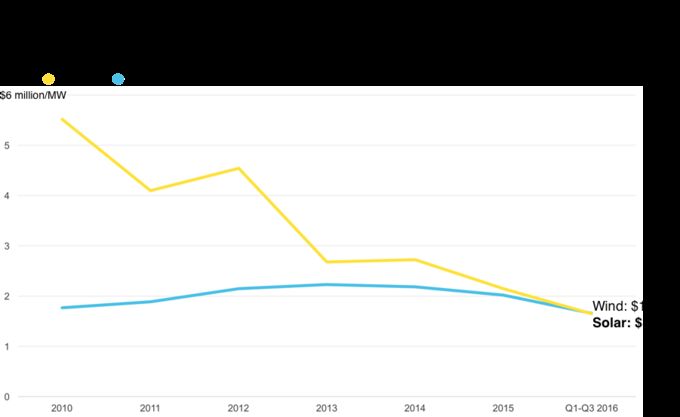
A transformation is happening in global energy markets that's worth noting as 2016 comes to an end: Solar power, for the first time, is becoming the cheapest form of new electricity. From a report on Bloomberg: This has happened in isolated projects in the past: an especially competitive auction in the Middle East, for example, resulting in record-cheap solar costs. But now unsubsidized solar is beginning to outcompete coal and natural gas on a larger scale, and notably, new solar projects in emerging markets are costing less to build than wind projects, according to fresh data from Bloomberg New Energy Finance. The chart shows the average cost of new wind and solar from 58 emerging-market economies, including China, India, and Brazil. While solar was bound to fall below wind eventually, given its steeper price declines, few predicted it would happen this soon.
Now that's great. That's like saying you're now finally running faster than the kid in the wheelchair.
Wake me when it gets cheaper than fossil fuel.
Errrr reading the statement above says.... "But now unsubsidized solar is beginning to outcompete coal and natural gas on a larger scale"
Wind has been cheaper than coal for 2 years with Solar only about a penny per/kw more. With solar approaching winds price both a far cheaper than even the cheapsest fossil fuel produced power in 100 year old (fully paid for coal plant). 4GWs of solarpower was installed last quarter and install rate is growing at 80%+ per year while prices are falling 20% per year for the last 6 years.
Whats funny to me is the jackasses that think solar and wind power are a partisan political issue, because they aren't.
Yeah, trade wars are lovely. Especially when the other side counters with retaliatory penalties.
Even if the price reduction curve slows, there's no reason to expect it to stop or reverse. A large portion of the cost of solar farms is the logistics and installation; it's not simply directly proportional to the cost of panels. All aspects of the cost of solar have been falling.
Likewise, technology is not going to just freeze. Just a dozen kilometers from my land, for example, Silicor is planning to build the world's first full-scale plant using an aluminum-based technology to produce solar silicon. Rather than using volatiles like silicon tetrachloride, it's done entirely in the liquid phase. They make a molten aluminum/silicon alloy (using aluminum from the smelter across the fjord), then cool it, causing the silicon to precipitate out as a layer on the top, with most of the impurities left in the aluminum (where they're harmless). The "waste" aluminum, now containing some silicon, is actually a more valuable alloy than the raw aluminum that they purchase, and is sold. A bit of aluminum is left on the silicon, which is dissolved (along with an additional amount of residual impurities) with hydrochloric acid, leaving polyaluminum chloride - a chemical in demand in water purification. In short, there's no waste products; everything that would be "waste" is actually value-added. And the lack of the use of volatiles makes it a comparatively green process.
Sometimes I doubt your commitment to Sparkle Motion.
Your numbers are wrong because you are either looking at rooftop solar, which is different to this, or you are looking at costs related to existing solar installations (ie, historical solar costs).
The real "Libtards" are the Libertarians!
Cheap Natural Gas is what killed coal, not regulations. There's almost nowhere in the country now that some other form of generation won't be cheaper than coal.
I can't comment much about your situation, as I don't know where you live. I can, however, say this in general.
* Intermittency is nothing new to grid operators; through the entire history of power generation, they've been having to deal with demand fluctuation and random losses of plants and lines. Hardware is, and always will be, built to the minimum needed to statistically guarantee a given level of uptime
* There have been many, many studies on the issue of high-renewables grids - here's an example covering cost analyses on wind + solar + HVDC + NG peaking (no power storage) using current technology only.
* A HVDC grid actually saves about three times more than it costs due to lower hardware (and thus capital) requirements for grid operators. While HVDC lines and conversion stations pose their own point of failure risks, overall they increase grid stability against localized failures, particularly cascading failures (AC sync failures don't cascade over HVDC). The stability benefits of HVDC links has led to the US to use a number of them even without long lines, just to connect different disjoint grids together (the lines are the cheap part, relatively - it's conversion stations that are expensive). HVDC provides baseload from Quebec hydro to the northeastern US. Europe and China both make heavy use of HVDC - Europe mainly for submarine links, China mainly for bringing power from the interior to the densely populated coast (plus some HVAC). Both have huge expansion plans.
* Large HVDC grids cause both timeshifting (aka, it's nighttime wind in on the east coast during the evening demand peak on the west and on the west coast during the morning rush in the east coast; likewise with solar shifting) and weather diversity (whenever a front is moving off the east, there's almost always a new one (or more) that has come in from the west).
* Solar and wind tend to run counter to each other. Wind peaks at night; solar in the day. High pressure zones create low winds and lots of sun; low pressure zones create high winds and little sun.
* Combined with NG peaking, these factors can provide a statistically guaranteed uptime with low power costs.
* All of this is based around there being no storage - which is a pessimistic assumption:
** Dirt cheap storage can be had by uprating hydro turbine houses, combined with the aforementioned HVDC grid. Hydro thus shifts from baseload to peaking. There's extensive hydro on both coasts that can be uprated.
** Pumped hydro - as standalone plants or as modifications to existing plants - can often be affordable, but depends entirely on local geography.
** Compressed air has gained some interest, although is not yet cost effective.
** Batteries used to be by far the most expensive option, but their prices too have been plummeting, to the point that li-ion is starting to make some grid penetration. There's not going to be some huge takeoff of it at current prices, but given that large scale production (gigafactory, etc) is expected to halve costs, that would seriously take off. There's other rival chemistries also seeking for the low cost per-Wh / per-W crown.
But, storage is not a necessity when you have peaking, source diversity, and geographic diversity with a modern, well-connected grid.
Sometimes I doubt your commitment to Sparkle Motion.
Don't believe those fake news websites. I looked at multiple energy sources for my house and calculated out these:
Cite your sources or your numbers are meaningless and most likely fictitious. The numbers I've seen aren't even remotely close to that and you didn't bother to account for externalities like the cost of dealing with fossil fuel pollution.
Yes, right now natural gas is kicking everyone's ass -- especially coal. That's why those coal mining jobs aren't coming back. It's also why the four nuclear plants under construction in the US were contracted out almost a decade ago and in two of the four cases had to receive federal loan guarantees from the Obama administration.
But this might not last forever. China is making a push to move into natural gas electricity generation, along with the rest of the advanced economies, and the US is just starting to export. The market for gas is still expanding, and in ten years time the price situation may be quite different.
Obama has been a very pro-gas president, but he's also tried to hedge his bets by encouraging alternative technologies. This is a wise course of action because you can't conjure a new technology out of thin air just when you need it.
Post may contain irony: discontinue use if experiencing mood swings, nausea or elevated blood pressure.
Apparently you're unaware of a certain multi-decade trade imblance that completely moots your point but regardless, they're more than welcome to tax the shit out of our exports which would be.... what, shale oil and shitty movies??
The US exports lots of stuff. Here are the top 10 categories of exports. Machines, electronics, aircraft, vehicles, oil, medical technology, plastics, gems/metals, pharmaceuticals, chemicals. The US is the second largest export economy in the world behind China. In 2014 the US exported roughly $1.45 Trillion in goods.
So Trump being the asshole he is promising to be and starting a trade war will hurt Boeing, Caterpillar, GM, Ford, Intel, etc. Not to mention all of us when the prices of everything goes up in the ensuing trade war. Tariffs do not make things better. They save a few jobs at the expense of most everyone else.
I know this triggers cognitive dissonance, but Obama is, in fact, pro-fracking, much to the displeasure of his base. He does favor more regulation than the industry would prefer, including regulations on worker safety and environmental impact.
It boils down to this: while burning more fossil fuel is bad for climate change, the growth of natural gas is largely at the expense of coal. Natural gas emits only half the net CO2 per BTU that coal does.
Clinton's plan was actually pretty good in this respect: continue the shift from coal to natural gas, but to hedge her bets with renewable technologies, locating renewable-related jobs in areas losing coal jobs. That's not as favorable to the coal miners as bringing back the glory days of coal, but the those days just aren't coming back. By 2020 the cost to generate a given amount of electricity with coal will be almost 1/3 higher than generating the same amount with natural gas. Even if you threw out all the safety and pollution regulations they aren't coming back, because you'd have to make coal 1/3 cheaper per BTU than gas before it could compete economically with gas plants, which are more efficient and cheaper to operate. You'd have to cut the price of coal by more than 1/2.
Post may contain irony: discontinue use if experiencing mood swings, nausea or elevated blood pressure.
Li-ion is also starting to get some initial traction for local grid stabilization that my grow into a more generalized resilience that can allow for slower spin up times on peaking solutions.
> Frequently they underestimate owner's costs and T&D in these comparisons and only look at simplistic
> models of construction labor/material and fuel costs
Fuel costs... for solar?
> I can tell you that natural gas combined cycle plants are still far cheaper to build and run than solar or wind.
They simply are not. They are certainly competitive, but in the last two years or so the CAPEX side for PV and wind has been plummeting. Here's a reasonably up-to-date listing:
https://www.lazard.com/media/2390/lazards-levelized-cost-of-energy-analysis-90.pdf
Look on page 11.
> Wouldn't it make more sense to
Ah yes, the "makes sense" clause, which in this case means "I have no clue but I'm going to post anyway".
> shut the turbine down and spare the maintenance?
No. The marginal production cost for wind is close to zero. As opposed to, say,a gas plant, where even at idle you're still burning fuel. This has been *repeatedly* covered here on Ars.
> The answer is the subsidies.
Maybe it's different in Texas, but everywhere I'm familiar with the subsidies are in the form of tax credits and are on the order of 20% of the LCoE. In comparison, something like the nuclear industry receives about 10 times that amount of money, all of it up-front, and still isn't competitive,
Why is anyone surprised by this? A wind turbine is a generator, which all plants have, some blades, a steel pole, and a concrete base. Of course that is going to be able to compete once the learning curve kicks in. PV is even simpler, it's basically a storm window with some wiring. It doesn't even have moving parts. On a pure CAPEX basis there's no way anyone can compete.
He couldn't make money running casinos.
Think about that.
You are welcome on my lawn.
Grid kWh costs are on a sliding scale since there is a base cost for the grid connection. If you use just a few kWh a month they will cost hundreds of cents each, easily more than locally generated power plus storage. And if you can't live without those kWh add in the cost for the backup generator.
Bill the grid infrastructure separately, then generation costs can compete on a fair basis at each particular time of the day. Local storage or backup generation is an unrelated issue.
As well, try getting them to instal a power line to your house if the place isn't already on a grid. Suddenly solar isn't just cheaper, it's mid bogglingly cheaper.
The shepherds did so well protecting the flock that the sheep no longer believed that wolves existed.
There are lots of places in the world that are not the US, and don;'t have the same subsidy system you have. Wind and PV are doing even better there, mostly because they don't have entrenched billionaires like the Koch brothers spending millions of dollars to convince you it's all a plot.
Aha, the mandatory /. Thorium comment! It seems like a late time to be suggesting alternatives, because we already have renewable energies that don't require radioactive materials, actually exist, and are nearly at parity with fossil fuels. I hate to be the one to tell you, but the people have spoken and solar/wind is the future, not nuclear.
And those subsidies are? I keep hearing about them, but all I ever get is some handwaving and "tax breaks" which are available to ALL companies, not just energy companies...
You mean besides the oil wars in the middle east that have cost trillions of dollars and caused the deaths of millions?
Besides the CO2 that's increasing Earth's greenhouse effect?
Besides the environmental damage (mining, oil spills, contaminated water supplies, fracking chemicals getting everywhere, etc) that never seems to get cleaned up?
Yeah, because besides all of those externalized costs, there are subsidies totaling around $30 billion per year! https://www.eia.gov/analysis/r...
Is that enough? Can we stop denying that fossil fuels are subsidized now? I'm tired of hearing this argument. Do some research instead of parroting that tired myth FFS.
A large chunk of the "no jobs" complaints are about the world economy moving on and leaving some people behind. Stuff gets automated. Trade happens. It's rough, and unless somebody has a brilliant solution the the displacements caused by those changes, it seems like retraining and a social safety net are about the best we can do.
The Democrats don't have a better solution and they're not good at pretending to listen and pretending to have a solution. The Republicans don't have a solution, but they're masters at pretending they care and that they have an answer. Trump is going to wave his hands and make human labor more efficient than robots. He'll stop all of the cheap imports competing with US products and still keep prices at Wal Mart low. Sure, if they can just build that wall, the manufacturing and mining jobs in places where there are no Mexicans will come back. The robots will be put out to pasture and we'll start relying on human labor in manufacturing again.
Well, he's 100% in charge now, so it will be interesting to see what happens. I wouldn't bet against the fundamental rules of economics, though. Those have a pretty solid winning record, especially when you compare it to the record of politicians promising jobs.
An interesting anagram of "BANACH TARSKI" is "BANACH TARSKI BANACH TARSKI"