 Slashdot Mirror
New Analysis Shows Lamar Smith's Accusations On Climate Data Are Wrong (arstechnica.com)
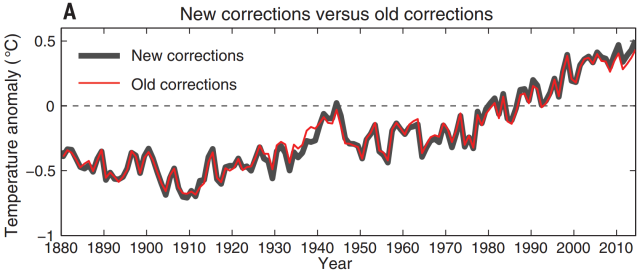
Layzej writes from a report via Ars Technica: In 2015, NOAA released version 4 of their marine temperature dataset called ERSST. The new dataset accounted for a known cooling bias introduced when ocean temperature measurements transitioned from being taken in ship engine intake valves to buoy-based measurements. The warming of the last couple decades increased ever so slightly in NOAA's new analysis. This was a red flag for U.S. House Science Committee Chair Lamar Smith (R-TX), who rejects the conclusions of climate science -- like the fact that the Earth's climate is warming. Suddenly he wanted to see the researchers' e-mails and echoed the accusations of contrarian blogs about scientists' supposedly nefarious adjustments to sea surface temperature measurements. Rather than invoking scientific conspiracies, issues like this should be settled by analyzing the data. A new study, led by University of California Berkeley's Zeke Hausfather, does just that -- and Rep. Smith won't like these results, either. To test the NOAA dataset, Zeke's team created instrumentally homogeneous temperature records from sensors available only over the last couple decades. As it happens, the Argo float data, the buoy data, and the satellite data each hew closer to the updated dataset that NOAA used. The older version (3b) gives a global average that is too cool in recent years, growing to an offset of about 0.06 degrees Celsius. The researchers repeat this same analysis for two more major sea surface datasets that are used by the UK Met Office and the Japanese Meteorological Agency for their global temperature records. Both of those datasets also drift cooler than the comparison data, but less so than NOAA's old dataset.
> These people can't tell the difference between "correcting for a known measurement problem" and "lying".
Unfortunately, neither side can. That's what's so frustrating - half the time the adjustments are lies, or at least intentionally skewed toward "raising awareness". Various researchers have admitted that in emails that leaked or other documents over and over again, a few publicly and openly. It's really, really difficult to get objective information. 90% of the researchers will tell you their objective is to "raise awareness of AGW" or similar, or they are funded by organizations with that as part of their stated agenda. That doesn't mean they are WRONG, of course. It just makes it difficult to get information you can trust to gauge the scale of the issue. Pretty clearly there *is* an issue, and pretty clearly San Francisco won't actually be underwater by 2020. In between the most extreme claims, it's very hard to know where reality is.
No amount of data will ever be able to satisfy anti-AGW people. They're just like the anti-vax people, or pretty much any other religious group that prides ignorance over reality.
They are emotionally dependent on their POV, and attempts to prove them wrong just make them dig their heels further. That has been proven as well.