 Slashdot Mirror
New Analysis Shows Lamar Smith's Accusations On Climate Data Are Wrong (arstechnica.com)
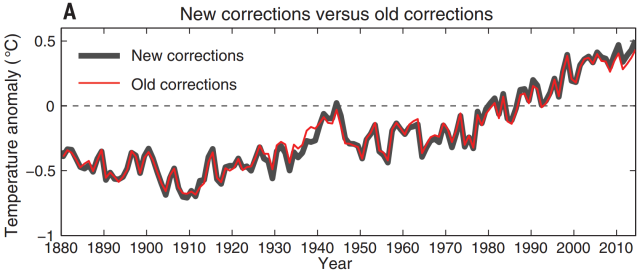
Layzej writes from a report via Ars Technica: In 2015, NOAA released version 4 of their marine temperature dataset called ERSST. The new dataset accounted for a known cooling bias introduced when ocean temperature measurements transitioned from being taken in ship engine intake valves to buoy-based measurements. The warming of the last couple decades increased ever so slightly in NOAA's new analysis. This was a red flag for U.S. House Science Committee Chair Lamar Smith (R-TX), who rejects the conclusions of climate science -- like the fact that the Earth's climate is warming. Suddenly he wanted to see the researchers' e-mails and echoed the accusations of contrarian blogs about scientists' supposedly nefarious adjustments to sea surface temperature measurements. Rather than invoking scientific conspiracies, issues like this should be settled by analyzing the data. A new study, led by University of California Berkeley's Zeke Hausfather, does just that -- and Rep. Smith won't like these results, either. To test the NOAA dataset, Zeke's team created instrumentally homogeneous temperature records from sensors available only over the last couple decades. As it happens, the Argo float data, the buoy data, and the satellite data each hew closer to the updated dataset that NOAA used. The older version (3b) gives a global average that is too cool in recent years, growing to an offset of about 0.06 degrees Celsius. The researchers repeat this same analysis for two more major sea surface datasets that are used by the UK Met Office and the Japanese Meteorological Agency for their global temperature records. Both of those datasets also drift cooler than the comparison data, but less so than NOAA's old dataset.
Or to quote Neil De Grasse Tyson: "It's basic physics. If you keep adding energy to a system, but you slow down the rate at which the energy can leave the system then the system gets hotter".
Unicode killed the ASCII-art *
No, there's another possibility here: (3) the accuracy of the measurement gives us an error that dwarfs the change, therefore comparing the measurements is completely meaningless. That would be my preferred option, mostly because it's the only option that requires you to forgo your grant funding and demonstrate a little scientific integrity.
Knock yourself out with it though.
Btw Steve McIntyre is a mathematician who won the national high school mathematics competition when he was a nipper. He's forgotten more about mathematics than most of the shills working in climate science ever learned. You can have that little factoid for free by the way.
Exactly, just because you are doing science does mean you abandon common sense. Most would call me a climate skeptic, but even I will admit there has been a warming trend over the period we have been taking actual measurements. Its not credible to assume a massive conspiracy exists to distort measurements. When the was suggestion of such it was investigated and debunked.
I also know based on other day to day encounters with the observable universe that at least on the atomic/chemical scale I occupy thermodynamics is a reality. Finally I know trends are well trends, they continue unless there is a reason for them them to not continue. So when someone argues there as a been a pause in the warming trend the correct response is actually skepticism. A pause would be caused by something, so there are two possibilities we don't know the cause of the pause or the measurements are not correct. Since the measurement methodology was changed that should be the FIRST place we look. Here the interesting thing isn't the absolute values but the deltas. Allowing for some noise in the older measurements we see similar deltas in the data gather in the new measurements, the correct conclusion is the older absolute values are off but the deltas are probably still accurate.
Think of this way, you have two thermometers in a room, one reads 68F the other 70F you turn the heat on and observe the readings again 30min later. The first now reads 70F the second now reads 72F. You can be pretty certain the room is 2F warmer than before, you might guess the actual temperature is 71F but your confidence in that should be low.
There is a reasonable debate to be had about:
1) Are human activities the primary driver of climate change or are other factors playing a more significant role
2) Are these changes really outside the normal range our planet and ecosystem have experienced in the past
2a) if no, is the rate of change outside the normal range
3) Is this a good or bad thing, in terms of our own best interest?
3a) how do you define 'our'
Those are the real questions where climate change is concerned, not that it has changed since the start of the industrial era or that it is changing.
Repeal the 17th Amendment TODAY! Also Please Read http://www.gnu.org/philosophy/right-to-read.html
I once pointed out how we had a ready-made carbon sequestration process in place already. Yard waste in landfills.
Sadly, this was killed by a competing environmentalist impulse based on innumeracy: We are running out of space for landfills. So now many areas ban yard waste in landfills. And what landfills there are often are areated so they can continue to rot away underground, also releasing that CO2.
Do your duty -- compost the yard waste to get the CO2 back into the atmosphere!
When I pointed this out to the environmentalist, he immediately said, well, CO2 wasn't that important as a greenhouse gas.
You have to pick and choose your environmentalist impulse values and pooh pooh any contrary ideas.
(-1: Post disagrees with my already-settled worldview) is not a valid mod option.
That's right, CO2 which is 100-fold less important than water vapor is somehow determinant of Earth climate.... on a planet covered with 80% oceans...
Where on earth did you come up with a ridiculous statement like that? Yes, Water vapor is the biggest greenhouse "gas" out there. But that doesn't mean that CO2 has no effect Or methane. That coal you might be fond of? That is not sequestered water is it? It is the sequestered carbon from the appropriately namedCarbiniferous age. This was an interesting time, with Average global temperatures of around 68 degrees - much warmer than today.
Oxygen levels were a lot higher than today composing over 32 percent by volume. This is why the insects of th eage were so large. CO2 was around 800 ppm.
Now here's where it gets interesting. Trees had developed Lignin which allowed them to grow very large, and a waxy substance developed that delayed decomposition. These trees were armed for bear Forests covered much of the land. These forests pulled a lot of CO2 out of the atmosphere, which over time cooled the planet. Finally by the end of the Pennsylvanian age, the earth had cooled enoughh that these tropical forests could no longer sustain themselves.
But in the meantime, as the trees went through their life cycle, the dead trees would drop, and when the conditions were correct, they would be covered, compressed, and turned into coal. Sequestered Carbon it was. Millions of years worth, and finally ended when the planet had cooled to the etent that the tropical climate couldn't be continued.
So fast forward to today. At the beginning of the industrial Revolution - generally attributed to 1750, we started digging up and using this sequestered material. And we've gone through a lot of it. In less than 300 years, we've re-introduced 800 terawatts worth of radiative forcing worth of Carbon that was sequestered over millions of years.
That's a lot, in a very short time.
So yeah Water vapor acts as a greenhouse "gas" that's really a very good thing. We need the Greenhouse effect to exist, as the Earth would be Arctic without it.
The shepherds did so well protecting the flock that the sheep no longer believed that wolves existed.
I despair.
CO2 from biological matter doesn't directly matter. (Land use changes that destroy biological matter and don't replace it are a different matter)
If it's plant based then all that CO2 that is released will have been recently extracted from the air to be incorporated into the plants tissues.
If it's animal based then any and all CO2 that is released will, ultimately, have come from the C in plants which, in turn, will have come from CO2 in the air.
it's really, really, easy to tell the difference between CO2 that has its source as the carbon cycle and "fossil" CO2 that has been sequestered for significant lengths of time. "Biological" CO2 will have been recently part of the atmosphere. Because C14 has a moderate half life (6Kyear), it will have needed to be sequestrated for tens to hundreds of millenia before all the (detectable) C14 will have decayed.
Almost all C14 is generated in the upper atmosphere (by thermal neutron capture by N14). Therefore, if the material you are burning, composting, digesting, gives off CO2 that contains C14 then the carbon that it contains (recently) came from the atmosphere.
God said, "div D = rho, div B = 0, curl E = -@B/@t, curl H = J + @D/@t," and there was light.
This is the oversimplified explanation of climate change which I have problems with. Unfortunately, it is the argument parroted by nearly all the armchair climatologists as the reason why global warming is real and we must do something about it Right Now.
From a thermodynamics standpoint, the rate of heat radiated by a black body is proportional to the fourth power of its temperature. The Ei > Eo state is a transitory state - it is only temporary. The temperature increases causes Eo to (quickly) increase, until Eo is large enough to match Ei.. So we end up with Ei = Eo again, but at a new, higher T. In other words, the system stabilizes at a new, higher temperature. This is why glass greenhouses don't continue to increase in temperature until the inside is hot enough to melt the glass. T^4 is a huge number. It only takes a small temperature increase to offset a large Ei increase (actually Pi would be more accurate - the rate of energy coming in, or power coming in).
Unstable "runaway" systems are extremely rare in nature. The reason is simple - anything that's unstable tends to, over billions of years, destroy itself. So the overwhelming majority of things remaining in the universe are stable systems. There is no "delicate balance" of nature. There is no "runaway" greenhouse effect - all we're doing is shifting the equilibrium point. We know this to be true because global CO2 concentrations and temperatures have been higher in the past than they are today, and the Earth did not self-destruct - it is still around with life intact.
Now, from all I've read, that new equilibrium temperature point is high enough to cause massive problems for human civilization if we don't address it. But the alarming layman's explanation of the greenhouse effect that you've given is just as wrong and misleading as the climate change deniers' explanations.