 Slashdot Mirror
New Analysis Shows Lamar Smith's Accusations On Climate Data Are Wrong (arstechnica.com)
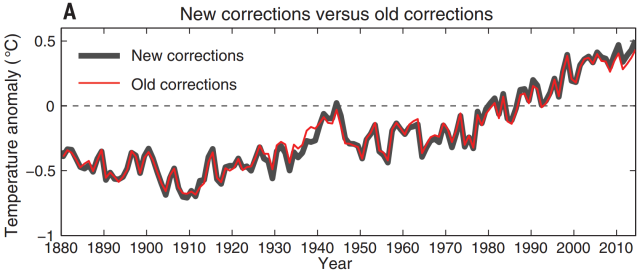
Layzej writes from a report via Ars Technica: In 2015, NOAA released version 4 of their marine temperature dataset called ERSST. The new dataset accounted for a known cooling bias introduced when ocean temperature measurements transitioned from being taken in ship engine intake valves to buoy-based measurements. The warming of the last couple decades increased ever so slightly in NOAA's new analysis. This was a red flag for U.S. House Science Committee Chair Lamar Smith (R-TX), who rejects the conclusions of climate science -- like the fact that the Earth's climate is warming. Suddenly he wanted to see the researchers' e-mails and echoed the accusations of contrarian blogs about scientists' supposedly nefarious adjustments to sea surface temperature measurements. Rather than invoking scientific conspiracies, issues like this should be settled by analyzing the data. A new study, led by University of California Berkeley's Zeke Hausfather, does just that -- and Rep. Smith won't like these results, either. To test the NOAA dataset, Zeke's team created instrumentally homogeneous temperature records from sensors available only over the last couple decades. As it happens, the Argo float data, the buoy data, and the satellite data each hew closer to the updated dataset that NOAA used. The older version (3b) gives a global average that is too cool in recent years, growing to an offset of about 0.06 degrees Celsius. The researchers repeat this same analysis for two more major sea surface datasets that are used by the UK Met Office and the Japanese Meteorological Agency for their global temperature records. Both of those datasets also drift cooler than the comparison data, but less so than NOAA's old dataset.
You're not going to convince an idiot by providing evidence that he doesn't understand.
Slashdot social media options: AIM, ICQ, Yahoo, Jabber and Mobile Text. Why no MySpace?
Suddenly he wanted to see the researchers' e-mails and echoed the accusations of contrarian blogs about scientists' supposedly nefarious adjustments to sea surface temperature measurements. Rather than invoking scientific conspiracies, issues like this should be settled by analyzing the data.
Most people wouldn't understand the data if you clubbed them over the head with it. Doubly so for politicians with no scientific training. The problem in the argument is that one side of this argument isn't arguing with facts and is actually incentivized to demonize any data that contradicts their pre-determined conclusions. They see the argument in one of two ways (sometimes both). A) They see climate change data as a threat to their personal interests - usually financial ones. If you are a politician sponsored by a fossil fuel company, this threatens your self interest. B) They see the climate change argument as something coming from the Other. It's a tribal thing - that Other group supports it ergo it must be bad. Often they frame it as a conspiracy despite the absurdity of that statement.
So in either case you have people who have no incentive whatsoever to acknowledge the data because it threatens what they hold dear. Rationality plays no role in it. The best way to combat this is to frame the argument in such a way as to align their incentives with the data. Point out how much money there is to be made/saved by working on the problem. Put it front and center as an economic issue. Figure out how to align solutions to the problem with economic and political self interest. Until you do that you're going to have this problem of certain politically powerful factions sticking their fingers in their ears and getting in the way.